Kojable research · Cross-Provider AI Query Fan-Out Study · Companion analysis
Same Candidate Queries, Different Search Plans
How Claude, Gemini, OpenAI and Perplexity selected, rewrote and moved beyond the same 100 supplied candidate queries
Giving AI systems the same candidate queries does not mean they will execute the same search plan.
In our cross-provider query fan-out experiment, Claude, Gemini, OpenAI and Perplexity received the same ten designed B2B buyer questions, the same task context and the same visible candidate-query scaffold: ten candidate queries per buyer question, or 100 candidates across the study.
The flagship report showed that the four provider stacks exposed materially different search plans.
This companion analysis asks a narrower question:
What did each provider actually do with the same candidate-query space?
We separate that into three behaviours:
Coverage: which supplied candidates appeared?
Transformation: when a query was candidate-derived, was it copied, rewritten or composed?
Expansion: how much of the observable plan could not be connected to the candidate space?
These dimensions should not be collapsed into one score. A provider can rewrite a candidate heavily while remaining inside the supplied semantic space. Another can reproduce candidates almost verbatim when it uses them but spend much of the rest of its plan searching outside them.
That is what happened in this benchmark.
Key finding
OpenAI covered every supplied candidate and executed candidate-derived queries mostly as exact copies. Perplexity selected 67% of candidates and rewrote most of its candidate-derived executions, yet only 4.2% of its total observable queries fell outside the matched candidate space. Claude combined moderate candidate coverage with both copying and rewriting, while 42.9% of its observable queries were non-candidate-matched. Gemini selected the smallest success-conditional share of candidates, mostly copied candidates exactly when it did use them, but 61.4% of its observable queries fell outside the matched candidate space.
Qualification: This is a fixed, seeded, exploratory benchmark with ten designed buyer questions and one observed run per provider-question cell. Candidate order was not randomized. A non-candidate-matched query is an operational provenance label—not proof of independent invention, better search or deeper reasoning.
- Candidate coverage
- Query rewriting
- Candidate-space expansion
- 12 min read
Answer first
Did the providers use the same candidate space in the same way?
Direct answer
No.
| Provider | Success-conditional candidate coverage | Candidate-derived execution pattern | Non-candidate-matched share |
|---|---|---|---|
| OpenAI | 100.0% | Predominantly exact copies | 11.9% |
| Perplexity | 67.0% | Predominantly rewrites | 4.2% |
| Claude | 49.0% | Mostly exact copies, with substantial rewriting | 42.9% |
| Gemini | 35.6% | Mostly exact copies when candidate-derived | 61.4% |
The key distinction is that rewriting is not the same as expansion.
Perplexity frequently changed the surface form of supplied candidates while staying within the matched candidate space. Gemini showed almost the reverse pattern: matched candidate material was usually close to an exact supplied form, while much of the rest of its observable plan sat outside the candidate scaffold.
So the useful questions are not simply:
Did the model copy the seed?
They are:
What did it select? How did it transform what it selected? And what appeared beyond it?
Finding 1
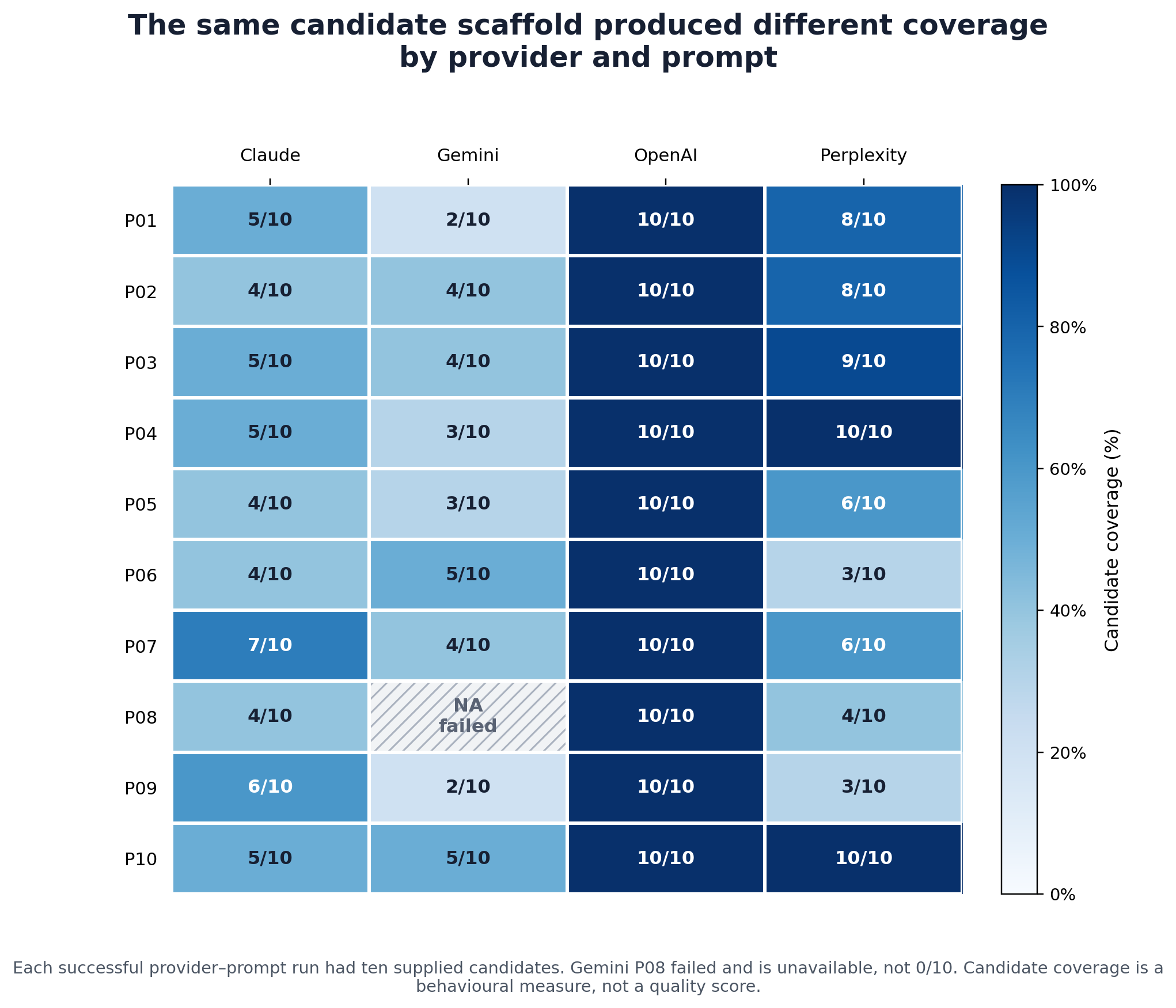
1. Candidate coverage differed before rewriting enters the picture
Candidate selection asks:
Of the ten supplied candidate queries for a buyer question, how many appeared at least once in the observable query plan?
Across successful runs:
| Provider | Candidates selected | Observable candidate opportunities | Selection rate |
|---|---|---|---|
| OpenAI | 100 | 100 | 100.0% |
| Perplexity | 67 | 100 | 67.0% |
| Claude | 49 | 100 | 49.0% |
| Gemini | 32 | 90 | 35.6% |
The Gemini denominator matters. P08 failed, so there is no observed Gemini search plan for that cell. Treating its ten supplied candidates as ten rejections would turn missing data into behaviour. The public comparison therefore uses 32 selected candidates from 90 opportunities across Gemini's nine successful runs.
OpenAI selected all ten candidates on every observed buyer question. Claude, Gemini and Perplexity were more selective and varied by prompt.
Several candidate-selection contrasts also remained directionally stable in the prompt-paired exploratory statistical analysis after false-discovery-rate adjustment.
But candidate coverage has no universal quality direction. Selecting everything could mean breadth or weak filtering. Selecting less could mean prioritization or missed paths.
This study measures use of the supplied scaffold, not optimal search.
Measurement distinction
2. Candidate selection and candidate execution are different measurements
A count of selected candidates is not the same as a count of candidate-derived query executions.
Candidate selection asks whether a unique supplied candidate appeared at least once.
Query provenance asks how each observable query connected to the supplied candidate space.
Those totals need not match one-to-one. A candidate can be executed more than once, and a composition can connect candidate material differently from an exact copy.
That distinction lets us ask the more useful question:
When candidate material was used, how was it expressed?
Finding 2
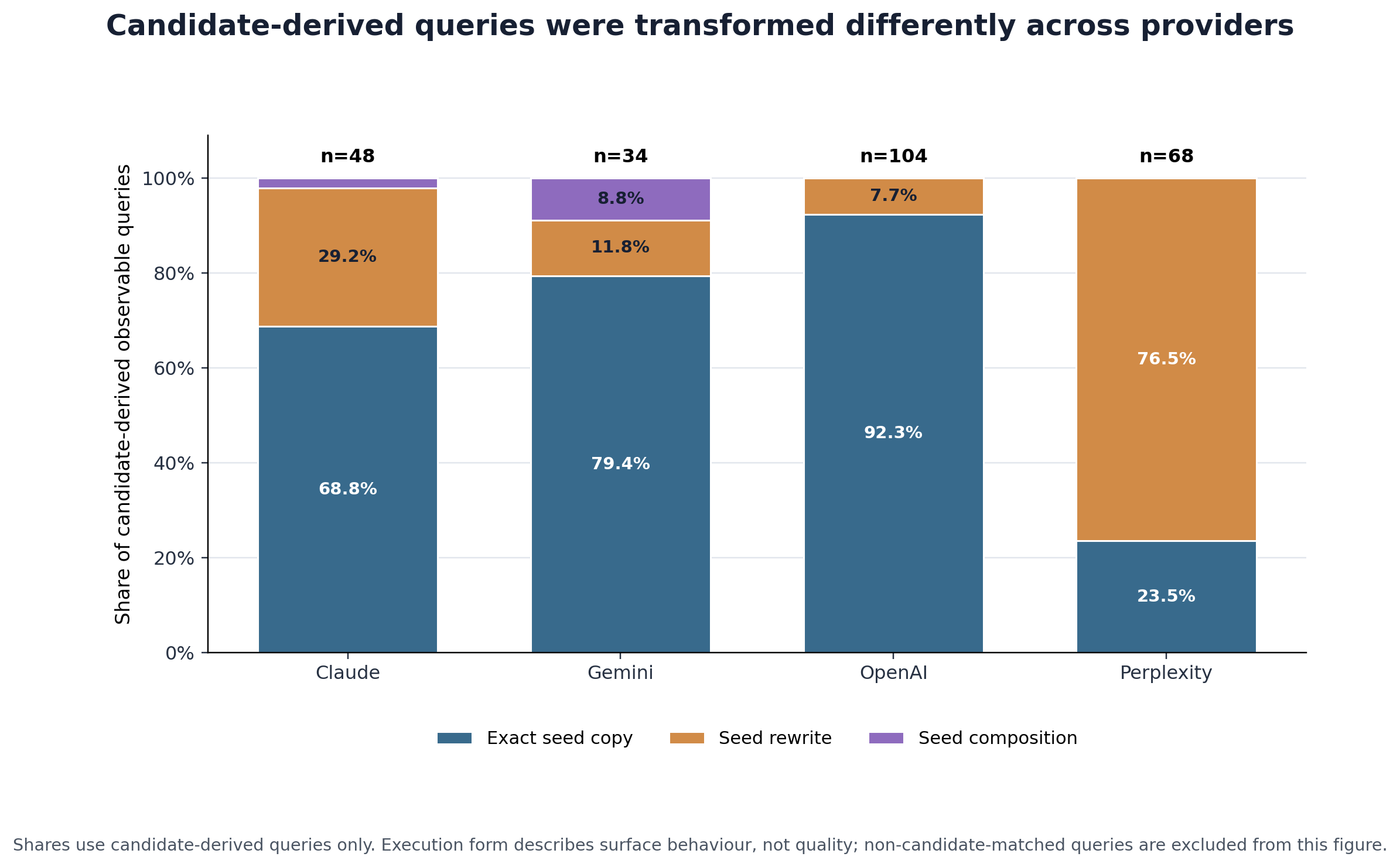
3. Candidate-derived queries were transformed very differently
The provenance analysis separated candidate-derived observable queries into:
- Exact seed copy
- Seed rewrite
- Seed composition
| Provider | Candidate-derived queries | Exact copies | Rewrites | Compositions |
|---|---|---|---|---|
| OpenAI | 104 | 96 (92.3%) | 8 (7.7%) | 0 |
| Gemini | 34 | 27 (79.4%) | 4 (11.8%) | 3 (8.8%) |
| Claude | 48 | 33 (68.8%) | 14 (29.2%) | 1 (2.1%) |
| Perplexity | 68 | 16 (23.5%) | 52 (76.5%) | 0 |
OpenAI's candidate-derived executions were overwhelmingly exact copies.
Perplexity showed almost the opposite surface pattern: more than three-quarters of its candidate-derived executions were rewrites.
Claude sat between those behaviours, with roughly seven in ten candidate-derived executions classified as exact copies and nearly three in ten as rewrites.
Gemini's candidate-derived queries were also mostly exact copies, with smaller rewrite and composition layers.
If we looked only at lexical distance from the supplied queries, Perplexity might appear to move farther from the seed than OpenAI.
But that would confuse:
surface-form change, with
movement beyond the candidate space.
A rewritten query can still represent the same supplied retrieval need.
Finding 3
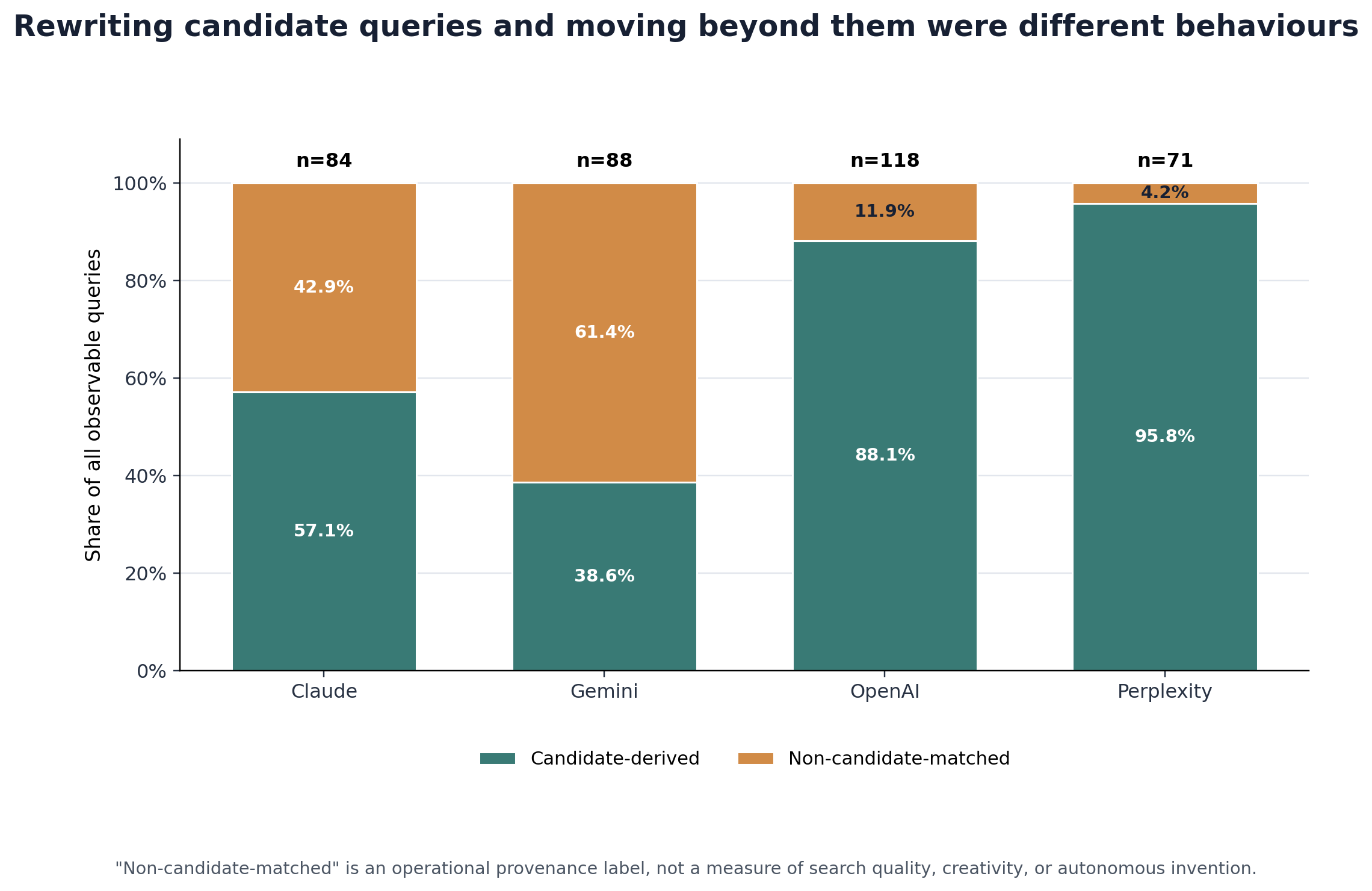
4. Rewriting and expansion were clearly different behaviours
Perplexity makes this distinction especially visible.
Among its candidate-derived observable queries, 76.5% were rewrites. Yet candidate-derived queries made up 95.8% of its total observable query plan. Only three of 71 observed Perplexity queries—4.2%—were classified as extensions.
So Perplexity often changed how a supplied retrieval need was expressed without frequently leaving the matched candidate space.
Gemini showed a different pattern.
Among Gemini's candidate-derived queries, 79.4% were exact copies. But candidate-derived queries accounted for only 38.6% of Gemini's total observable query strings. The remaining 61.4% were non-candidate-matched.
Claude combined both forms of variation: 29.2% of its candidate-derived executions were rewrites, while 42.9% of its overall queries were non-candidate-matched.
OpenAI combined full candidate coverage, highly literal candidate-derived execution and a smaller extension layer.
| Provider | Candidate-derived queries | Candidate-derived share | Extensions | Extension share |
|---|---|---|---|---|
| Perplexity | 68 | 95.8% | 3 | 4.2% |
| OpenAI | 104 | 88.1% | 14 | 11.9% |
| Claude | 48 | 57.1% | 36 | 42.9% |
| Gemini | 34 | 38.6% | 54 | 61.4% |
This is why one "query novelty" number is not enough.
At minimum, fan-out measurement should separate:
- candidate coverage;
- candidate transformation;
- candidate-space expansion.
Finding 4
5. The providers selected different subsets, not just different totals
Candidate overlap tells us whether providers chose the same items from the supplied list.
Mean candidate-selection Jaccard overlap was:
| Provider pair | Mean Jaccard | Prompts |
|---|---|---|
| OpenAI–Perplexity | 0.670 | 10 |
| OpenAI–Claude | 0.490 | 10 |
| Claude–Perplexity | 0.466 | 10 |
| Gemini–OpenAI | 0.356 | 9 |
| Gemini–Claude | 0.302 | 9 |
| Gemini–Perplexity | 0.289 | 9 |
OpenAI comparisons need a small caution. Because OpenAI selected every supplied candidate, overlap with OpenAI is strongly affected by the other provider's overall candidate coverage.
Even so, the broader result is clear:
A common candidate space did not produce a common selected subset.
Candidate-selection overlap was also positively associated with semantic-query overlap in the flagship analysis. Providers selecting more of the same candidates tended to expose more similar semantic fan-out plans in this sample.
That relationship is observational and scaffold-dependent.
Design constraint
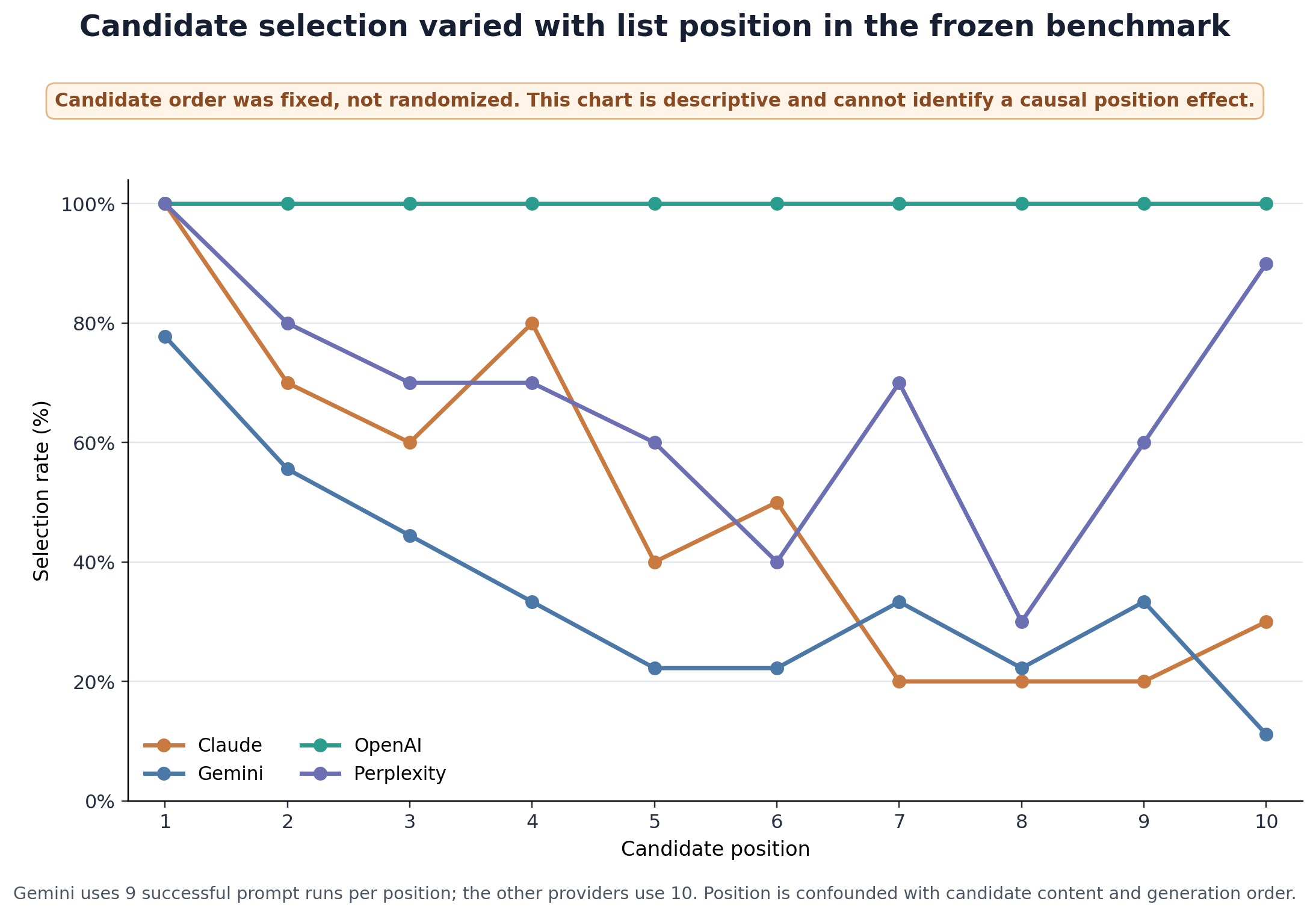
6. Fixed candidate order is an important confound
Candidate order was not randomized.
For Gemini and Claude, earlier positions were selected more frequently than many later positions. OpenAI selected every position. Perplexity showed a less monotonic pattern.
The exploratory prediction baseline also found candidate position informative.
But none of this identifies a causal position effect.
Earlier candidates may have been:
- broader;
- better formed;
- more relevant;
- ordered higher by the candidate-generation process.
Position and content are entangled.
The next experiment should randomize candidate order within prompts and repeat runs. Until then, position is a descriptive correlate rather than an identified mechanism.
Finding 5
7. What did the plans do when they moved beyond the candidate space?
An extension is an observable query that the deterministic provenance rules did not connect to the visible candidate set.
That does not automatically mean a completely new idea.
Extensions included:
- more specific searches;
- exact-page or title refinding;
- publisher or author targeting;
- terminology expansion;
- diagnosis;
- measurement and methodology;
- comparison and solution discovery.
The primary-family mix differed descriptively. Claude's extensions often included creator/author or publisher targeting. Gemini's were spread across source-policy/exclusion, exact-page refinding and several other families. OpenAI had only 14 extensions, while Perplexity had only three, making Perplexity's family mix too sparse for provider-level interpretation.
No significance sweep was run across these family categories. They are examples of where the observable plans moved, not stable provider specialisms.
AEO and GEO measurement
What this means for AEO and GEO measurement
Separate the scaffold from the search plan
A candidate list is a hypothesis space, not the provider's observed plan.
Monitoring systems should preserve:
candidate generated → candidate selected → candidate transformed → query beyond candidate space
If those stages are collapsed, a tool can accidentally present its own candidate-generation logic as provider-native behaviour.
Separate lexical variation from retrieval-need variation
Perplexity's pattern shows why string difference is not enough. A query can be substantially rewritten while remaining connected to the same retrieval need.
Teams should cluster related formulations rather than treating every lexical variation as a separate optimization target.
Report coverage and expansion separately
A provider can select fewer candidates but expose a large additional query layer. Another can select many candidates and stay close to the scaffold.
Candidate recall and expansion are different measurements.
Treat seeded consensus as scaffold-dependent
The flagship study showed that most cross-provider semantic consensus was seeded. This companion shows how: the candidate list influences what is available to select and what can later be classified as inside or outside the supplied space.
Seeded experiments measure:
behaviour conditional on the candidate scaffold.
They do not directly measure unprompted provider search planning.
Exploratory inference
Statistical interpretation
Candidate-selection comparisons were evaluated at the buyer-question level, not by treating the 100 candidate rows as independent experiments.
The exploratory layer used prompt-blocked comparisons, exact paired sign-flip tests, prompt-paired bootstrap intervals, false-discovery-rate adjustment and leave-one-prompt-out checks.
Several candidate-selection and extension-rate contrasts met the stronger exploratory criteria.
Because the statistical plan followed descriptive inspection and there is only one run per provider-question cell, the findings remain hypothesis-generating rather than confirmatory.
Evidence boundaries
Limitations
- Ten designed buyer questions:
not a random sample of all queries or industries.
- One run per provider-question cell:
run-to-run selection stability is unknown.
- Fixed candidate order:
position is confounded with candidate content.
- Seeded design:
behaviour is conditional on the supplied scaffold.
- Deterministic provenance matching:
rewrites, compositions and extensions can be misclassified.
- Heterogeneous provider telemetry:
exported traces are not identical windows into internal systems.
- No downstream quality outcome:
coverage, rewriting and expansion are not provider-quality scores.
Research agenda
What should be tested next
A stronger candidate-use experiment should include:
- 30–50 or more prompts across unrelated domains;
- seeded and unseeded conditions;
- randomized candidate ordering;
- multiple independent candidate sets;
- three to five repeated runs;
- time-separated collection;
- human validation of query provenance;
- downstream source and answer-quality outcomes.
The central causal question is:
How much does changing the candidate scaffold change the provider's observable search plan?
That is more informative than asking which provider had the highest extension rate in one seeded benchmark.
Conclusion
Conclusion
The same candidate queries did not produce the same search plan.
The four provider stacks differed in:
- how much of the 100-query scaffold they covered;
- which candidates they selected;
- whether candidate-derived queries were copied, rewritten or composed;
- how much of the observable plan fell outside the matched candidate space.
The most useful distinction is between rewriting and expansion.
Perplexity rewrote many candidate-derived queries while remaining close to the supplied candidate space overall. Gemini usually executed matched candidate material literally but exposed a much larger non-candidate-matched layer. Claude combined both forms of variation. OpenAI covered the full supplied list and executed most candidate-derived queries as exact copies.
That is why fan-out analysis needs more than string matching and more than one novelty score.
A better measurement chain is:
what was supplied → what was selected → how it was transformed → what appeared beyond it
That separation makes it easier to distinguish the researcher's candidate scaffold from the observable provider behaviour that follows.
FAQ
Frequently asked questions
Which provider selected the most supplied candidates?
OpenAI selected all 100. Perplexity selected 67, Claude 49 and Gemini 32 across its nine successful runs, giving Gemini a success-conditional rate of 35.6%.
Why is Gemini 35.6% rather than 32%?
Gemini P08 failed. A failed run is missing, not ten observed non-selections. The public comparison therefore uses 32 selected candidates from 90 observable candidate opportunities.
Which provider rewrote candidate-derived queries the most?
Perplexity: 52 of 68 candidate-derived executions, or 76.5%, were classified as rewrites.
Does rewriting mean moving beyond the supplied candidate space?
No. A provider can substantially reformulate a candidate while remaining connected to the same supplied retrieval need.
Does a higher extension rate mean better search?
No. Extension is an operational provenance measure. The study does not identify a universal quality direction.
Should companies optimize for every candidate or exported fan-out query?
No. The evidence supports grouping related formulations into broader retrieval needs and evidence requirements rather than creating one optimization target per literal query.