Kojable research · Cross-Provider AI Query Fan-Out Study · Companion analysis
When AI Search Systems Extend the Search
Where non-candidate-matched queries appeared, how search sequences changed, and what observable follow-up looked like across four provider stacks
AI search does not always stop with the queries it was given.
In our cross-provider fan-out experiment, Claude, Gemini, OpenAI and Perplexity received the same ten designed B2B buyer questions and the same visible candidate-query scaffold. Some observable search queries mapped back to that supplied space. Others did not.
We call the latter extensions: observable queries that the deterministic provenance system could not connect to the supplied candidate-query set.
The flagship study showed that extension rates differed sharply across provider stacks. This companion asks a narrower question:
When did extensions enter the observable search sequence, how did the sequence change after that point, and when can we see evidence that a later query was conditioned on an earlier search result?
The answer is not one universal search pattern.
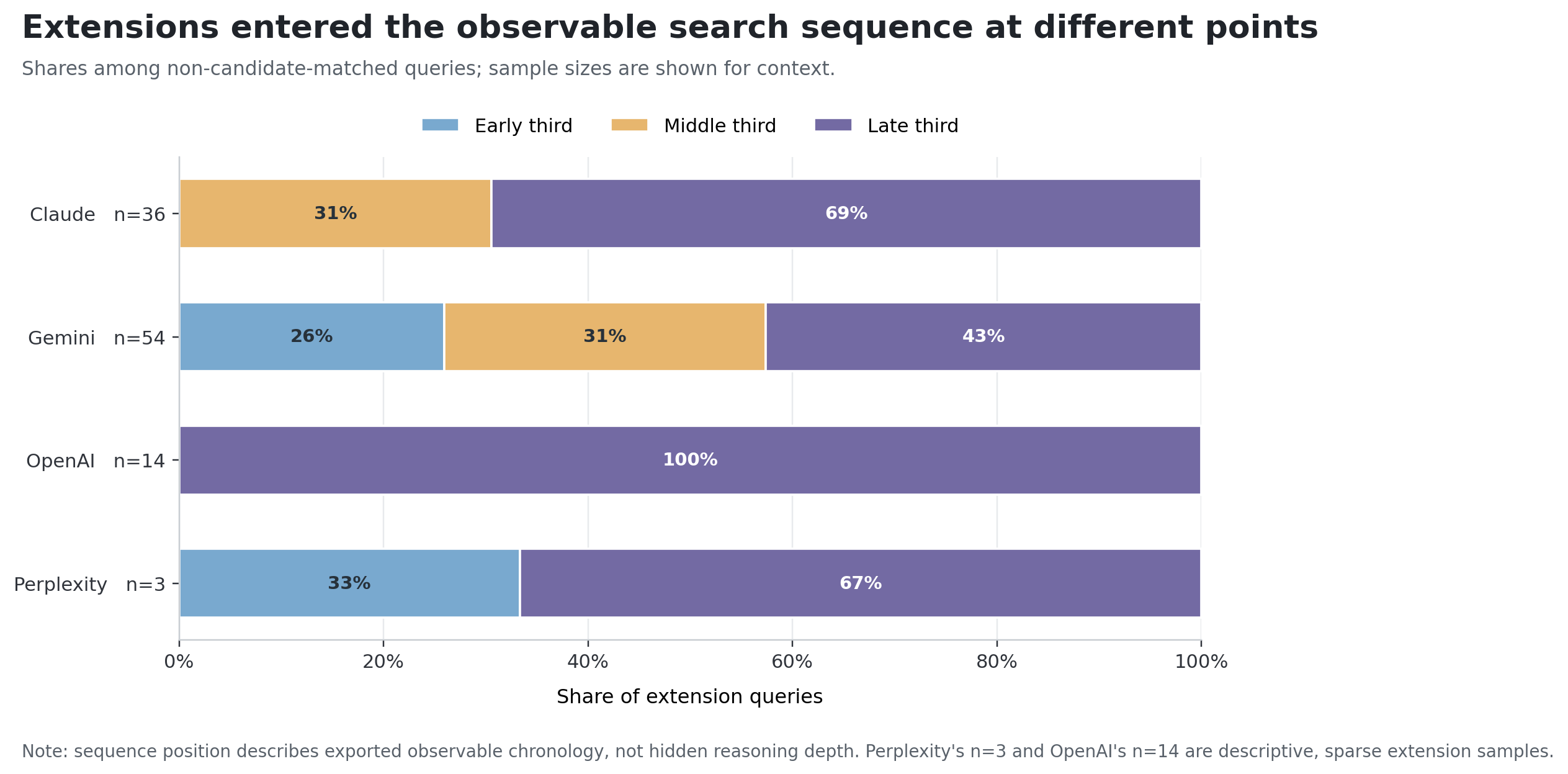
Gemini and Claude produced extensions in every successful run. OpenAI did so in seven of ten runs. Perplexity did so in only three of ten.
The timing differed too. Claude’s extensions were heavily concentrated late in its observable query sequence. Gemini’s were spread across early, middle and late positions. OpenAI’s small extension layer appeared entirely late in the exported sequences.
And only Claude exposed sufficiently direct query-to-result chronology in this dataset for us to identify eight concrete cases where distinctive information from an earlier result appeared in a later extension query.
Key finding
Extensions were not simply “extra queries.” They entered different provider traces at different points and sometimes served as follow-up searches, refinding queries, publisher checks or author verification. But sequence position is an observable execution property—not evidence of hidden reasoning depth or provider quality.
Qualification: “Extension” is an operational provenance label. A non-candidate-matched query may represent a genuinely new retrieval need, a specialized reformulation, a result-conditioned follow-up, or something the deterministic matcher could not connect to the visible seed space. Provider telemetry also differs substantially, so chronology is not equally observable across systems.
Read the flagship cross-provider study
- Query extension
- Search sequencing
- Result-conditioned follow-up
- 9 min read
Answer first
When did AI systems move beyond the candidate-query space?
Direct answer
The observable patterns differed substantially.
| Provider | Runs with any extension | Extension queries | Extension share of observed queries | Early | Middle | Late |
|---|---|---|---|---|---|---|
| Gemini | 9/9 | 54 | 61.4% | 25.9% | 31.5% | 42.6% |
| Claude | 10/10 | 36 | 42.9% | 0.0% | 30.6% | 69.4% |
| OpenAI | 7/10 | 14 | 11.9% | 0.0% | 0.0% | 100.0% |
| Perplexity | 3/10 | 3 | 4.2% | 33.3% | 0.0% | 66.7% |
The table needs two cautions.
First, OpenAI and especially Perplexity contribute far fewer extension queries than Gemini and Claude. Percentages based on three Perplexity extensions should not be interpreted as a stable provider tendency.
Second, “early,” “middle” and “late” refer to normalized position in the exported observable sequence. They do not reveal internal planning steps that the provider did not expose.
Definition
1. An extension is not automatically a new idea
The term “extension” can sound stronger than the measurement actually is.
In this study, an extension means:
an observable query that could not be deterministically matched back to the supplied candidate-query space.
That is useful because it separates obvious candidate use from observable movement beyond the scaffold.
But several processes can create an extension.
A provider might introduce a genuinely new retrieval need, specialize a broad candidate, search for a specific publisher, search for an author discovered in an earlier result, refind an exact article or title, or formulate the same underlying need in a way the provenance matcher does not connect to the seed.
So extension rate should not be translated into a “creativity” score.
The more informative question is:
What role does the extension play in the observable search sequence?
Finding 1
2. Gemini and Claude extended consistently; Perplexity rarely did
Extensions appeared in every successful Gemini and Claude run.
For Gemini:
- 9 successful runs
- 9 contained extensions
For Claude:
- 10 successful runs
- 10 contained extensions
OpenAI produced at least one extension in 7 of 10 runs.
Perplexity produced extensions in only 3 of 10.
This aligns with the query-level composition from the earlier companion:
- Gemini extension share: 61.4%
- Claude: 42.9%
- OpenAI: 11.9%
- Perplexity: 4.2%
But run-level presence and query-level rate measure different things.
OpenAI is a useful example. Seven runs contain at least one extension, yet extensions account for only 11.9% of all OpenAI query strings.
That pattern is consistent with a relatively small late extension layer rather than a search plan dominated by extensions.
Finding 2
3. Claude tended to establish candidate-derived searches before extending
Claude’s sequence structure was especially clear.
Its 48 candidate-derived queries had a mean normalized sequence position of approximately 0.279.
Its 36 extensions had a mean position of approximately 0.794.
More than half of Claude’s candidate-derived queries appeared in the early third of the sequence, while 69.4% of Claude extensions appeared in the late third.
Across all ten Claude runs, the first extension came only after candidate-derived searches had already appeared.
For example:
- P01: first extension at normalized position 0.625
- P05: 0.500
- P07: 0.750
- P09: 1.000
- P10: 0.444
This creates an observable pattern of:
candidate-derived search → later non-candidate-matched search
That is compatible with follow-up behaviour.
But “compatible with” is the right phrase.
Sequence order alone cannot tell us what information caused the later query.
Finding 3
4. Gemini often extended much earlier
Gemini showed a different architecture in the exported trace.
Its extensions were distributed:
- 25.9% early
- 31.5% middle
- 42.6% late
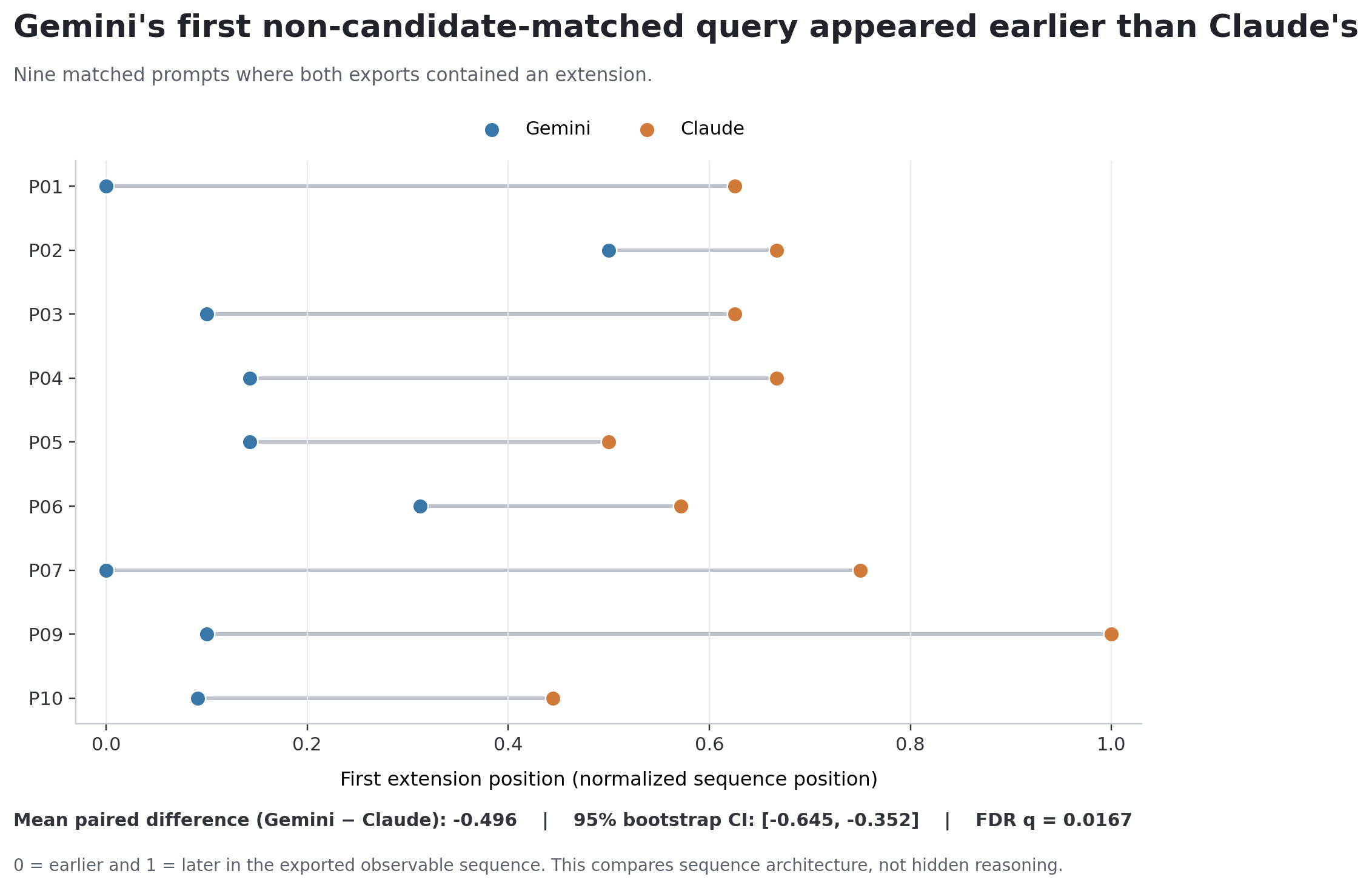
In two successful runs—P01 and P07—the first observable Gemini query was already classified as an extension.
In several others, the first extension appeared near the beginning:
- P03: normalized position 0.10
- P04: 0.143
- P05: 0.143
- P09: 0.10
- P10: 0.091
The prompt-paired comparison between Gemini and Claude is one of the stronger sequence findings.
Across the nine prompts where both were observable and extended, Gemini’s first extension appeared approximately 0.496 normalized-sequence units earlier on average than Claude’s.
The paired bootstrap interval was approximately:
[−0.645, −0.352]
and the FDR-adjusted exploratory q-value was approximately 0.0167.
This difference was directionally consistent across all nine matched prompts.
The appropriate interpretation is:
Gemini’s exported sequence moved beyond the candidate-matched space earlier than Claude’s in this frozen experiment.
Not that one provider is “more creative” or “thinks deeper.”
Finding 4
5. OpenAI’s extensions were late—but they formed a small layer
OpenAI produced 14 extensions across seven prompts.
All 14 appeared in the late third of the exported query sequence.
On runs with extensions, the first extension typically appeared after approximately ten or eleven candidate-derived queries.
Examples:
- P02: normalized first-extension position 0.846
- P03: 0.909
- P04: 0.909
- P08: 1.000
- P09: 0.833
That pattern looks structurally different from Gemini.
But direct comparison requires care.
OpenAI exposes ordered multi-query search batches with batch-level result linkage, not Claude-style query-to-result chronology. A late OpenAI extension can be identified as late in the observable sequence, but we generally cannot attribute it to one specific earlier result.
So this article treats timing and result-conditioned evidence as separate claims.
Sample boundary
6. Perplexity produced too few extensions for a strong timing profile
Perplexity had only three extension queries across the entire study.
They appeared in P01, P02 and P08.
Their normalized first-extension positions were:
- 0.25
- 1.00
- 0.80
With three observations, percentages such as “66.7% late” are mathematically correct but scientifically weak.
The better conclusion is:
Perplexity largely stayed within the candidate-matched space in this seeded experiment, leaving too few extensions for a stable sequence-timing profile.
Finding 5
7. Claude also showed the strongest specificity increase relative to Perplexity
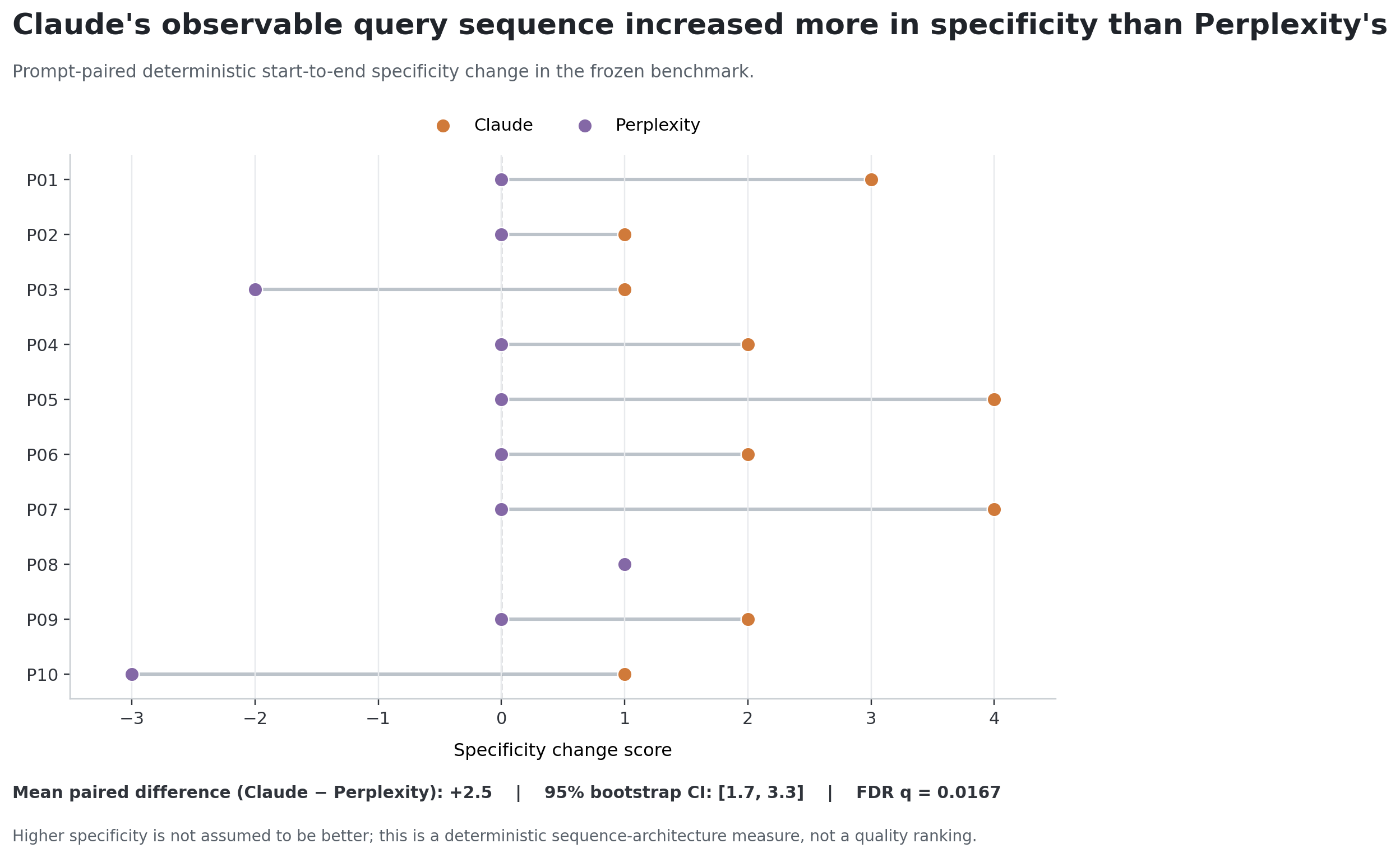
The sequence analysis measured a deterministic specificity-change score from the beginning to the end of each observable query plan.
Claude’s complete-prompt mean specificity change was approximately +2.1.
Perplexity’s was approximately −0.4.
The prompt-paired Claude–Perplexity difference was:
+2.5
with a paired bootstrap interval of:
[+1.7, +3.3]
The FDR-adjusted q-value was approximately 0.0167, and the direction remained stable in leave-one-prompt-out analysis.
This supports a narrow statement:
Claude’s observable search sequences became more specific from beginning to end than Perplexity’s sequences in this benchmark.
It does not establish that greater specificity is better.
Specificity is sequence structure, not a universal quality metric.
Direct observability
8. Eight Claude cases show direct evidence of result-conditioned follow-up
Timing alone cannot prove that one search result influenced the next query.
Claude provides something stronger in eight cases.
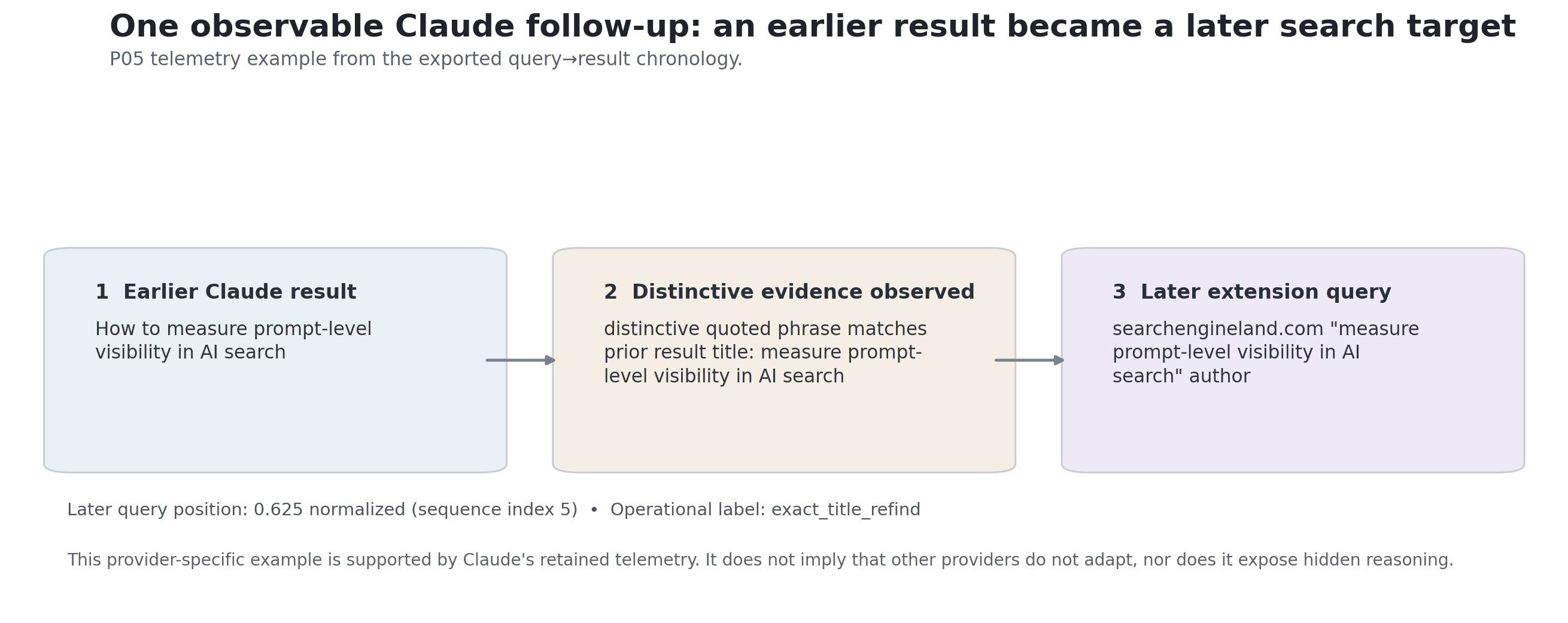
Because Claude exposes ordered single-query tool calls with direct result linkage, we can observe situations where distinctive vocabulary first appears in a retrieved result and then appears in a later extension query.
The eight canonical cases include:
| Prompt | Later query | Observable conditioning evidence |
|---|---|---|
| P01 | Search Engine Land AI visibility scores limits diagnosis author | Earlier result introduced searchengineland.com |
| P01 | Sword and the Script blog author Frank Strong AI visibility | Earlier result introduced the publisher/domain |
| P05 | searchengineland.com "measure prompt-level visibility in AI search" author | Quoted phrase matches an earlier result title |
| P05 | Alex Birkett Omniscient Digital co-founder | Person name first appeared in earlier result |
| P05 | sparktoro "AIs are highly inconsistent when recommending brands" author Fishkin | Quoted phrase matches earlier result title |
| P05 | "AI recommendation lists repeat less than 1% of the time" searchengineland author byline | Earlier result introduced publisher/domain |
| P07 | Forrester "Seven Roles, One Goal" answer engine optimization author analyst | Quoted phrase matches an earlier result title |
| P08 | Kevin Indig Growth Memo "AI visibility is not one score" rank tracker | Person name first appeared in earlier result |
These cases include publisher verification, author verification, exact-title refinding, creator targeting and credibility verification.
This is the strongest evidence in the dataset for an observable pattern of:
retrieve evidence → extract a distinctive entity or phrase → issue a later targeted query
But the conclusion should remain provider- and case-specific.
The study does not show that every Claude extension is result-conditioned, and it cannot make the same direct attribution for OpenAI, Perplexity or Gemini because their exported result linkage is coarser.
Descriptive taxonomy
9. Extensions were often targeted rather than merely broader
The extension taxonomy provides useful descriptive context.
Extension queries included labels such as publisher targeting, creator or author targeting, exact-page refinding, source-policy or exclusion searches, measurement, solution discovery, terminology expansion and diagnosis.
The labels can overlap, so their shares should not be added as if they formed mutually exclusive categories.
Still, the patterns help explain what “moving beyond the candidate space” looked like.
For Claude, extension queries frequently carried publisher and creator/author targeting labels.
For Gemini, exact-page refinding was common among extension labels, alongside publisher targeting, source-policy searches and solution discovery.
OpenAI’s smaller extension layer included source targeting, measurement and diagnosis.
Perplexity’s three extensions are too sparse for a meaningful family profile.
The practical point is that extension can mean narrowing or verifying, not only broadening.
Implications
What this means for AEO and GEO measurement
Extension rate is not enough
A dashboard that reports only “X% of queries were novel” loses important structure.
Useful questions include:
- Did the provider extend at all?
- How early did extension begin?
- Were extensions concentrated late?
- Did later queries become more specific?
- Did they target authors, publishers or exact pages?
- Is there direct evidence that a previous result conditioned the next query?
Those are different behaviours.
Sequence can reveal where evidence needs change
A broad candidate-derived search may establish the information need.
A later search might look for the original publisher, an author, an exact article title, credibility evidence or supporting methodology.
For GEO teams, this suggests that visibility may depend not only on answering a broad topic but also on having evidence that survives later verification or refinding steps.
That remains a hypothesis until content interventions are tested.
Result-conditioned evidence should be distinguished from inferred adaptation
If a provider exposes direct query-result lineage, we can make stronger chronology claims.
If it exposes only batch- or run-level linkage, we should not infer the same mechanism from query order alone.
Measurement quality depends on observability.
Constraints
Limitations
- Extension is operational: non-candidate-matched does not equal independently invented.
- One run per provider-question cell: timing stability is unknown.
- Provider telemetry differs: direct result-conditioned attribution is strongest only for Claude.
- Few Perplexity extensions: no stable timing profile can be inferred.
- Only 14 OpenAI extensions: its all-late pattern comes from a smaller extension layer.
- Specificity is a deterministic score: it is not a quality or intelligence measure.
- Post-descriptive statistics: inferential results are exploratory.
- Candidate seeding shapes the sequence: an unseeded condition could produce different extension behaviour.
Next experiment
What should be tested next
A stronger sequencing experiment should include:
- seeded and unseeded conditions;
- randomized candidate order;
- repeated provider runs;
- more prompt domains;
- direct query-result lineage where available;
- explicit classification of extension purpose;
- human validation of result-conditioned follow-ups;
- downstream evidence-quality outcomes.
A particularly useful endpoint would be:
Given an earlier retrieved result, what is the probability that the next query introduces an entity, phrase, publisher or page discovered in that result?
That would turn the Claude case evidence into a repeatable adaptation measure.
Conclusion
Conclusion
Extensions entered the four observable search plans differently.
Gemini extended in every successful run and often moved beyond the candidate space early.
Claude also extended in every run, but its extensions were concentrated later: 69.4% fell in the late third of the exported sequence.
OpenAI produced a smaller extension layer that was entirely late.
Perplexity produced only three extensions, too few for a stable timing profile.
The strongest matched sequence contrast was between Gemini and Claude: Gemini’s first extension appeared about half a normalized sequence earlier on average.
Claude also showed a larger start-to-end specificity increase than Perplexity.
And in eight Claude cases, the telemetry lets us go beyond sequence timing: distinctive information from an earlier result visibly reappeared in a later extension query.
The useful conclusion is not that one provider “explores better.”
It is:
AI search extension has structure—when it appears, what it targets, and whether it visibly follows from earlier evidence can differ across provider traces.
For AEO and GEO measurement, that sequence structure deserves to be tracked separately from raw query count or extension rate.
FAQ
Frequently asked questions
What is an extension query?
An observable query that the deterministic provenance system could not match back to the supplied candidate-query space.
Which providers extended in every run?
Gemini in all 9 successful runs and Claude in all 10 runs.
Which provider extended earliest?
In the matched Gemini–Claude comparison, Gemini’s first extension appeared substantially earlier in the exported sequence.
Did OpenAI extend?
Yes. Seven of ten runs contained at least one extension, but extensions represented only 11.9% of its total observable queries and all 14 occurred late in the sequence.
Did Perplexity extend?
Yes, but only three extension queries appeared across three of ten runs.
Does a late extension mean a provider reasoned more deeply?
No. Sequence position is not a measure of hidden reasoning depth.
What is result-conditioned search?
An observable case where information first seen in an earlier retrieved result—such as a publisher, person name or exact title phrase—appears in a later search query.
Which provider allowed direct result-conditioned analysis?
Claude, because its exported telemetry includes ordered single-query tool calls with direct query-result linkage.
Does the study prove Claude adapts more than other providers?
No. The other provider exports do not expose equally strong query-level chronology, so the study cannot make a fair cross-provider ranking of result-conditioned adaptation.