Case Study · AI Answer Alignment
B2B AEO Case Study: 79 Recommendations and a Matched AI Answer Follow-Up
An anonymised B2B software programme · United States · English-language AI answers · September–October 2026
- Ranked recommendations
- 79
- Domains
- 56
- Valid matched observations
- 118 per date
- Approved pages cited in retained final answers
- 0 of 10
Quick answer
Unbranded AI visibility rose 11.31 percentage points in a corrected matched September–October comparison. Across seven buyer questions that did not name the company, the equally weighted visibility score increased from 50.00% to 61.31% across four measured AI surfaces. The study observed the change and could not determine its cause.
AEO means Answer Engine Optimisation: work concerned with how information about a company is discovered, represented and supported in AI-mediated answers.
At a glance
- Research output: 79 prioritised recommendations—69 proposed new mentions and 10 improvements to existing mentions.
- Worked examples: two anonymised proposals identifying a page-level gap, suggested addition and evidence needed before publication.
- Follow-up across all ten questions: the equally weighted score rose from 65.00% to 72.92%, up 7.92 percentage points. Branded-question presence remained at 36/36 on both dates.
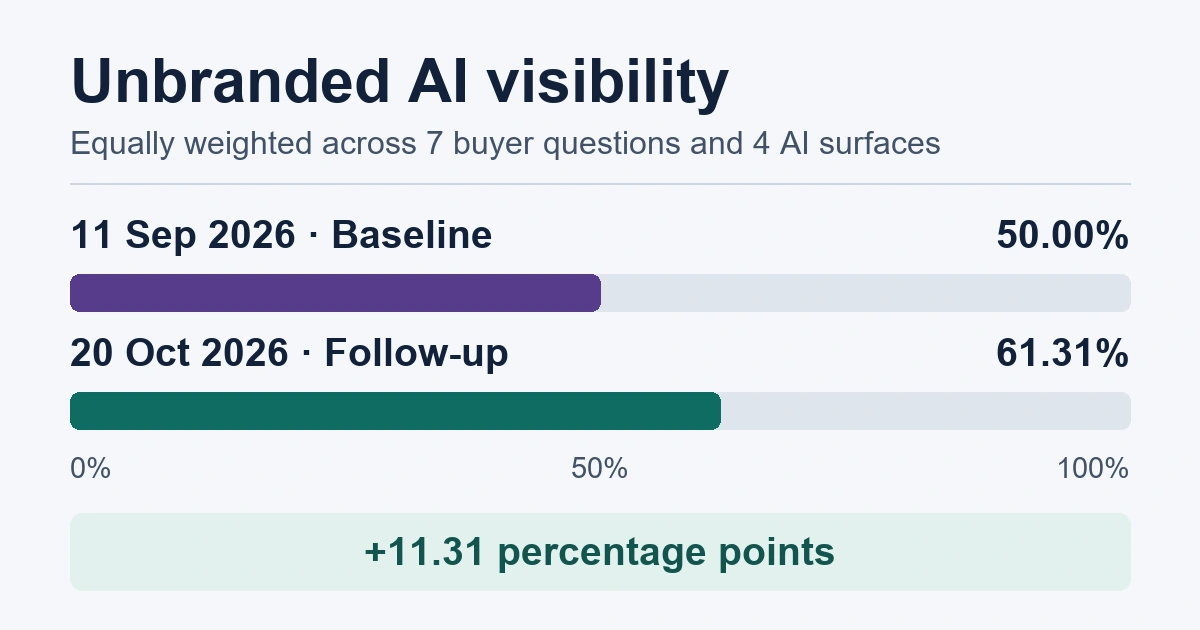
This case follows the September baseline for Company B, which reported 56 of 105 unbranded answers (53.3%) across five surfaces. The corrected comparison uses four surfaces, excludes Google AI Overview on both dates and removes the two unusable Gemini pairs.
The study at a glance
| Measurement field | This case |
|---|---|
| Client | Anonymised B2B software company |
| Market and language | United States; English |
| Buyer-question panel | 10 themes: 7 without the company name, 3 naming the company |
| Matched collection dates | 11 September and 20 October 2026 |
| AI/search surfaces | ChatGPT, Gemini, Google AI Mode and Claude API |
| Planned repetitions | 3 per question and surface on each date; 120 planned observations per date |
| Valid matched observations | 118 per date: 82 unbranded and 36 branded; 236 retained across both dates |
| Measured outcome | Visible company presence in captured answers, including its name or domain in visible source labels |
| Headline score | Equal-weight average of the presence rates for each question and surface pairing |
Two October Gemini responses contained errors. The corrected panel removes them and their September matches, retaining all ten question themes. Google AI Overview was unavailable in October and is excluded on both dates. The measurement rules explain how raw counts and weighted scores are calculated.
What the evidence showed
Kojable analysed buyer questions and AI answers, investigated sources and competitor coverage, assessed existing mentions, and qualified individual pages for review. The work included publisher or author research where available, evidence and verification notes, and a matched AI-answer follow-up.
These counts describe different units of research and cannot be read as conversion rates.
| Evidence | Finding |
|---|---|
| Delivered work | 79 ranked page-level recommendations across 56 domains: 69 proposals for new mentions and 10 to improve existing mentions. |
| Publication status | Ten separately approved external pages were reported live before the October follow-up. Two overlapped with the 79 recommendations. Exact publication dates were not established. |
| Measured outcome | Equally weighted unbranded visibility rose from 50.00% to 61.31%, up 11.31 percentage points. The equally weighted overall score rose from 65.00% to 72.92%, up 7.92 percentage points. |
| Final citations | 0 of 10 approved pages observed in final citations. This covers the 236 retained observations across both dates. Retrieved-only results and the separate DataForSEO provider audit are separate records; the finding does not rule out citations elsewhere. |
The buyer problem: being known is not the same as being discovered
The company had no difficulty appearing when an AI prompt named it directly. Across three branded comparison and migration questions, it appeared in all 36 of 36 matched answers on 11 September.
The more interesting question was what happened when a buyer did not provide the company name. Would the company appear when someone asked about alternatives to a familiar platform, AI-assisted operations, governance requirements or the practicalities of setting up a tool?
Across seven such unbranded questions, the company appeared in 41 of 82 retained September observations. That gave the research a direction: look for places where the company's relevance to those decisions was missing, thinly explained or difficult to verify.
The objective was therefore more specific than “get more AI mentions”. The team wanted to identify relevant pages and publishers, understand how competitors were discussed, and prepare credible additions that a delivery partner could review for possible outreach.
From ten buyer questions to 79 ranked recommendations
Kojable examined AI-answer and source material associated with the agreed buyer questions, compared competitor coverage, inspected candidate pages and researched relevant authors or publishers where information was available.
The research records contain several different counts. They describe the volume of material examined and the final decision set; they should not be read as independent citations or as a simple conversion funnel.
| Research record | Count | What it represents |
|---|---|---|
| Source occurrences | 13,285 | Recorded source appearances in the research material; not 13,285 unique sources |
| Unique pages visited | 3,793 | Distinct visited page records in the source investigation |
| Canonical pages | 2,880 | Pages consolidated for review after canonicalisation |
| Potential target pages screened | 206 | Pages considered for a possible editorial opportunity |
| Prioritised recommendations delivered | 79 | Ranked page-level entries for partner review, spanning 56 domains |
The final 79 entries were not a generic list of publications to contact. Each entry connected an identifiable page with a buyer-question theme, the relevant competitor or existing-mention context, a reason it might matter, a proposed addition and any wording or verification concerns. Previously shared opportunities and unsuitable pages were removed before handover.
The delivered workbook gave the partner three connected views:
- Campaign analysis: the buyer decisions, existing answer patterns, source gaps, uncertainties and recommended next steps.
- Buyer-question map: ten question themes with answer summaries, surface observations and brand-mention status.
- Ranked page-level proposals: candidate URLs and titles, authors or publishers where available, existing mentions, suggested insertion points, rationales and review notes.
Of the 79 recommendations, 69 proposed adding a relevant new mention to existing third-party content. The remaining 10 proposed improving a mention already present but insufficiently explained. The distinction matters: a missing company name and a company name with weak context are different editorial problems.
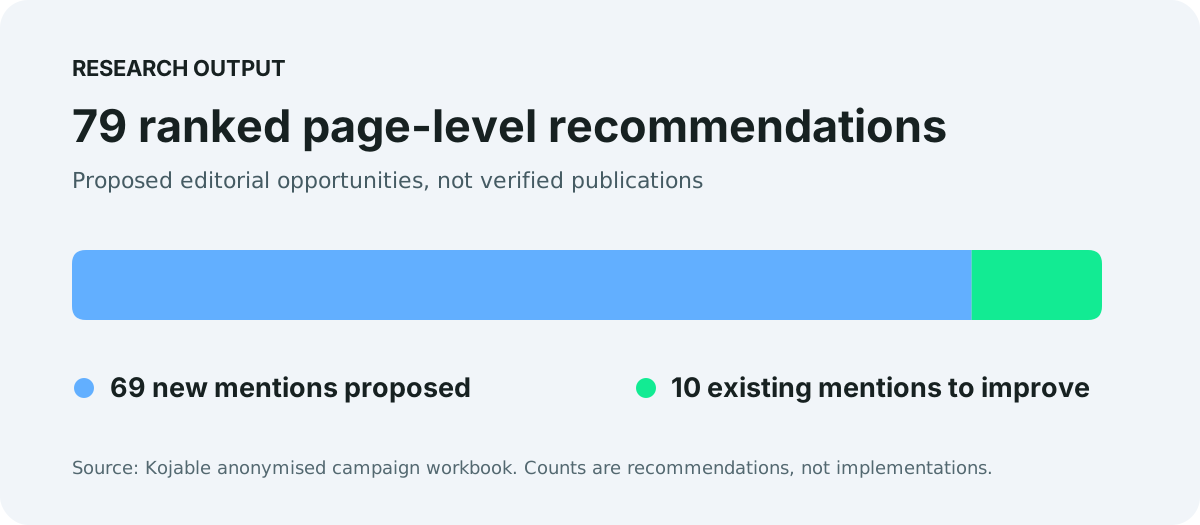
These were recommendations delivered to a partner for review and outreach, not a record of 79 published changes. The partner retained responsibility for external outreach and publication.
Two proposed changes, shown in context
The examples below are generalised from the delivered workbook. Product names, publication names and identifying workflow details have been removed. They describe proposals, not verified edits to live pages.
Example 1: A workflow implementation guide needed a more useful product example
The page-level gap. A guide explained how tools in a workflow integrated with one another. It did not describe the client's potential role in the review or approval stage, a distinction that could matter to a buyer evaluating how proposed changes are handled before use.
The proposed change. In the guide's existing integration section, add a short example describing how a proposed change could move through review or approval before being applied. This would connect the client's role to a workflow the reader was already trying to understand, instead of adding an unrelated brand mention elsewhere on the page.
The evidence gate. The wording would require client-approved product documentation and a verified workflow example. The workbook specifically flagged governance language for review. Without that confirmation, an apparently helpful addition could introduce an inaccurate capability claim.
What this changes for a buyer. The reader would have a clearer basis for judging whether the product belongs in a governed operational workflow. That is more useful than a bare inclusion in a list of tools.
Example 2: A migration article mentioned the company without explaining fit
The page-level gap. An alternatives article already listed the client. But its migration section did not explain how a buyer would replace the functions they might lose when leaving an incumbent platform.
The proposed change. Expand the existing mention within the migration discussion. The proposed addition would address the relevant workflow, buyer selection criteria and capabilities needed after a move—not merely repeat the product name.
The evidence gate. Any feature or competitor comparison would need current, approved documentation supporting the specific claims. The proposal was not permission to invent parity with an incumbent or promise an effortless migration.
What this changes for a buyer. A buyer comparing options could better assess practical suitability and migration trade-offs. The goal of the recommendation was an accurate, useful explanation in a relevant place, not mention volume for its own sake.
The two examples illustrate the difference between source research and publication. The research can identify a credible page and proposed contribution; the publisher and delivery team still need to decide whether to accept it, confirm the facts and make any change.
What changed in the matched AI answers?
On 20 October 2026, Kojable repeated the ten-question panel across ChatGPT, Gemini, Google AI Mode and Claude API. The comparison uses 118 valid matched observations per date and measures visible company presence.
| Measure | 11 September | 20 October | Observed change |
|---|---|---|---|
| Unbranded visibility score (equal weight) | 50.00% | 61.31% | +11.31 percentage points |
| Overall visibility score (equal weight) | 65.00% | 72.92% | +7.92 percentage points |
| Unbranded presence (raw share) | 41/82 (50.00%) | 50/82 (60.98%) | 9 more appearances |
| Overall presence (raw share) | 77/118 (65.25%) | 86/118 (72.88%) | 9 more appearances |
| Branded presence (raw share) | 36/36 (100%) | 36/36 (100%) | No change |
Each question and surface pairing counts equally in the visibility score, even when it has fewer valid repetitions. The raw share counts every retained observation once. All nine additional appearances came from unbranded questions; the three branded questions were at 100% on both dates.
The movement was not uniform across AI surfaces
Gemini contributed 19 valid matched observations per date for the seven unbranded questions. Each other surface contributed 21. The weighted change averages the seven question-level presence rates on each surface.
| AI/search surface | 11 September | 20 October | Additional appearances | Weighted change |
|---|---|---|---|---|
| ChatGPT | 7/21 | 11/21 | +4 | +19.05 percentage points |
| Claude API | 10/21 | 14/21 | +4 | +19.05 percentage points |
| Gemini | 12/19 | 13/19 | +1 | +7.14 percentage points |
| Google AI Mode | 12/21 | 12/21 | 0 | No change |
| All four surfaces | 41/82 | 50/82 | +9 | +11.31 percentage points |
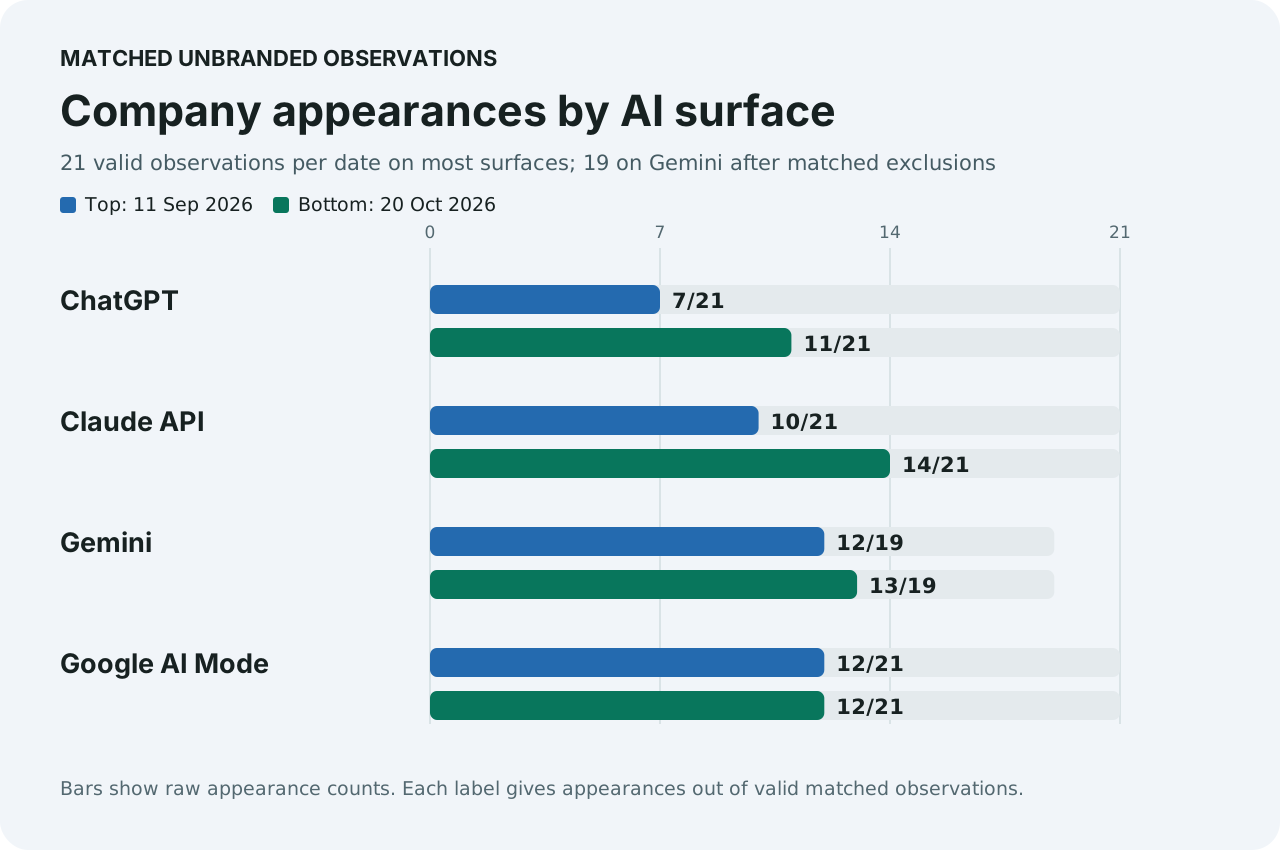
ChatGPT and Claude API accounted for eight of the nine additional appearances. Gemini gained one after the matched exclusions, and Google AI Mode held steady. The differences describe this panel; they cannot tell us how each system responds to particular content changes.
One buyer question accounted for much of the difference
The fuller question-level comparison is important because an aggregate percentage can conceal where movement occurred.
| Anonymised buyer-question theme | 11 September | 20 October | Additional appearances |
|---|---|---|---|
| Alternatives to an incumbent platform | 12/12 | 12/12 | 0 |
| Company compared with an incumbent platform | 12/12 | 12/12 | 0 |
| Company as a migration option | 12/12 | 12/12 | 0 |
| Company compared with another provider | 12/12 | 12/12 | 0 |
| AI-assisted operations tools | 1/11 | 6/11 | +5 |
| Specialist AI assistants | 0/12 | 1/12 | +1 |
| Tools for internal teams | 3/12 | 4/12 | +1 |
| Enterprise governance requirements | 5/12 | 5/12 | 0 |
| Operational monitoring and remediation | 9/12 | 11/12 | +2 |
| Ease of setup and ongoing use | 11/11 | 11/11 | 0 |
Five of the nine additional unbranded appearances came from the AI-assisted operations question. Ease of setup held at 11 of 11 after removing the unusable Gemini pair. Four unbranded questions gained appearances and the other three held steady.
For a marketing team, that is the practical interpretation: the overall result moved, but the question-level pattern is more useful for deciding what deserves investigation next. It would be premature to declare a broad improvement across every buyer need.
What the follow-up does—and does not—establish
The source programme and the answer panel provide two useful forms of evidence: an inspectable set of proposed page-level changes and a later, comparable answer observation. They do not provide a verified chain connecting each recommendation to a dated live edit, a particular retrieved source and a changed answer.
There are several reasons to be careful.
First, delivery is not implementation. The 79 recommendations were handed to a partner. The available publication record does not show that all or most were implemented, nor that either worked example was published.
Second, the ten pages reported live were a different set. The campaign team reported ten approved external pages live before the October follow-up, but individual publication dates were not documented. Only two of those ten pages were also in the 79-recommendation list. Treating all ten as completed recommendations would incorrectly join two different records.
Third, the final citation check covers only the captured panel. None of the ten final approved page URLs appeared in the final citation lists of the 236 retained observations. Retrieved-only results were excluded. A separate DataForSEO LLM Mentions audit also returned zero exact-page records in its ChatGPT and Google AI Overview dataset, which has a different scope. Neither check rules out citations elsewhere.
Fourth, the two dates cannot establish causation or durability. There was no control group, complete dated implementation log or additional longitudinal panel demonstrating persistence. Changes in model behaviour, retrieval conditions, external information and ordinary answer variability remain plausible explanations. The panel retained two or three valid repetitions per question and surface on each date; within-week variability was not measured.
ChatGPT, Gemini and Google AI Mode used DataForSEO captures. The Claude results used its API rather than its consumer interface. Per-answer search-use logs were not independently verified.
This observational follow-up measures visible company presence. A name or domain appearing in an answer or its visible source labels does not establish a recommendation, endorsement, page citation or commercial outcome.
What this changes for a B2B marketing team
Three lessons are useful even without an attributable intervention effect.
1. Separate known-brand comparison from unprompted discovery. A company can appear consistently when a buyer supplies its name and much less consistently when that buyer describes a problem. Those are different measurement questions. Start with the real decisions buyers are trying to make, as described in Kojable's buyer-question monitoring guide, rather than collapsing every prompt into one visibility score.
2. Give the team a specific editorial decision, not just another source list. “This publisher writes about our category” is not enough to justify outreach. A stronger recommendation identifies the relevant article section, the missing or thinly explained information, the buyer's need and the evidence necessary to make a factual contribution. Where an omission may have several explanations, Kojable's missing-proof diagnostic guide helps keep a plausible gap separate from an established cause.
3. Report what moved before asking why. The follow-up tells us which questions and AI surfaces changed. It does not tell us which publication caused the change. A future programme seeking intervention-level evidence would need a dated change log, the precise pages altered, suitable comparison conditions and repeated retests. Kojable's AEO verification guide explains that stronger measurement design.
The wider point is not that every team needs exactly 79 recommendations. It is that research should leave someone with decisions they can examine: what to review, what evidence is missing, who owns the next action and which comparable answer will tell them whether their intended gap has moved.
How this differs from other public AEO case studies
Public AEO studies use different outcome measures. For example, Optimist's B2B AEO case study centres on LLM referral traffic and revenue while acknowledging attribution limits. Broworks' 90-day B2B case study reports a fixed prompt panel alongside citations, traffic and lead measures, including outcomes that had not yet converted into attributable revenue.
Those studies are useful examples of different reporting approaches, not controls or corroboration for this client's results. Their periods, questions, collection systems and units differ from this case. Here, the defensible claim is narrower: Kojable delivered a ranked source/content plan, and brand presence in a fixed captured-answer panel was higher at follow-up.
Our view: the useful output is an evidence trail
At Kojable, we think AI answer alignment has to go beyond counting how often a name appears. The harder work is understanding which buyer questions matter, what the accessible information says, what might be inaccurate or incomplete, and which changes are worth proposing.
This programme made that work tangible. It produced a ranked set of editorial opportunities with page-specific context, and it preserved a comparable later measurement. It also shows why discipline matters: a recommendation is not a publication, a citation is not proof of influence, and a higher follow-up count is not proof of cause.
For us, that is a useful basis for the next decision. Monitor the answer, diagnose the evidence environment, propose an improvement, and verify what can actually be observed. When the records cannot support a stronger conclusion, say so.
Frequently asked questions
What did Kojable deliver in this B2B AEO case study?
Kojable delivered an anonymised ten-question research and content plan, including source and competitor analysis, author or publisher information where available, and 79 ranked page-level recommendations across 56 domains. Of those recommendations, 69 concerned proposed new mentions and 10 concerned improving existing mentions. The recommendations were passed to a delivery partner for review and possible outreach.
Were all 79 recommendations implemented?
The available records do not establish that. They document delivery of the recommendations, not 79 confirmed publications. Ten separately approved external pages were reported live before follow-up, but only two overlapped with the 79 recommendations, and their exact publication dates were not recorded.
What changed between September and October 2026?
Across seven questions that did not name the company, the equally weighted visibility score rose from 50.00% to 61.31%, up 11.31 percentage points. The raw unbranded share rose from 41/82 (50.00%) to 50/82 (60.98%). Across all ten questions, the equally weighted score rose from 65.00% to 72.92%, and branded presence stayed at 36/36.
Did AI answers cite the ten approved pages?
None of the ten final approved URLs appeared in the final citation lists across 236 retained observations. This result excludes retrieved-only search results and is separate from the DataForSEO provider audit. It does not establish whether the pages were cited outside the panel.
Did the recommendations cause the increase in AI-answer appearances?
That cannot be determined from this study. There was no controlled change record connecting the recommendations, dated live publications, specific retrieval events and follow-up answers. The result is an observed difference between two matched measurement dates, not an estimated causal effect.
What would a team need to verify whether a specific AEO change worked?
It would need a clearly defined starting answer and evidence gap, the exact dated page or source change, a consistent question and measurement contract, suitable comparison conditions where feasible, and repeated follow-up observations. The team should measure whether the intended answer or claim changed, not rely on a general visibility percentage alone. See the Kojable AEO verification guide for the fuller procedure.
Start with what AI says about your company
If you are unsure how AI systems describe your business—or whether they introduce you when a buyer asks about your category—start with Kojable's free AI brand audit. It provides an initial Brand Summary, Associated Topics and Competitor Snapshot.
Detailed publisher, source and creator research is scoped separately. Kojable's Creator & Publisher Intelligence explains how evidence-led source research can help turn observed information gaps into reviewable opportunities.
The next step is not necessarily to publish more content. It is to decide which buyer questions and evidence gaps are important enough to investigate.
Methodology and sources
First-party records. This anonymised account draws on the campaign research, the corrected matched comparison and the separate citation audit. The public question themes and examples are generalised to protect the identities of the company, partner and publishers.
Panel and exclusions. The plan was 10 questions × 4 surfaces × 3 repetitions, or 120 observations per date. Two October Gemini responses were errors. Removing them and their matching September observations leaves 118 valid observations per date: 82 across seven unbranded questions and 36 across three branded questions. Google AI Overview is excluded from both dates because it was unavailable in October.
Measurement rule. An observation counts as company presence if the company is visible in the captured answer, including its name or domain in a visible source label. To calculate the visibility score, take the share of valid repetitions with company presence for each question and surface pairing, then average those shares equally. The headline uses the 28 unbranded pairings; the overall score uses all 40. Since the seven unbranded questions make up 70% of the full panel and the branded score was unchanged, the unbranded improvement contributes 7.92 points to the overall score. We calculate changes before rounding.
Raw observations. Raw shares divide appearances by the total number of valid observations in the group. They give equal weight to each observation, so they can differ from the scores when some pairings have fewer valid repetitions.
Citation rule. The check compared the ten approved page URLs with the retained final citation lists, normalising common URL variants. An exact page match was required; a shared domain did not qualify. The check excluded sources that were only retrieved and kept the separate DataForSEO provider audit apart from the matched panel.
External context, not evidence of this client's outcome. Optimist's published B2B AEO programme and Broworks' fixed-panel B2B AEO case illustrate different metrics and reporting choices. They are not matched comparisons for this case.
Limits. This selected panel covers two dates with two or three valid repetitions per question and surface on each date. There was no control group, no complete dated implementation record and no evidence beyond the two dates to establish persistence. The comparison documents higher measured visibility. It cannot establish which changes caused it or infer broader market visibility, leads or revenue.

About Kojable
Kojable helps companies understand and improve how AI systems describe, compare, cite and recommend them. Learn more about Kojable.