Kojable Blog reference entry
How AI Changes the B2B Buyer Journey
The B2B buyer journey is the sequence of decisions a business buyer makes while researching, comparing, validating and shortlisting companies; AI adds another information environment to that process rather than proving a universal new funnel.
Category AI Search Guides
Also known as B2B buyer journey, AI-mediated B2B buyer journey, B2B AI buyer journey, AI buyer journey
AI is changing the B2B buyer journey by adding another environment in which buyers can research companies, compare alternatives, validate claims and prepare a shortlist. It does not follow that AI has replaced the rest of the buying process.
For B2B teams, the practical requirement is to identify the questions that materially affect evaluation, give each question a clear and supportable answer, and monitor how the company is represented when those questions are asked across relevant AI systems.
What changes when AI enters the B2B buyer journey?
AI changes how information can be gathered and synthesised, not necessarily the underlying decisions a B2B buyer needs to make.
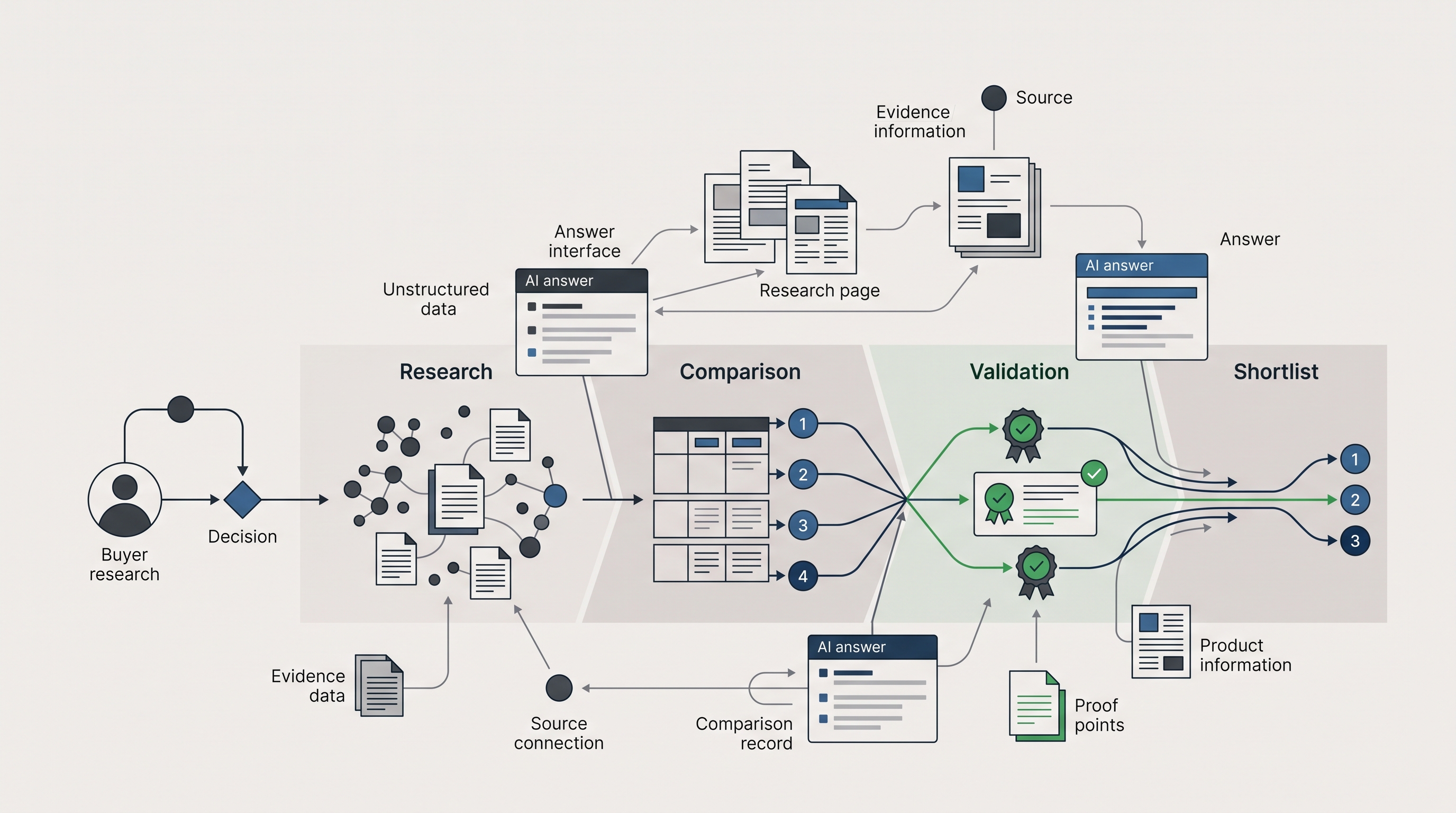
Forrester's 2026 State of Business Buying research reports that 94% of business buyers use AI during the buying process, while buyers also seek validation from peers, product experts, analysts and other trusted voices.
Source: https://www.forrester.com/blogs/state-of-business-buying-2026/
6sense's 2025 Buyer Experience research reports the same 94% LLM-use figure in its study while buyers still averaged 16 interactions per person with the winning vendor, statistically similar to 2023. Its follow-up analysis places many LLM uses in comparison, proposal evaluation, stakeholder synthesis, shortlist creation and summarising third-party material.
Sources:
- https://6sense.com/science-of-b2b/buyer-experience-report-2025/
- https://6sense.com/blog/stop-panicking-how-b2b-buyers-really-use-llms/
The useful conclusion is not that every B2B buyer now follows a new AI funnel. It is that B2B companies have another information environment to manage.
Which questions matter before a B2B company reaches the shortlist?
Start with the buyer decision rather than the channel.
Kojable's AEO Buyer-Question Mapping Playbook, updated on 14 August 2026, uses eight practical questions covering category, fit, alternatives, pricing, integration, proof, credibility and reasonable expected outcomes. It explicitly describes the framework as a practical starting point rather than a universal buyer-journey model.
Adapt the framework using customer interviews, sales and discovery calls, support questions, search and site data, win-loss analysis, product documentation and observed AI answers.
The goal is not to predict every prompt a buyer could type. It is to identify the small set of decisions for which unclear or weak evidence could materially affect evaluation.
How does question context change what a company needs to provide?
A category question and a comparison question are different information problems.
If someone asks what a company does, the answer needs clear category, audience and capability information. If someone asks which of two companies is better for a particular situation, the answer needs relevant comparison criteria, trade-offs and evidence.
If the question concerns credibility, the answer may need research, security information, customer proof or methodology. If the buyer is close to a shortlist, practical issues such as pricing, implementation requirements, risk and expected outcomes become more important.
The practical implication is simple: do not use one generic AI prompt as a proxy for the whole B2B research environment. Monitor materially different buyer questions separately.
What should teams provide across research, comparison, validation and shortlist decisions?
| Context | Buyer decision | Answer required | Evidence required | Representation check |
|---|---|---|---|---|
| Research | Does this company or category fit the problem? | Clear category, audience, use cases and important exclusions | Product facts, documentation and category definitions | Is the company categorised and described accurately? |
| Comparison | Which option better fits the decision criteria? | Comparable criteria, trade-offs and meaningful differentiation | Current product facts, comparison evidence and decision criteria | Are the relevant differences present and accurate? |
| Validation | Can the claims be trusted and implemented safely? | Proof, methodology, technical fit, risk and limitations | Research, documentation, customer evidence, security or compliance records | Does the answer reflect current evidence without overstatement? |
| Shortlist | Is the company credible enough to progress? | Commercial fit, implementation reality and reasonable expected outcomes | Pricing, deployment evidence, cases, assumptions and constraints | Is the company represented as a realistic option for the intended buyer? |
This is not a new funnel. It is a way to connect buyer decision, answer, evidence and representation check.
Should every buyer question get its own page?
No. A material buyer question needs a clear answer owner, but it does not always need a separate URL.
Kojable's AEO Buyer-Question Mapping Playbook lists several possible answer locations, including substantial sections of broader pages, product documentation, comparison pages, pricing pages, trust centres, case studies and research pages.
Google's current generative Search guidance says foundational SEO remains relevant and warns against manufacturing separate content for every possible AI query variation.
Source: https://developers.google.com/search/docs/fundamentals/ai-optimization-guide
What has changed over the past few months?
Three developments sharpen the practical picture.
AI use is substantial, but human validation remains important
Forrester's January 2026 research reports widespread AI use in business buying while also emphasising validation through trusted internal and external voices.
B2B buyers are using LLMs heavily without abandoning vendors
6sense reports 94% LLM use in its 2025 buyer study while buyers still averaged 16 interactions per person with the winning vendor.
Google has made generative Search more measurable
On 3 June 2026, Google announced dedicated Search Console reporting for generative AI features, including AI Overviews, AI Mode and generative features in Discover.
Source: https://developers.google.com/search/blog/2026/06/gen-ai-performance-reports
How should teams audit AI representation across the buyer journey?
Start with a defined question set that represents real buying decisions.
For each observation, record the exact question, prompt family, platform or surface, date, geography and language where material, whether the company appeared, how it was categorised, capabilities included or omitted, competitors mentioned, factual or entity errors, citations where available and current evidence gaps.
Then distinguish the observation from the diagnosis. If a competitor appears and your company does not, the omission is observable. It does not prove why the competitor appeared.
This is why the operating process matters:
Monitor → Diagnose → Improve → Verify
What evidence should teams fix first?
Prioritise the intersection of decision importance, observed representation gap and evidence readiness.
If the company cannot yet support the desired answer with defensible evidence, the first action may be research, documentation or proof collection rather than publishing.
The rule is simple: fix the evidence or narrow the claim before creating more content.
How should the B2B buyer journey be measured?
Do not collapse the whole journey into one visibility score.
Brand mention rate
eligible responses mentioning the company ÷ eligible responses
Direct citation rate
eligible responses containing a direct citation to the defined company page or domain ÷ eligible responses
Other useful measurement dimensions can include entity accuracy, competitor co-mentions, recommendation status, source overlap and answer or citation volatility. Their exact counting rules should be defined before they are treated as metrics.
What does the evidence not prove?
Forrester and 6sense study human B2B buyers using their own samples and methodologies. The Kojable Playbook is a planning framework, not a behavioural study.
None of the evidence presented here proves that every B2B buyer uses AI, one AI journey applies to every category, a citation caused an answer, appearing in an AI answer causes shortlist inclusion, or AI visibility necessarily produces revenue.
Frequently asked questions
Is AI replacing the traditional B2B buyer journey?
The evidence does not support a complete replacement. Current research shows widespread AI use while buyers continue to rely on human validation, external evidence and vendor interaction.
Does every B2B buyer question need its own page?
No. Give each materially important decision one clear answer owner, but consolidate superficial query variations.
Does this article prove buyers use AI at every stage?
No. The article combines current buyer research with a practical planning framework. It does not claim that one universal AI-mediated buyer journey applies across all B2B markets.
How should a team start?
Choose the buyer decisions that matter commercially. Establish how the company is currently represented when those questions are asked. Improve the appropriate information source, then retest comparable questions.
What is the practical takeaway?
The important change in the B2B buyer journey is not a new diagram. It is a new requirement for answer readiness.
Start with the buyer decision. Then Monitor → Diagnose → Improve → Verify.