Kojable Blog reference entry
AI Brand Monitoring: What to Measure and How to Build a Baseline
AI brand monitoring is the systematic observation of how AI systems describe, compare, cite and recommend a company across defined buyer questions.
Category AI Search Guides
Also known as AI reputation monitoring, AI brand visibility monitoring, AI search brand monitoring, LLM brand monitoring
AI brand monitoring is the systematic observation of how AI systems describe, compare, cite and recommend a company across defined buyer questions. A useful programme records more than visibility. It preserves the question, provider or surface, representation, competitors, citations and measurement rules so observations can be compared over time.
Build the baseline around real buyer decisions, separate branded representation from market visibility, and diagnose material gaps before deciding what to change. Then retest comparable questions to verify what changed.
01 · Question
What is AI brand monitoring?
AI brand monitoring means systematically observing how AI systems represent a company across defined buyer questions and monitoring conditions.
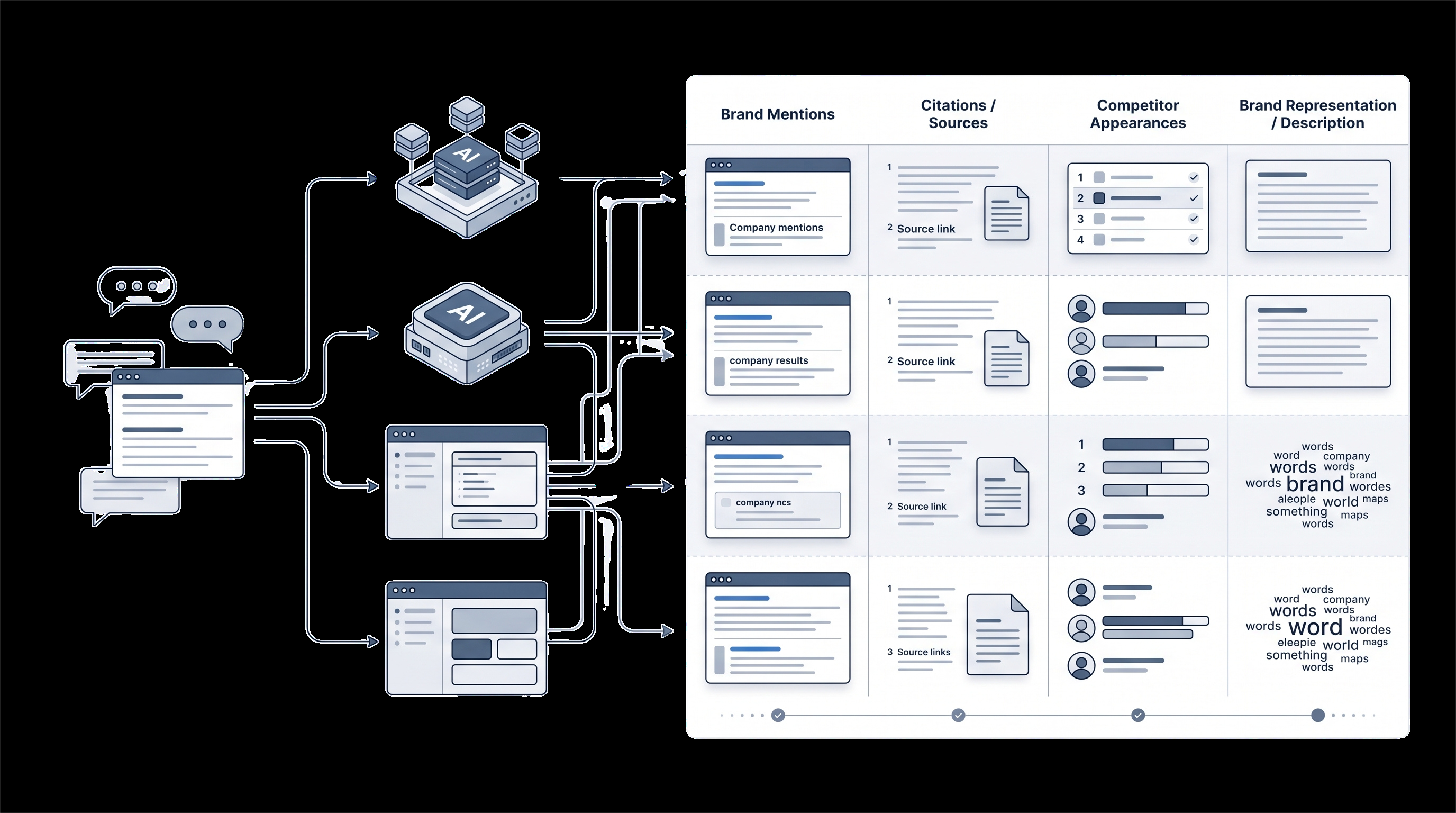
That representation can include:
- whether the company appears;
- how it is described;
- which category or audience it is associated with;
- which capabilities are included or omitted;
- which competitors appear beside it;
- whether it is recommended;
- which sources are cited;
- whether the answer contains inaccurate or outdated information.
In this guide, AI brand monitoring means monitoring AI-generated representation of a company. It does not simply mean using AI to automate social listening, media monitoring or review analysis.
That distinction matters because the evidence is different. A social post, review or news article already exists as a published object. An AI answer is generated under a particular question, provider, product surface and set of conditions. A useful monitoring system needs to retain that context.
AI-generated information is also becoming relevant to B2B research. In a Gartner survey of 645 B2B buyers conducted in August and September 2025, 45% said they had used generative AI during a recent purchase, primarily to gather information about vendors and products. That does not mean AI answers replace other sources. Gartner also reported that 69% preferred to validate AI-generated insights with sales representatives.
The practical point is narrower: AI answers are now one information surface that companies may need to monitor.
02 · Question
How is AI brand monitoring different from conventional brand monitoring?
Conventional brand monitoring primarily observes published mentions and conversations across channels such as media, reviews, forums and social platforms. AI brand monitoring observes generated answers under defined questions, providers and conditions.
A modern monitoring stack may cover both. The difference is therefore not simply traditional tools versus AI tools. It is the object being measured and the evidence needed to interpret it.
| Discipline | Primary object | Typical evidence | Main analytical unit | Main question |
|---|---|---|---|---|
| Conventional brand monitoring | Published mentions and conversations | Media, reviews, social posts, forums | Mention, post, article or review | What is being publicly said about the company? |
| AI brand monitoring | Generated AI representation | Answers, citations, recommendations, comparisons | Prompt, response, provider or defined citation event | How is the company represented in AI answers? |
| Brand reputation management | Perception and response | Monitoring evidence plus issue and stakeholder context | Issue, channel or response action | What response is warranted? |
| AI answer alignment | Gap between company reality, public evidence and AI answers | Monitoring, diagnosis, improvement and retesting | Defined representation gap and comparable retest | What gap matters, what should change and what changed afterwards? |
The first two can coexist in the same operating stack.
A company may monitor media coverage, reviews and social discussions while separately monitoring what AI systems say when buyers ask category, comparison or vendor questions.
The important mistake to avoid is combining those observations as though they measure the same thing.
03 · Question
How is AI brand monitoring different from brand reputation management?
Brand monitoring provides evidence about what is being said or represented. Brand reputation management is broader and may use that evidence to determine or execute a response intended to manage perception.
The two practices are related, but they are not interchangeable.
A monitoring finding might show that an AI answer:
- places the company in the wrong category;
- repeats an outdated product description;
- omits an important capability;
- confuses the company with a competitor;
- cites an old third-party source;
- describes the company accurately but unfavourably;
- varies significantly between providers.
Those findings do not all require the same response.
An inaccurate product description may belong with the product or content team. An outdated third-party profile may require outreach. Weak differentiation may be a positioning and evidence problem. A legitimate negative review may belong in a reputation-management process. An isolated answer may simply require further observation before anyone acts.
This is why Kojable separates Monitor → Diagnose → Improve → Verify.
Monitoring establishes what was observed. Diagnosis determines what the gap means and what evidence is associated with it. Improvement defines the justified action. Verification shows whether comparable answers changed afterwards.
04 · Question
What should AI brand monitoring measure?
AI brand monitoring should separate presence, representation, recommendations, competitors and evidence rather than combine them into one vague visibility score.
Useful signals include:
| Signal | Example question it answers | Possible analytical unit | Important caution |
|---|---|---|---|
| Mention rate | How often does the company appear? | Response | Mention does not establish accuracy or recommendation |
| Recommendation rate | How often is the company recommended when recommendation is relevant? | Eligible recommendation-intent response | Define what counts as a recommendation |
| Representation accuracy | Are important company attributes stated correctly? | Claim, attribute or response | Requires a defined ground truth |
| Competitor co-mentions | Which competitors appear with the company? | Response or competitor event | Co-occurrence does not establish preference |
| Citation coverage | How often do eligible answers contain attributable sources? | Response | A citation is not proof of causal influence |
| Citation Share of Voice | What share of accepted citation events belongs to company-owned sources? | Citation event | This is one specific denominator, not a universal definition of AI visibility |
| Source overlap | Do two observed source sets contain the same URLs or domains? | Defined source set | Low overlap does not establish provider quality |
| Answer or citation volatility | How much does the result vary between repeated observations? | Repeated response or source set | Requires comparable runs |
Positive sentiment is not enough.
An answer can be favourable while still describing the company incorrectly. A high mention rate can coexist with poor category alignment. A company can be visible but routinely framed through an outdated product position.
That is why AI visibility is one monitored signal within AI representation, not the complete monitoring problem.
05 · Question
Which buyer questions should teams monitor?
Monitor questions that correspond to real buyer decisions, and distinguish questions where the company is already named from questions where it must independently enter the consideration set.
A useful panel may include:
- Branded questions: “What does Company X do?”
- Category questions: “What are the main platforms for solving Y?”
- Comparison questions: “Company X vs Company Y for Z?”
- Use-case questions: “Which providers support this use case?”
- Capability questions: “Does Company X provide feature A?”
- Evidence questions: “What proof supports Company X's claim?”
- Recommendation questions: “Which vendors should a team consider for this problem?”
These question types do not necessarily share the same denominator.
Kojable's Branded AI Visibility vs Market Visibility research illustrates the distinction. In that study, the target company was already part of the research frame. That makes the resulting evidence useful for branded or target-oriented discoverability, but it does not estimate unaided market visibility or the probability that an AI system would independently select the company from the market.
The practical rule is simple:
Do not use branded questions to make unbranded market-visibility claims.
Design the question panel around the decision you actually want the monitoring programme to answer.
06 · Question
Which AI systems and surfaces should teams monitor?
Monitor the systems and product surfaces relevant to the buyer journey, and keep their identity attached to each observation.
Avoid storing a result as simply:
AI said...
Record which provider and surface produced it.
That matters because different systems, and sometimes different product surfaces from the same provider, can use different models, retrieval techniques or presentation methods.
Google, for example, states that AI Overviews and AI Mode may use different models and techniques and may show different responses and links.
Kojable's Different Answers, Different Evidence study reached a related observational conclusion. In a fixed cross-provider benchmark, the provider stacks frequently surfaced substantially different cited URL sets for the same buyer questions.
That study used a defined matched panel and one observed run per provider-question cell. It does not establish permanent provider preferences or universal behaviour.
The monitoring implication is narrower:
Provider and surface identity should remain inspectable, even when the organisation also uses an aggregate dashboard.
07 · Question
How should teams establish an AI brand monitoring baseline?
A useful baseline is a dated, structured record of comparable AI-answer observations. It is not one screenshot or one composite score.
At minimum, retain:
- prompt ID;
- exact question;
- buyer intent;
- provider and product surface;
- date and time;
- run identifier;
- geography and language where relevant;
- whether the company appeared;
- observed company description;
- category and audience framing;
- capabilities included or omitted;
- competitors mentioned;
- recommendation status;
- citations or source links;
- factual errors or outdated claims;
- relevant metric and aggregation rules.
Screenshots can still be useful evidence, particularly where layout or citations matter.
They should not be the only record.
A structured baseline makes it possible to answer questions such as:
- Did the same inaccurate description recur?
- Is a problem isolated to one provider?
- Does the answer change when the question moves from branded to category discovery?
- Did competitor framing change?
- Did the cited evidence change?
- Is the result stable enough to warrant action?
Without the baseline, later observations become anecdotes rather than comparable measurements.
08 · Question
How should AI brand monitoring metrics be defined?
Define what is being counted before comparing percentages. Every metric should state its numerator, denominator, analytical unit, eligibility rules and relevant deduplication.
This matters because the same metric label can describe different calculations.
“AI share of voice”, for example, may refer to:
- share of eligible responses mentioning a company;
- share of all brand mentions belonging to one company;
- share of recommendations;
- share of citation occurrences;
- share of prompts in which the company appears.
Those calculations can all produce percentages. They do not answer the same question.
A metric should therefore specify:
- What is the numerator?
- What is the denominator?
- What is the analytical unit?
- Which observations are eligible?
- What is excluded?
- How are repeated events or duplicate citations handled?
- Which provider, model, surface, geography and date range apply?
For example, Kojable's production Citation Share of Voice is defined at the citation-event level:
owned accepted citation events ÷ all accepted citation events
That metric should not be confused with prompt share, domain share or general AI visibility.
The general principle matters more than the label:
A percentage is only useful when the reader knows what was counted.
09 · Question
What can AI citations tell you about brand representation?
An AI citation shows that an observable source attribution appeared in the recorded answer. It can support source analysis, but it does not reveal the hidden causal mechanism that produced the answer.
Useful citation questions include:
- Which sources recur?
- Are they company-owned or third party?
- Are they current?
- What claims do they contain?
- Are competitors or comparable vendors frequently represented?
- Does the source set differ by provider?
- Is the source realistically actionable?
But a citation does not prove:
- that the source caused the answer;
- that it was the most influential source;
- that the system considers it authoritative;
- that it was used in model training;
- that repeating the same source will reproduce the answer.
Kojable's Do AI Systems Cite the Same Sources? research found very low exact-source overlap in the fixed provider benchmark. The companion analysis uses the same underlying experiment, so it should not be treated as an independent replication.
The practical implication is that a citation list from one provider is not automatically a complete source map for another.
Kojable's Which Sources Appear in AI Citations? study also observed several overlapping source families in final emitted citations, including company-owned, comparable-vendor, community, official-documentation and other third-party sources.
That research concerns final cited evidence. It does not expose hidden candidate retrieval or prove why a source was selected.
Use citations as diagnostic evidence, not hidden-model telemetry.
10 · Question
Why should teams compare AI providers?
Comparing providers helps distinguish a recurring representation pattern from a provider-specific observation.
One AI system may describe the company accurately while another uses older category language. One may cite company-owned evidence while another cites comparison sites or community discussions. One may mention the company for a category question while another omits it.
Those differences can change the diagnosis.
Kojable's cross-provider research observed substantial differences in cited URL sets under the tested conditions. The study does not prove one provider is better or that any provider has a permanent preference for a source type.
Instead, it supports a monitoring design decision:
Keep provider-level evidence visible before deciding which gaps are recurring enough to deserve action.
11 · Question
What should happen when monitoring finds a representation gap?
Classify the gap before prescribing a fix. First establish whether it is reproducible and material, then identify the appropriate owner and intervention.
A useful triage starts with the type of problem.
Absence or visibility gap
The company does not appear where it might reasonably be considered.
Ask:
- Is the question genuinely relevant to the company?
- Is the company already named or must it enter the answer independently?
- Do competitors appear consistently?
- Is the result recurring?
Factual accuracy gap
The answer contains incorrect product, company or capability information.
Ask:
- What is the verified current fact?
- Which public sources contain the wrong information?
- Is the error isolated or recurring?
- Is there an obvious owned or third-party correction path?
Positioning gap
The answer is broadly factual but reflects old or generic positioning.
Ask:
- What positioning should the company own today?
- Is that positioning clearly evidenced publicly?
- Does the old framing recur across sources or providers?
Competitor-framing gap
A competitor appears more clearly differentiated or is repeatedly associated with the category.
Ask:
- What evidence supports the competitor's framing?
- Is the company's relevant differentiation visible and current?
- Is this a presence problem or an evidence problem?
Citation or evidence gap
The answer relies on weak, old or competitor-adjacent sources.
Ask:
- Which sources recur?
- What do those sources actually say?
- Are more current owned or independent sources available?
- Is there a realistic action path?
Reputation issue
The monitored answer reflects criticism, reviews or negative public information.
That may need a reputation-management response rather than a generic AI-optimisation action.
Insufficient evidence
Sometimes the correct next step is more monitoring.
One unusual response should not automatically produce a new content project.
Prioritise using:
- recurrence;
- factual importance;
- buyer relevance;
- commercial significance;
- evidence strength;
- actionability;
- ownership.
That is more useful than a universal instruction to “fix AI first”.
12 · Question
How should teams verify whether AI representation changed?
Retest comparable questions against the original baseline and preserve the same measurement rules where possible.
After an intervention:
- rerun the relevant questions;
- retain the same provider and surface definitions where possible;
- preserve the same eligibility and counting rules;
- compare the new answer with the baseline;
- record changes in representation, competitors and sources;
- repeat where necessary to assess volatility.
Then classify the result carefully.
You can state directly that:
- a description changed;
- an outdated claim disappeared;
- a competitor stopped appearing in the tested answer;
- a new source was cited;
- the company appeared in more eligible responses.
You should not automatically state that:
- the intervention caused the change;
- a particular page changed the model;
- a source permanently reshaped the answer;
- the new result will persist everywhere.
A before-and-after difference is an observation. Causal interpretation requires stronger evidence.
13 · Question
How often should AI brand monitoring run?
There is no universal evidence-backed monitoring cadence. Choose a schedule that matches the importance of the question, expected rate of change, observed volatility and the team's ability to act.
A high-value category or competitor question may justify more frequent observation than a low-impact branded definition.
A company going through a major repositioning may temporarily increase monitoring around the affected questions.
A stable, low-volatility question may require less frequent checking.
Document the cadence so later changes are interpretable.
Avoid scheduling monitoring around assumed model-update cycles unless the provider publishes information that actually supports that approach.
The purpose of cadence is not to produce more data. It is to maintain a useful baseline and detect meaningful changes.
14 · Question
What should teams look for in an AI brand monitoring tool?
Look beyond a single visibility score. The tool should let the team inspect the observations behind the metric and compare them over time.
Useful capabilities include:
- configurable question panels;
- prompt and observation history;
- provider and surface breakdowns;
- competitor tracking;
- factual or entity-accuracy review;
- source and citation records;
- clear metric definitions;
- historical comparisons;
- geography and language context;
- exports or retained raw observations;
- missing-data handling;
- repeated-run support where useful;
- a practical route from monitoring into diagnosis.
Different tools use different collection designs, prompt sources, provider coverage and integrations. Compare the design with the business question rather than assuming their results are interchangeable.
15 · Question
What should an AI brand monitoring programme produce?
The output should be a representation baseline, a change record and a prioritised diagnosis queue, not merely a dashboard score.
A useful programme should leave the team able to answer:
- What are AI systems currently saying?
- Which patterns recur?
- Which claims are inaccurate or outdated?
- Where does provider behaviour differ?
- Which competitors appear and in what context?
- Which sources recur?
- Which gaps are commercially important?
- Which findings deserve action?
- Who owns the next step?
- What will be retested?
That creates a repeatable operating loop:
Monitor → Diagnose → Improve → Verify → Monitor again.
Monitoring is therefore the beginning of the process, not the entire process.
16 · Question
How has this AI brand monitoring guide evolved?
Earlier Kojable guidance published on 16 June 2026 covered brand monitoring and brand reputation management separately. The current AI Brand Monitoring reference entry was first published on 16 August 2026 to focus specifically on monitoring AI-generated representation. This consolidated edition brings the useful boundaries from those earlier guides into the stronger measurement and answer-alignment framework.
The first earlier guide, What Is Brand Monitoring and Why Does It Matter for Your Brand, treated monitoring across media, social platforms, reviews, forums, search and AI-generated answers.
Several ideas remain useful:
- monitor more than mention volume;
- check whether the representation is accurate;
- review findings on a defined schedule;
- connect observations to an owner who can act.
Other parts reflected an earlier stage of the category. In particular, it drew too sharp a line between conventional monitoring platforms and AI monitoring and relied on an oversimplified distinction between indexed content and model training.
Current monitoring approaches increasingly span conventional and AI-search use cases, so the more useful distinction is between different observation types and measurement methods.
The second guide, What Is Brand Reputation Management, emphasised continuous monitoring, ownership and response.
Its most durable contribution is the distinction between collecting evidence and acting on it:
Monitoring tells the team what was observed. Reputation management may determine an appropriate response.
The broader reputation-management article also contained claims that do not belong in the current framework, including stronger assumptions about AI training inputs, universal prioritisation of AI issues and deterministic content correction.
On 16 August 2026, Kojable published this dedicated AI Brand Monitoring reference entry. It moved the subject from generic channel monitoring towards a more rigorous AI-representation baseline built around:
- buyer questions;
- provider and surface identity;
- explicit analytical units;
- metric definitions;
- competitors;
- citations and source evidence;
- diagnosis;
- comparable retesting.
This consolidation keeps the original 16 August 2026 publication date because that is the publication date of the canonical AI Brand Monitoring entry. The article's modified date should change when the consolidated version is published.
The result is a broader but more precise guide: conventional monitoring explains part of the surrounding context, reputation management defines one possible response boundary, and AI brand monitoring remains the practical Monitor layer within Kojable's wider AI answer-alignment process.
Frequently asked questions
What is the difference between AI brand monitoring and AI visibility?
AI visibility measures whether and how prominently a company appears in relevant AI-mediated discovery. AI brand monitoring is broader. It can also record descriptions, factual accuracy, category framing, competitors, recommendations, citations and changes over time.
A company can therefore have high visibility and poor representation accuracy.
How is AI brand monitoring different from conventional brand monitoring?
Conventional brand monitoring typically observes published media, social posts, reviews, forums and related conversations. AI brand monitoring observes generated answers under defined questions and provider conditions.
A modern monitoring programme may use both.
Is brand monitoring the same as reputation management?
No. Brand monitoring gathers evidence about what is being said or represented. Reputation management is broader and may use that evidence to determine or execute a response.
Not every AI-monitoring finding is a reputation problem.
Can I monitor only ChatGPT?
You can monitor one provider if that is the deliberately defined scope, but you should not assume the result represents AI systems generally.
Kojable's cross-provider research observed materially different cited source sets across provider stacks in a fixed benchmark. That supports preserving provider identity rather than generalising one system's output to the whole market.
Does an AI citation mean the source caused the answer?
No.
A citation shows that a source attribution appeared in the observed response. It does not establish that the source caused the answer, was the most influential input, was used in model training or is considered authoritative by the system.
How often should AI brand monitoring be repeated?
There is no universal cadence. Set one based on buyer importance, expected change, volatility and the team's ability to act.
More frequent monitoring is useful only when the resulting observations can inform a decision.
What should teams do when they find an inaccurate AI answer?
First record the exact question, provider, date and error. Determine whether it recurs and compare it with verified company facts. Then identify whether the gap appears to involve owned information, third-party information, positioning, evidence, competitor framing or another issue.
Make the justified change where possible, then retest comparable questions.
From monitoring to answer alignment
AI brand monitoring becomes useful when it creates a reliable starting point for decisions.
The goal is not to collect the largest number of screenshots or produce the highest possible visibility score. It is to understand the current representation well enough to distinguish:
- presence from accuracy;
- branded representation from market visibility;
- one provider from another;
- citation from causal influence;
- isolated variation from recurring gaps;
- monitoring evidence from reputation response;
- observed change from demonstrated causality.
Kojable uses that baseline as the first stage of AI answer alignment, the process of reducing the gap between company reality, available public evidence and the answers AI systems give buyers.
The operating model is:
Monitor. Diagnose. Improve. Verify.
Start with what the systems actually say. Identify the gaps that matter. Make justified improvements with clear ownership. Then retest comparable questions to see what changed.
Explore the research behind this guide
This guide translates Kojable research into a practical monitoring framework. For the underlying evidence, explore: