Kojable Blog reference entry
AI Representation: What It Means for Companies and How to Measure It
AI representation is the observable pattern of how AI systems describe, categorise, compare, cite and recommend a company across relevant questions.
Category AI Search Guides
Also known as AI brand representation, brand representation in AI
AI representation is the observable pattern of how AI systems describe, categorise, compare, cite and recommend a company across relevant questions. It is broader than AI visibility: a company can appear frequently while still being described inaccurately, incompletely or in the wrong competitive context. A reliable evaluation uses defined buyer questions, recorded prompts and AI surfaces, comparable observations, and explicit checks for accuracy, completeness, framing and evidence before deciding that a meaningful representation gap exists.
TL;DR
- AI visibility is one part of AI representation. Appearing in an answer does not tell you whether the description is accurate or useful.
- One AI answer is an observation, not a baseline. Look for recurring patterns across defined buyer questions and comparable tests.
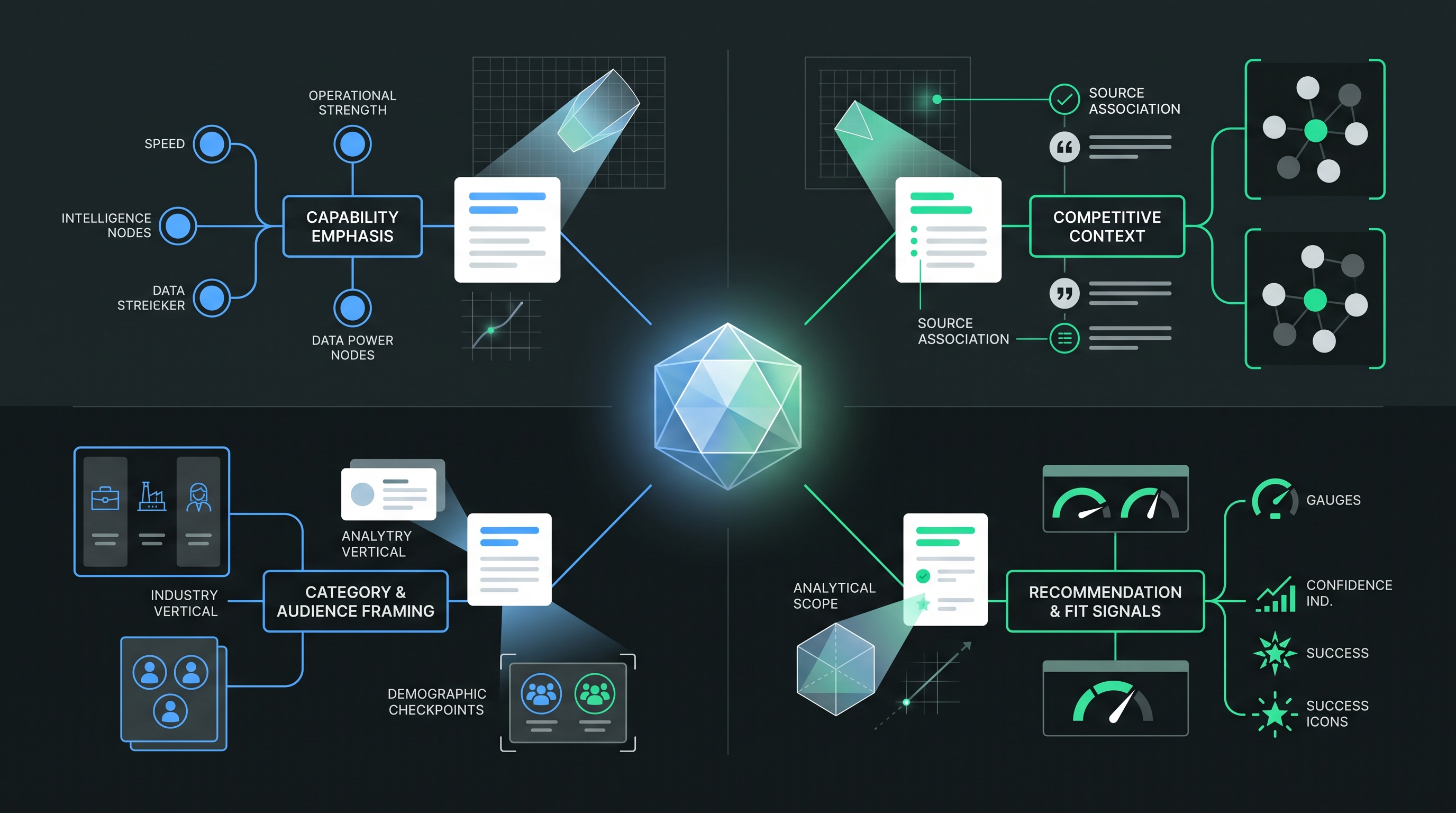
- Representation has several dimensions. Category, audience, capabilities, competitive framing, recommendations, currency and source associations can all matter.
- Citations are diagnostic evidence, not causal proof. A cited source does not automatically explain why an AI system produced an answer.
Editorial history: This Reference Entry consolidates Kojable's earlier AI Brand Alignment: What It Means and How to Apply It coverage, first published 5 July 2026, and How AI Representation Works, first published 10 August 2026, into the canonical AI Representation article first published 9 August 2026 and substantially updated 16 August 2026.
What is AI representation of a company?
AI representation is the observable pattern of how AI systems describe, categorise, compare, cite and recommend a company across relevant questions.
For a B2B company, that can include the category the company is placed in, the audience it is associated with, the capabilities mentioned or omitted, the competitors it is compared with, the sources attached to the answer and whether the company is recommended for a particular use case.
This article uses AI representation in that company-facing sense. It does not mean knowledge representation in computer science, representation learning in machine learning or representation engineering inside a model.
The distinction matters because representation is not a binary state. A company can appear in an answer and still be represented poorly. It might be assigned to an outdated category, described for the wrong audience or presented without the capability that makes it relevant to the buyer's question.
The practical question is therefore not only:
Did the company appear?
It is:
What did the answer communicate about the company, and does that pattern hold strongly enough to deserve action?
That is the measurement problem AI representation creates.
How is AI representation different from AI visibility and AI brand monitoring?
AI visibility concerns whether and how prominently a company appears. AI brand monitoring is the process of collecting observations over time. AI representation is the broader substance of what those observations communicate.
The concepts overlap, but they answer different questions.
| Concept | Main question | Example observation | Role |
|---|---|---|---|
| AI visibility | Did the company appear? | The company appeared in 7 of 10 eligible answers | Representation signal |
| AI brand monitoring | What is changing over time? | The same buyer questions are checked on a defined cadence | Measurement process |
| AI representation | What is being communicated? | The company appears, but its category is outdated and a key capability is missing | Object being evaluated |
| AI answer alignment | How well does that representation match current company reality and available evidence? | Recurring answers differ materially from verified positioning | Parent managed problem |
This distinction changes how a team interprets monitoring data.
A high mention rate does not establish that the company is being described accurately. A citation count does not establish that the right proof is being surfaced. A positive sentiment score does not establish that the company is being placed in the correct category.
Visibility is useful. Monitoring is necessary. Neither should be mistaken for a complete representation diagnosis.
Which parts of AI representation should teams evaluate?
A practical representation assessment should examine what the answer says, what it leaves out, how the company is framed and how consistently those patterns recur.
Entity and category accuracy
Start with the most basic question: has the AI system identified the correct company and placed it in an appropriate category?
Entity confusion can be obvious, such as mixing two similarly named companies. It can also be subtle. A company may be named correctly but repeatedly placed in an old category that no longer reflects its business.
The reference point should be current, verified company evidence rather than the frequency of an online description alone.
Audience framing
Check who the answer says the company is for.
A company that now serves enterprise buyers may still be associated with an earlier small-business audience. A specialist provider may be presented as a general-purpose product. These descriptions can be factually plausible while still being commercially incomplete.
The question is not whether every possible audience appears. It is whether the framing relevant to the tested buyer question reflects current reality.
Capability completeness
An answer can be accurate without being complete.
A company may be described correctly at a high level while the capabilities most relevant to the buyer's question are absent. That matters because omission can change the apparent fit between a company and a use case even when nothing in the answer is strictly false.
Capability completeness should therefore be assessed against the prompt's intent, not against a requirement that every answer reproduce the entire product catalogue.
Competitive framing
When AI systems compare companies, look at the criteria used to structure the comparison.
Which competitor is treated as the default choice? Which company is described as specialised? Which capabilities are used to distinguish them? Is the comparison based on current evidence, or does it reproduce an older category narrative?
Competitive framing is often more commercially useful to inspect than a simple positive-versus-negative sentiment label.
Recommendations
A recommendation is stronger than a mention.
Record whether the company is included, excluded or recommended conditionally for relevant buyer questions. Also record the criteria attached to that recommendation.
A company may have strong visibility but consistently appear as a secondary option because an important use case or proof point is missing from the answer.
Citations and observable sources
When an AI surface exposes citations or sources, capture them.
The useful questions are whether particular sources recur, whether they are current, what claims they contain and whether they are realistically actionable.
Do not jump from:
This source appeared with the answer.
to:
This source caused the answer.
Those are different claims.
Currency
Representation should be checked against what is true now.
Positioning, products, audiences, pricing and proof can change faster than the surrounding information environment. A description that was accurate two years ago may be outdated today.
Record the date of the observation so a baseline is treated as a dated measurement rather than a permanent statement about a model.
Consistency
Finally, look at whether the pattern recurs.
Differences across prompts, surfaces and collection dates are themselves useful information. A description that appears once is a different diagnostic signal from one that recurs across several commercially relevant questions.
Consistency is why a screenshot should not be treated as a complete representation assessment.
How should teams measure AI representation reliably?
Start with buyer-relevant questions, preserve the exact prompts and AI surfaces, collect comparable observations, and look for recurring patterns instead of treating one answer as definitive.
A useful baseline follows five practical stages: define, record, observe, compare and classify.
Define the questions that matter
Start with real decisions in the buyer journey.
For example, a company might need to understand its representation when a buyer is discovering a category, comparing vendors, checking fit for a specific use case or validating an important claim.
The goal is not to generate the largest possible prompt list. It is to create a panel that represents commercially meaningful questions.
A hundred vague prompts can produce less useful evidence than a smaller set tied to actual buyer decisions.
Record the conditions
For every observation, retain the exact prompt, AI product or surface, date and relevant mode or configuration.
"Tested on Gemini" or "checked ChatGPT" may be too broad if the product has different search, grounding or answer modes.
This detail matters because the evidence environment can vary by surface.
Kojable's Cross-Model Citation Study tested the same matched B2B questions across four provider stacks and observed very low overlap between their cited source sets. The practical implication for representation measurement is not that one provider has a permanent source preference. It is that the provider or surface being tested belongs in the measurement conditions.
The study used one observed run per provider-question cell. It therefore does not establish stable provider-wide source preferences or run-to-run persistence. Those limitations belong with the finding.
Observe the full answer
Do not record only whether the company appeared.
Capture the parts of representation relevant to the question: category, audience, capabilities, competitors, recommendation status, citations, apparent currency and any material inaccuracies or omissions.
The purpose of the baseline is to preserve enough evidence to understand the answer later, not merely to generate a score.
Compare like with like
Comparison requires a stable reference point.
If a prompt changes substantially, if the AI surface changes, or if a different counting rule is introduced, note the change rather than treating the two observations as automatically comparable.
There is no universal evidence-based rule that every company needs exactly the same number of prompts or runs. The appropriate panel depends on the decisions being tested.
Classify the observation
A practical classification can separate four states:
Direct observation: what appeared in the retained answer.
Recurring pattern: an observation that repeats across comparable checks.
Plausible association: a possible explanation supported by evidence but not established as causal.
Insufficient evidence: an interesting observation that does not yet justify a stronger conclusion.
That discipline prevents a single unexpected answer from turning immediately into an expensive content or positioning project.
What AI representation gaps should teams look for?
A representation gap is a meaningful difference between what the tested answer communicates and what current, verified evidence supports about the company.
Useful gap types include:
| Gap | What it can look like | What to verify before acting |
|---|---|---|
| Outdated positioning | The answer repeats an earlier category, product or audience | Current approved positioning and dated source evidence |
| Wrong category or audience | The company is placed in a segment it does not primarily serve | Current category and audience definitions |
| Missing capability | A capability relevant to the buyer's question is absent | Whether the capability is real, current and publicly evidenced |
| Generic representation | The description could apply to several competitors | Current differentiation and proof |
| Competitor confusion | A capability, audience or claim is attributed to the wrong company | Entity and source evidence |
| Missing proof | The answer omits evidence that materially affects fit or trust | Whether credible public proof exists and is relevant to the prompt |
These are diagnostic categories, not a statistically ranked list of the most common problems.
The useful prioritisation question is:
Does this gap recur, does it matter commercially, is the current evidence clear, and is there a realistic action available?
A small wording variation may not deserve intervention. A recurring wrong-category association across high-intent buyer questions probably deserves much closer examination.
What can citations and source patterns tell you about AI representation?
Citations and recurring source patterns are useful diagnostic evidence, but they do not by themselves prove that a source caused an answer, was the most influential input or was used in model training.
When a cited page contains the same outdated description that appears in an AI answer, that is worth investigating. When the same source recurs across several comparable observations, the pattern becomes more interesting.
But the evidence still supports:
This source recurred alongside the observed representation and may be relevant to the gap.
It does not automatically support:
This source caused the model to describe the company this way.
The distinction is important because several different processes can sit between an available source and a generated answer.
Kojable's research on GEO measurement and experimental design makes the same methodological point more broadly: observing the sources that were selected is not enough to establish why they were selected. Stronger claims about influence require a design that includes the relevant comparison opportunities and can identify the proposed effect.
For representation work, the practical use of source data is therefore diagnostic.
Ask whether a source is relevant, current, recurring, credible and actionable. Then decide whether it deserves further investigation.
Do not turn citation frequency into a hidden "influence score" unless the methodology actually supports that metric.
What should teams do after finding an AI representation gap?
Move from observation to diagnosis. Verify that the gap is meaningful, identify the evidence and source patterns associated with it, choose an intervention that fits the evidence, and retest comparable questions to assess what changed.
This is where AI representation connects to AI answer alignment.
At Kojable, the operating model is:
Monitor → Diagnose → Improve → Verify.
Monitor establishes the current representation baseline.
Diagnose identifies the gaps that recur, the evidence associated with them and the likely drivers worth investigating.
Improve converts the diagnosis into a specific action. That might mean updating an owned page, clarifying positioning, adding missing proof, correcting a third-party description or taking another justified action. "Publish more content" is not a diagnosis.
Verify means retesting comparable questions and comparing the new observations with the baseline.
Verification has its own evidence boundary. If an answer changes after an intervention, the change is observable. That does not automatically prove that the intervention caused the difference. Repeated comparable movement under a stronger design supports stronger conclusions.
The objective is not to control a third-party AI system. It is to understand the representation well enough to make justified improvements to the information environment and measure what changes afterwards.
Frequently asked questions about AI representation
What is AI representation?
AI representation is the observable pattern of how AI systems describe, categorise, compare, cite and recommend a company across relevant questions. It includes not only whether the company appears, but what is said about its category, audience, capabilities, competitors, evidence and suitability for a particular use case.
Is AI representation the same as AI visibility?
No. AI visibility measures whether and how prominently a company appears in relevant AI-mediated discovery. AI representation is broader. A company can have high visibility while being described inaccurately, incompletely or in an outdated competitive context. Visibility is therefore one signal within representation rather than a substitute for it.
How should a company measure AI representation?
Start with a defined set of buyer-relevant questions. Record the exact prompt, AI surface, date and observation conditions. Assess the resulting answers for category and audience accuracy, capability completeness, competitive framing, recommendations, citations, currency and consistency. Look for recurring patterns across comparable observations rather than treating a single answer as representative.
Does a cited source cause an AI answer?
A citation does not by itself prove that the source caused the answer. It shows an observable source relationship in that answer context. Source recurrence can be useful evidence for diagnosis, but stronger claims about influence require stronger evidence. A visible citation also does not establish that the source was used in model training.
Start with the current representation
The most useful first step is not to optimise every page or produce more content. It is to establish what AI systems currently communicate about the company across the buyer questions that matter.
That baseline gives the team something concrete to diagnose, improve and retest.
Ready to establish your current baseline? Run your free AI brand audit.