Kojable Blog reference entry
AI Citations: What They Are, How They Work, and How to Measure Them
AI citations are observable source attributions in AI-generated responses.
Category AI Search Guides
Also known as AI citations, AI source citations, Generative AI citations
AI citations are observable source attributions associated with AI-generated responses. They show which sources were exposed alongside an answer under defined conditions, but they do not by themselves prove that a page was fetched, that a source caused a claim, that the evidence supports every statement, or that the source was endorsed. Useful citation analysis therefore separates citation presence, retrieval, grounding, relevance, support, source composition, position and recommendation, then measures each with the appropriate unit and denominator.
Editorial history: This Reference Entry was first published on 8 August 2026. This update incorporates relevant concepts from Kojable’s earlier Factual Grounding coverage, first published 10 April 2026, and AI Citations Meaning, first published 7 August 2026. It also incorporates subsequent Kojable Research and connects this broader citation framework with the specialist Citation Position in AI Answers Reference Entry, first published 11 August 2026.
01 · Definition
What are AI citations?
An AI citation is an observable attribution between a source and an AI-generated response, captured for a defined prompt, platform or surface, run and point in time.
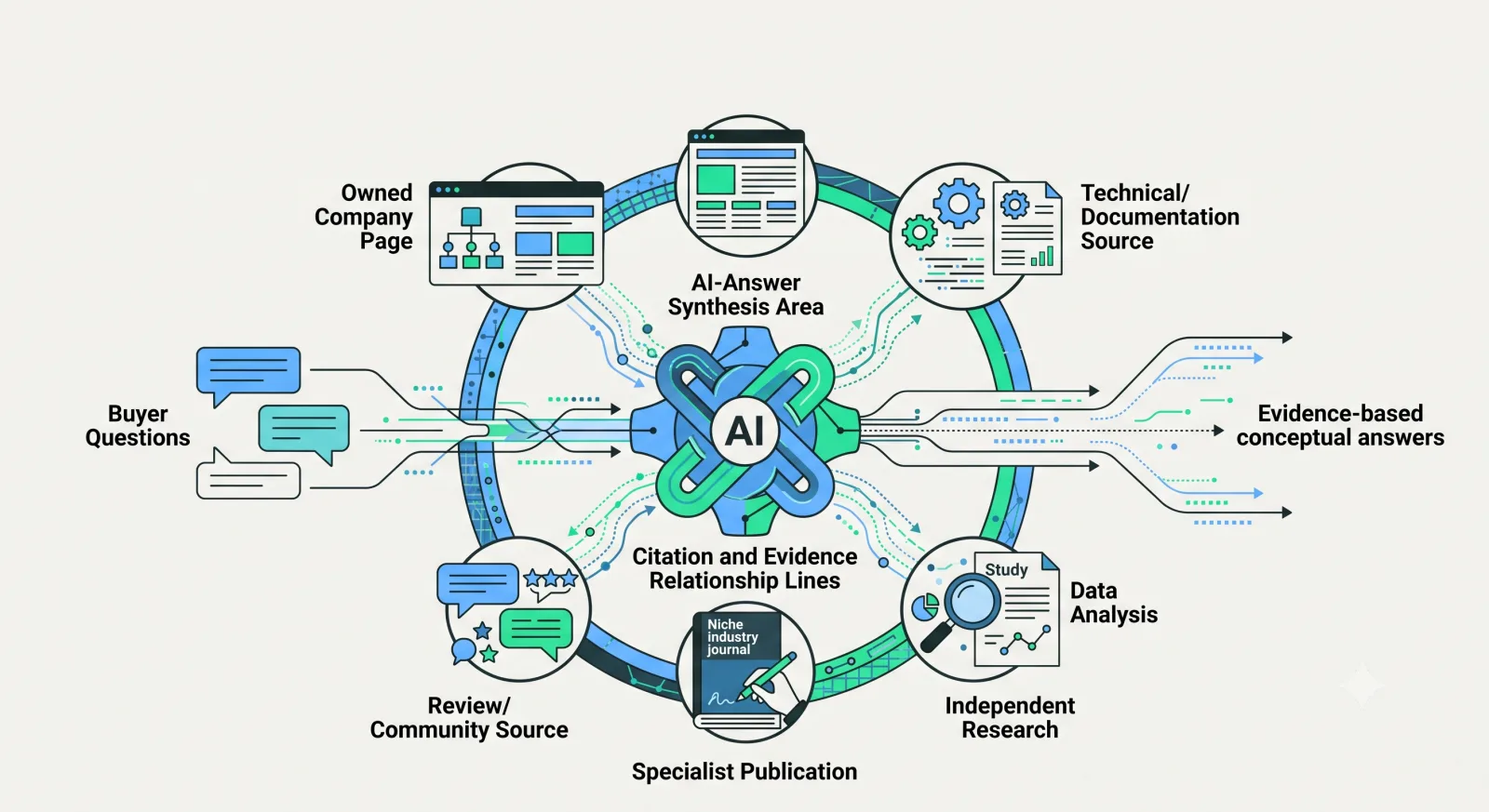
That definition is deliberately narrow.
If an answer cites a company website, documentation page, research article, review, community discussion or another source, the citation establishes that the source was visibly attributed in the recorded output. It does not expose the complete process that produced the answer.
This is also different from citing AI-generated content in an academic paper. Here, AI citation means a source attribution presented by an AI answer system.
The distinction matters because citation analysis can become too ambitious too quickly. A team sees a source link and concludes that the source influenced the model, earned its trust or caused a statement to appear.
Those conclusions require more evidence than the citation itself supplies.
The better starting question is:
What source was visibly attributed, around which answer or claim, under which conditions?
Everything stronger should be evaluated separately.
02 · Evidence objects
How do AI citations differ from mentions, retrieval, grounding and backlinks?
AI citations sit beside several related concepts, but they should not be treated as interchangeable.
| Object | What it describes | What it does not automatically prove |
|---|---|---|
| AI citation | A visible or recorded source attribution associated with an AI response | That the source caused or determined the answer |
| Brand mention | A company, product or entity appears in the generated response | That the company’s website or evidence was cited |
| Retrieval or search result | A source or result appears in a search or retrieval layer | That it became a visible citation in the final answer |
| Grounding or support | A product-specific relationship between generation and supplied or retrieved evidence | That every grounding source was shown to the user |
| Backlink | A hyperlink from one web page to another | That an AI system retrieved, used or cited the destination |
| Citation share | A proportion calculated from a declared citation-related unit | Anything interpretable until its denominator is defined |
A brand mention and a citation therefore answer different questions.
An AI answer can mention a company without citing that company’s website. It can also cite company documentation while giving the company little narrative prominence.
Grounding is broader again. Kojable’s earlier Factual Grounding coverage focused on whether generated claims remain supported by a defined evidence boundary. That concept remains useful, but grounding should not be reduced to “a citation exists”.
A response can expose a citation without proving that the cited evidence supports every claim. Equally, a system can use supplied or retrieved information without exposing every supporting source as a visible citation.
The practical rule is:
Measure the object you actually observed. Do not rename an observable citation as hidden retrieval, grounding, influence or support.
03 · Platform mechanics
How do citation systems differ across AI platforms and surfaces?
There is no single citation architecture shared by ChatGPT, Gemini, Google Search features, Claude and Perplexity.
Even products from the same provider can expose different source objects.
| Surface | What may be observable | Measurement caution |
|---|---|---|
| ChatGPT Search | Search-enabled answers may contain inline citations; a Sources panel can also expose cited sources and other relevant links | Do not assume every Sources-panel URL is an inline citation |
Gemini generateContent with Google Search grounding | Final answer plus separate grounding metadata, including mappings between answer segments and source chunks | Grounding metadata and visible citation presentation are different objects |
| Gemini Interactions API | Search calls and search results can appear as separate execution steps, while final output can contain source annotations | Record the exact API and response object captured |
| Google AI Overviews / AI Mode | AI-generated Search responses with supporting links; both can use query fan-out | Treat AI Overviews and AI Mode as separate surfaces |
| Claude web search | Search-result objects and cited final-response content | A returned search result is not automatically a final citation |
| Perplexity Search API | Ranked structured web results | This is retrieval output, not an LLM-generated cited answer |
| Perplexity Agent API | Generated web-grounded responses with citations | Keep this separate from raw Search API results |
OpenAI’s current ChatGPT Search documentation says search-enabled responses may contain inline citations and that the Sources panel can include cited sources plus other relevant links.
Google exposes an even clearer structural distinction. Its generateContent API can return separate grounding metadata and support mappings, while the newer Interactions API separates search calls and results from citation annotations in the final output.
Anthropic similarly exposes web-search result objects separately from citations in the final Claude response. Perplexity explicitly distinguishes retrieval-oriented Search API results from generated answers with citations.
The practical implication is simple:
Do not report “ChatGPT citations”, “Gemini citations” or “Perplexity citations” without identifying the exact product or surface and capture method.
04 · Evidence boundary
What can an AI citation prove?
One narrow thing:
A source attribution appeared in the recorded answer under the tested conditions.
That is meaningful evidence. It is also much less than a complete explanation of why the answer occurred.
A visible citation does not establish that the source:
- caused a statement;
- was the system’s most influential input;
- is trusted by the model;
- appeared in model training;
- generated a click;
- created buyer trust;
- or affected a commercial outcome.
The earlier AI Citations Meaning article was right to distinguish citations from mentions and to treat recurring sources as more useful diagnostically than a one-off appearance.
The stronger conclusion, that recurrence proves a source is shaping or influencing the answer, should not carry forward.
A recurring source is a stronger diagnostic pattern than a one-off source. It gives the team something worth investigating, but recurrence alone does not prove causal influence.
For example, suppose an outdated directory repeatedly appears around answers that describe a company using old positioning.
That combination deserves attention.
The next question is not “Did this directory cause the answer?” It is:
What does the page say, what does the answer say, how often does the pattern recur, and does the wider public evidence contain the same gap?
05 · Volume and support
Does more citation volume mean better evidence?
No. Citation volume, material-claim citation coverage and evidentiary support answer different questions.
Kojable’s Citation Volume vs Support research compared several layers that are often compressed into the vague phrase “citation quality”.
| Measurement | What it asks | Typical analytical unit |
|---|---|---|
| Citation intensity | How citation-heavy is the answer? | Visible citation events per 1,000 answer words |
| Material-claim citation coverage | Did identified material claims have an observed citation placement? | Material claim |
| Reviewed support | Does the reviewed evidence directly or partially support its mapped claim? | Reviewed claim-citation relationship |
The study found that the ordering produced by visible citation density did not reproduce the ordering seen in reviewed direct support.
More citation markers did not automatically mean better-supported evidence.
That does not mean fewer citations are better. It means raw count cannot answer questions it was never designed to answer.
Support review also needs its own denominator. In the Kojable study, 120 of 1,298 mapped claim-citation relationships were reviewed, approximately 9.2% of the mapped set.
The reviewed-support results describe the rated relationships under the study design. They are not provider-wide factual-accuracy scores.
If you want to know how often citations appeared, measure citation participation.
If you want to know whether important claims were visibly cited, measure claim coverage.
If you want to know whether the evidence supports a claim, inspect the relationship between the claim and the cited evidence.
06 · Access and extraction
Do AI citations prove content access and extraction?
No. A visible final citation does not establish that the live page was fetched, parsed and converted into usable text during the historical generation event.
Kojable’s Content Access and Extraction research examined a historical citation dataset containing final answer text and emitted citation URLs.
The retained output did not contain internal fetch attempts, HTTP outcomes, parser traces, extracted page text, passage segmentation or rejected candidates.
Historical page access and extraction therefore could not be established from final citation output alone.
That limitation is not a weakness to hide. It is the finding.
So:
citation URL ≠ fetch log
and:
citation breadth ≠ extraction volume
A team can still inspect the cited page now. It can check whether the information is current, whether the relevant evidence exists and whether the page reflects the company’s current positioning.
What it should not do is convert that current inspection into a retrospective claim that the platform definitely fetched that live page in a particular way.
07 · Source composition
Which sources appear in final AI citations?
Final citation portfolios can contain several overlapping source families.
Kojable’s Source Composition research identified recurring groups including:
- brand-owned sources;
- comparable-vendor sources;
- official documentation;
- community material;
- and a wider third-party long tail.
The mix varied by platform and buyer-question context.
The important conclusion is not that one source family “wins”.
Frequency is also not authority.
For practical diagnosis, evaluate a recurring source across separate dimensions.
Relevance: Does the source actually address the buyer’s question?
Currentness: Is the information still accurate?
Support: Does the source support the claim appearing around it?
Authority: Is this an appropriate source for this particular assertion?
Ownership: Is it owned, earned or independent?
Actionability: Is there a realistic and legitimate way to improve or correct the evidence?
Authority and actionability are not the same thing.
Do not treat every cited source as equally actionable.
08 · Passage relevance
Do final AI citation passages match the query?
Sometimes there is enough observable evidence to test passage relevance separately from citation presence.
Kojable’s Passage Semantic Relevance research analysed a selected subset of Gemini citations where text-fragment pointers exposed passage-like text associated with the final citation.
Under an analyst-created matched comparison, the selected fragments aligned more strongly with their own prompts than with plausible alternatives.
Observable selected passages in that subset showed query-specific semantic alignment.
It does not prove Gemini’s internal relevance score, candidate set, threshold or reranking method.
The analysis observes final survivors, not rejected candidates.
When the data allow it:
Do not stop at “this domain was cited”. Read the evidence associated with the question.
09 · Position and recommendation
Does citation position mean endorsement or recommendation?
No. Citation position tells you where a source appears in the observed answer structure.
That is measurable. It is not the same as endorsement.
The specialist Citation Position in AI Answers Reference Entry goes deeper into citation rank, entity visibility, narrative position, prompt intent and recommendation. For the broader AI citation framework, the key distinction is:
source included → citation position → entity included → narrative position → comparative framing → explicit recommendation
Each is a different observation.
Kojable’s Citations Not Endorsements research tested the stronger downstream question directly.
In its eligible population, 25 positive recommendation events occurred among 1,576 response-entity candidates.
Rank-1 source entities did not show a credible recommendation advantage over entities at Ranks 3 to 5 on the available evidence.
That does not prove citation position can never matter. The study was observational, recommendation events were sparse, and the analysed population was restricted.
If recommendation matters, measure recommendation directly. Do not infer it from citation rank.
10 · Answer readiness
Can AI-cited evidence support a clean final answer?
A clean final answer can look specific, direct and well cited without revealing the quality of every upstream evidence decision.
Kojable’s Answer Readiness research distinguishes the observable final answer from the unobserved population of candidate or finalist passages.
In the historical dataset, final cited answers frequently satisfied analyst-created surface proxies for being standalone, answer-first and specific.
But those properties were observed after generation. They are not passage-level readiness pass rates.
The historical export also lacked the full finalist population, rejected finalists and exact claim-to-passage mappings needed to prove that every citation supported every nearby claim.
Fluency is not the same as evidentiary support.
| Property | Question |
|---|---|
| Answer presentation | Is the final answer clear and specific? |
| Citation presence | Were sources visibly attributed? |
| Passage relevance | Does the cited material address the query? |
| Claim support | Does the evidence actually support the mapped claim? |
11 · Measurement
How should AI citations be measured?
Start with the decision you want the metric to support. Then define the analytical unit before calculating the percentage.
| Metric | Formula | Question answered |
|---|---|---|
| Citation participation rate | Responses containing at least one captured citation ÷ all eligible responses | How often did eligible answers contain a citation? |
| Domain cited-response rate | Responses citing domain X ÷ all eligible responses | How broadly did this domain appear across answers? |
| Citation-link share | Eligible citation links to X ÷ all eligible citation links | What share of captured links went to this source? |
| Citation occurrence count | Total captured citation occurrences under a declared rule | How much citation activity occurred? |
| Unique cited URLs | Distinct URLs after a documented normalisation rule | How broad was the final URL set? |
| Source overlap | Intersection of two defined source sets ÷ union of those sets | How similar were source sets across runs or groups? |
| Citation intensity | Citation events ÷ answer words, often normalised to 1,000 words | How citation-heavy was the response? |
| Material-claim citation coverage | Eligible material claims with observed citation placement ÷ eligible material claims | Were important claims visibly cited? |
| Reviewed direct support | Reviewed mapped relationships labelled direct support ÷ reviewed mapped relationships | Did reviewed evidence directly support the mapped claim? |
| Recommendation rate | Explicit recommendation events ÷ eligible recommendation-intent response-entity candidates | How often was the entity explicitly recommended? |
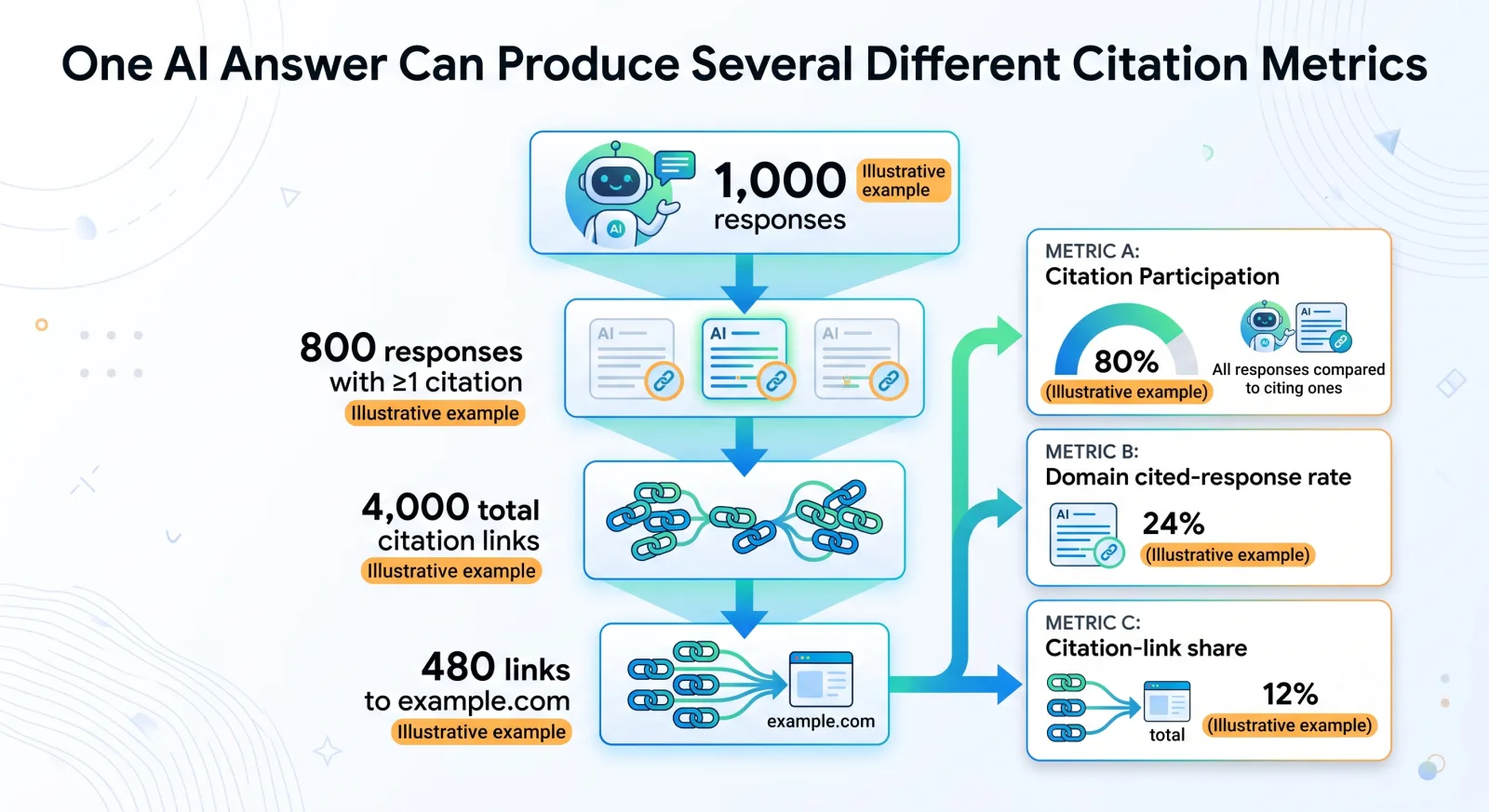
The phrase citation share is incomplete on its own.
For every public metric, retain:
- numerator;
- denominator;
- analytical unit;
- eligibility rule;
- exclusions;
- aggregation rule;
- collection period;
- platform or surface;
- and capture method.
That information determines what the number means.
12 · Citation exposure
How common are visible AI citations?
Visible citation exposure can be high in search-enabled AI environments, but citation prevalence should not be treated as one permanent property of an AI platform.
Kojable’s multi-month citation-exposure research analysed more than 55,000 responses across ChatGPT, Gemini and Perplexity under defined monitoring conditions.
The study found material differences between platform and query contexts.
The exact study result should not be converted into a universal benchmark such as “AI answers cite sources X% of the time.”
A citation rate only becomes interpretable when its platform, surface, prompt set, observation period, run design, capture method, numerator and denominator are known.
Use platform citation benchmarks as study-specific context, not permanent expectations for your own prompts.
13 · Comparability
Why do AI citation statistics conflict?
Two citation studies can report different numbers without either being wrong. The discrepancy can come from materially different measurement designs.
Platform and surface
ChatGPT Search, Gemini APIs, Google AI Overviews, AI Mode, Claude web search and Perplexity products do not expose one universal citation object.
Prompt set and intent
A technical documentation question creates a different evidence environment from a vendor comparison, current-news question or broad educational query.
Time
Source availability, model behaviour, search systems and product interfaces change.
Run count
One run should not be mistaken for a stable citation ranking.
Denominator
Response-level citation participation is not citation-link share. Source-family exposure is not domain share. Claim coverage is not reviewed support.
Capture method
Browser-visible citations, Sources-panel URLs, API result objects, extracted links, grounding metadata and parsed source annotations can create different datasets.
A minimum comparison record should retain:
platform, surface, exact prompt, intent, date, run, denominator, capture method, geography or account context where material, and model/version when known.
14 · Operating framework
What practical AI citation framework should teams use?
Citation data becomes useful when it helps a team make a better decision. The practical process is Monitor → Diagnose → Improve → Verify.
Monitor
Start with buyer-relevant questions rather than generic citation hunting.
Record the exact prompt, platform and surface, date, run, answer, company mention, recommendation status, citation presence, cited URLs, competitors and capture method.
Diagnose
Read the answer and cited evidence together.
Ask whether the source is relevant, current, supportive, appropriate for the claim, recurring, competitor-framed or part of a wider evidence gap.
A recurring source pattern deserves more attention than a one-off appearance, but recurrence is still a pattern, not causal proof.
Improve
Act on the diagnosed gap, not on citation presence by itself.
Update inaccurate owned evidence, add missing proof where it belongs, correct realistic third-party gaps and use legitimate corroboration paths.
The objective is not “get more citations”.
Improve the information environment relevant to the buyer question.
Verify
Retest comparable prompts after the work is carried out.
Compare the new answer with the baseline and record what changed across description, category framing, entity inclusion, recommendation, citations, source composition, competitor framing and factual gaps.
A before-and-after difference is an observation. It is not automatically proof that one intervention caused the change.
Example: an outdated positioning pattern
Suppose an AI answer describes a software company as serving small businesses and cites an older announcement containing that positioning.
The first diagnosis should not be “This citation caused the answer.”
Inspect the wider evidence environment.
If the current website clearly describes an enterprise offer, independent sources reflect the new positioning and the old announcement appears only once, the citation may be a weak or transient signal.
If current product pages contain limited enterprise proof, several directories still use the old description and the same framing recurs across buyer questions, the problem is broader.
The justified response is to improve the controllable evidence, address realistic third-party gaps and retest.
15 · Limits and conclusion
What are the limits and the bottom line?
AI citations are useful because they expose part of the evidence environment around an AI answer. They are limited because they expose only part of that environment.
A citation can tell you that a source attribution appeared.
It cannot, by itself, tell you every document considered, every page fetched, every passage extracted, how evidence was weighted, whether another uncited source mattered more, whether the model “trusted” the source, whether the source was endorsed, or whether changing the page will change the next answer.
Do not optimise citation count while answer accuracy deteriorates.
Do not call a source authoritative merely because it recurs.
Do not call citation rank endorsement.
Do not infer content access from a final URL.
Do not treat a polished answer as proof of claim-level support.
Use citations to identify evidence worth investigating. Measure the question you actually care about. Improve justified information gaps. Retest comparable questions.
Quick answers
Frequently asked questions
What is the difference between an AI citation and an AI mention?
A mention means a company, product or entity appears in the generated answer. A citation means a source was visibly attributed. A company can be mentioned without its website being cited, and a company source can be cited without the company receiving meaningful narrative prominence. Measure mention rate and citation rate separately.
Is an AI citation the same as grounding?
No. Grounding is a broader, product-specific relationship between generation and supplied or retrieved information. A citation is an observable attribution exposed in or alongside the output.
Does an AI citation prove the page was accessed?
No. A final citation URL does not by itself establish whether the live page was fetched, what representation was retrieved, how it was parsed or what text entered context. See Kojable’s Content Access and Extraction research.
Are more AI citations better?
Not automatically. Citation count measures visible citation activity. It does not tell you whether important claims are cited or whether the evidence supports those claims. See Kojable’s Citation Volume vs Support research.
Does citation position mean the source is endorsed?
No. Citation position is an observable placement metric. Endorsement or recommendation is a separate outcome. See Citation Position in AI Answers and Kojable’s Citations Not Endorsements research.
What is AI citation share?
AI citation share is a proportion based on a declared citation-related unit. It is not interpretable until the numerator and denominator are specified.
How do you calculate an AI citation rate?
One useful response-level metric is:
citation participation rate = eligible responses containing at least one captured citation ÷ all eligible responses
Other metrics require different denominators.
Why do ChatGPT, Gemini, Claude and Perplexity cite different sources?
They expose different search, grounding, generation and citation systems. Results can also vary with prompt intent, time, run and capture method.
How often should AI citations be monitored?
There is no universal cadence. Monitoring frequency should reflect the commercial importance of the buyer questions, observed answer and citation volatility, and whether important evidence or positioning recently changed.
Measure your own AI citation baseline
Generic benchmarks can provide context, but the questions your buyers actually ask are the measurement set that matters.
Kojable is an AI answer alignment platform for B2B companies. It helps teams monitor how AI systems represent the company, diagnose recurring answer and evidence gaps, guide practical improvements, and retest comparable questions to verify what changed.
Monitor → Diagnose → Improve → Verify
The next step is to establish your own AI representation baseline, then identify which citation and evidence patterns actually deserve action.