Kojable research · Decision 6 · Passage semantic relevance
Do Final AI Citation Passages Match the Meaning of the Query?
Selected Gemini citation fragments align much more strongly with their own queries than with plausible matched alternatives, but final-output alignment does not reveal the hidden relevance gate that produced those survivors.
Key finding
Selected citation fragments ranked first against five matched alternatives about 54% of the time under the primary semantic proxy, versus roughly 17% expected by chance.
Qualification: The analysis measures selected final-output fragments, not Gemini's internal candidate set, relevance score, threshold or rejected passages.
- Passage relevance
- Matched-decoy analysis
- Gemini citation fragments
- 14 min read
Study overview
Executive summary
A citation can point to a relevant page while still failing to identify text that meaningfully answers the user's question. Decision 6 moves from page-level evidence to a more demanding test: whether passage-like text selected in a final AI citation matches the meaning and information need of the originating query.
For a selected subset of Gemini citations, emitted URLs contain browser text-fragment pointers that identify text on the cited page. We decoded those final-output anchors and compared each fragment with its own prompt and with five contextually plausible matched alternatives.
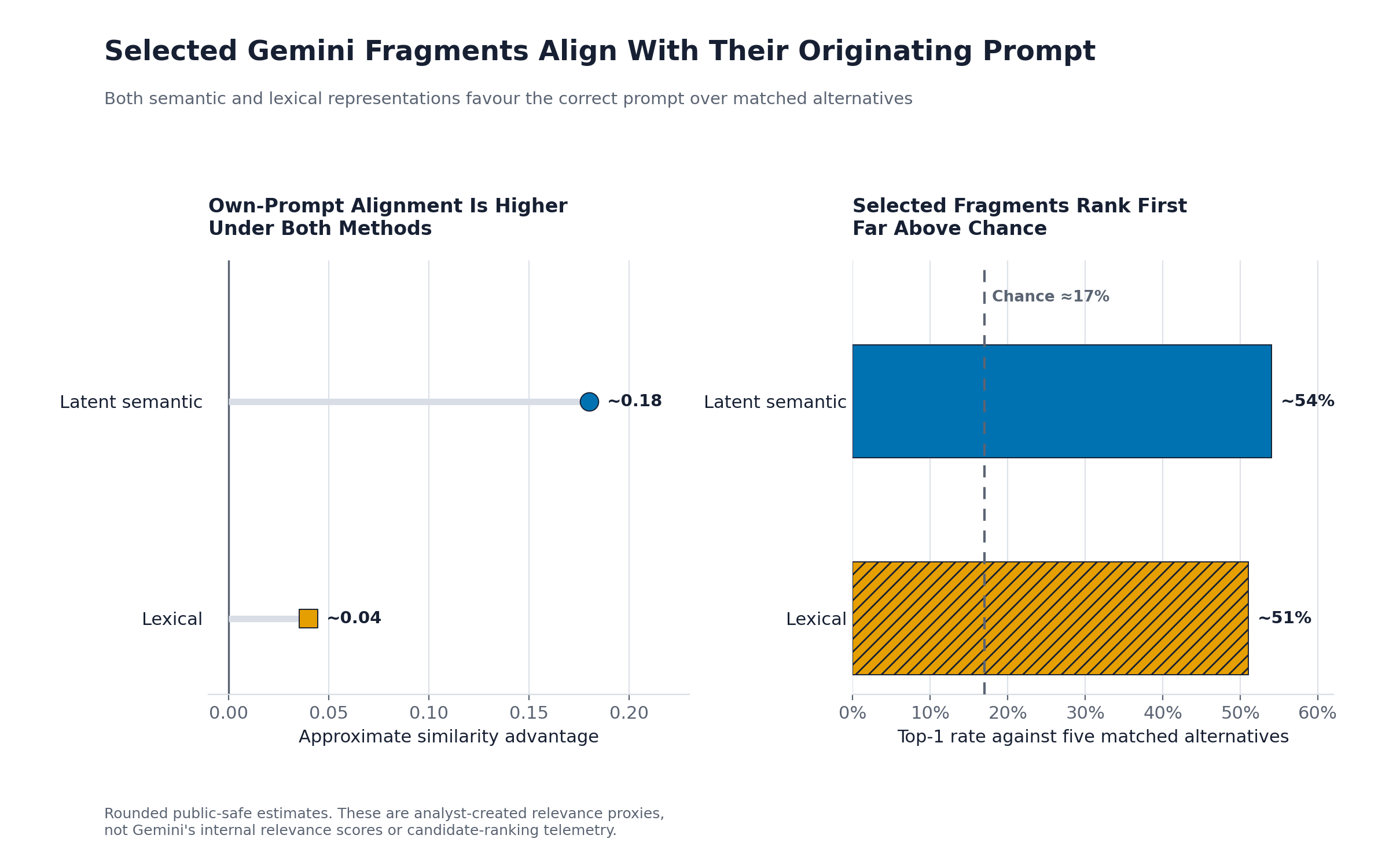
Across roughly 6,000 usable Gemini prompt-fragment pairs representing around 300 distinct prompt templates, own-prompt similarity was approximately 0.27 under the primary analyst-created latent-semantic representation, compared with approximately 0.09 for matched decoys. The alignment advantage was therefore about 0.18.
The selected fragment ranked first against five matched alternatives in roughly 54% of template-level comparisons, versus approximately 17% expected by chance. A simpler analyst-created lexical representation produced a smaller advantage of about 0.04 and a top-1 rate of roughly 51%, pointing in the same direction.
Selected Gemini citation fragments show strong query-specific semantic alignment, but the platform's internal candidate-level relevance gate remains unproven.
Direct answer
Do passage-like fragments selected in final AI citations match the query that produced them?
-
Yes, for the observable Gemini subset
Selected fragments are materially more aligned with their own prompts than with plausible matched alternatives. But this final-output result does not prove Gemini's hidden candidate-level semantic-relevance gate, threshold, reranker or causal selection process.
Research lineage
Decision 6 moves the citation diagnostic to passage meaning
-
Decision 1
Retrieval need and citation exposure: when is a visible citation more likely to appear?
-
Decision 2
Buyer-question type and citation exposure: how does query context change the pattern?
-
Decision 3
Ecosystem source availability: did citable material exist elsewhere when one platform missed?
-
Decision 4
Selected-source composition: which source families survive into final citations?
-
Decision 5
Content-access and extraction observability: why does final citation output not prove historical fetch and extraction?
-
Decision 6
Passage-level semantic alignment: when selected text is observable, does it match the meaning of the query?
A source can exist, be accessible and be cited while the selected passage remains poorly matched to the buyer's question. Semantic relevance is therefore a separate diagnostic stage.
Interpretation boundary
Three claims must remain separate
- Final-output alignment
- Supported for the selected Gemini fragment subset. Selected citation text is more aligned with its own query than with matched alternatives.
- Internal relevance-gate validity
- Not directly observed. Rejected passages, internal scores, thresholds and pass-or-fail decisions are unavailable.
- Causal selection
- Not established. The study cannot show that semantic relevance caused selection rather than authority, source quality, duplication control, policy, answer readiness or another downstream factor.
Observable passage proxy
Passage-like evidence exists only for a selected Gemini subset
Most final citations expose only a page or URL. Some Gemini citation URLs in the observed export contain browser text-fragment directives that point to selected text on the cited page. These anchors are more passage-like than ordinary URLs, but they do not establish the full passage considered internally, the text placed in model context or the candidate text evaluated by a reranker.
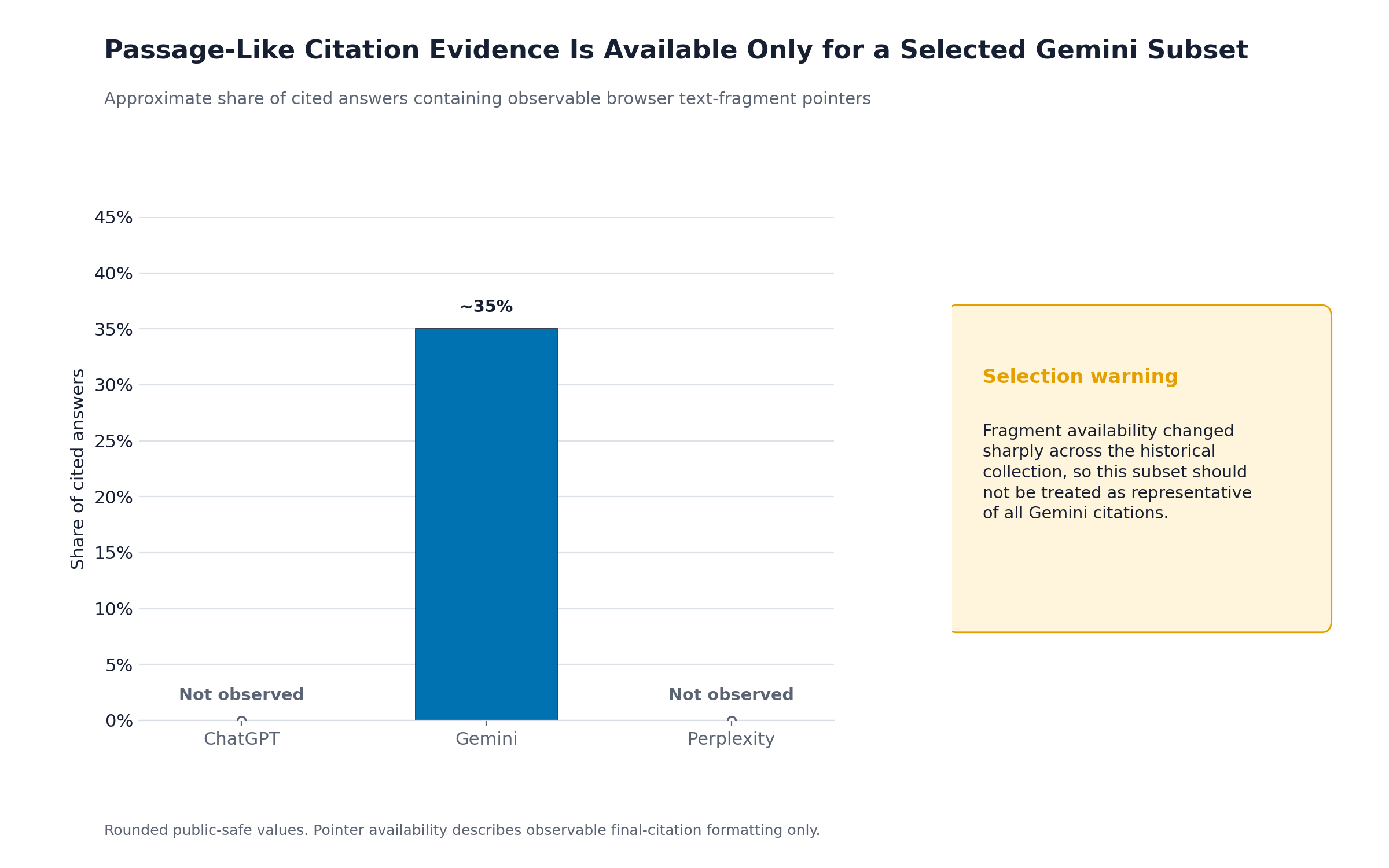
| Platform | Passage-like text-fragment evidence |
|---|---|
| ChatGPT | Not observed in this export |
| Gemini | ~35% |
| Perplexity | Not observed in this export |
Method
Matched alternatives create a demanding benchmark
A raw similarity score has no universal meaning across text representations or corpora. Decision 6 therefore uses a relative matched-decoy test focused on final-output query specificity.
-
Pair the survivor
Each selected fragment is paired with the originating prompt that produced the final citation.
-
Choose five alternatives
The fragment is compared with five fragments associated with different prompt templates.
-
Keep decoys plausible
Matching prefers comparable buyer-question and collection context, creating a harder negative control than unrelated text.
-
Test specificity
The analysis asks whether selected final-output text matches its own query more strongly than plausible wrong prompts.
The decoys are analyst-created controls. They were not observed as Gemini candidates and cannot be described as passages Gemini rejected.
Main quantitative result
Two text representations point in the same direction
The primary analysis uses an analyst-created latent-semantic text representation that captures broader word and phrase co-occurrence. Own-prompt similarity is approximately 0.27, versus approximately 0.09 for matched decoys—an advantage of about 0.18.
A secondary analyst-created lexical word-and-phrase representation produces a smaller alignment advantage of about 0.04. The selected fragment ranks first against five matched alternatives about 54% of the time under the semantic representation and about 51% under the lexical representation, compared with roughly 17% expected by chance.
| Representation | Approx. alignment advantage | Approx. top-1 rate |
|---|---|---|
| Latent semantic | ~0.18 | ~54% |
| Lexical | ~0.04 | ~51% |
| Chance benchmark | — | ~17% |
Interpretation: These are analyst-created relevance proxies applied to selected final citation fragments, not internal Gemini ranking scores. The meaningful result is comparative rather than a universal relevance threshold.
Buyer-question consistency
All five well-covered query categories show positive alignment
The aggregate result is not driven by one major buyer-question category. Every well-covered category shows positive own-prompt versus matched-decoy latent-semantic alignment.
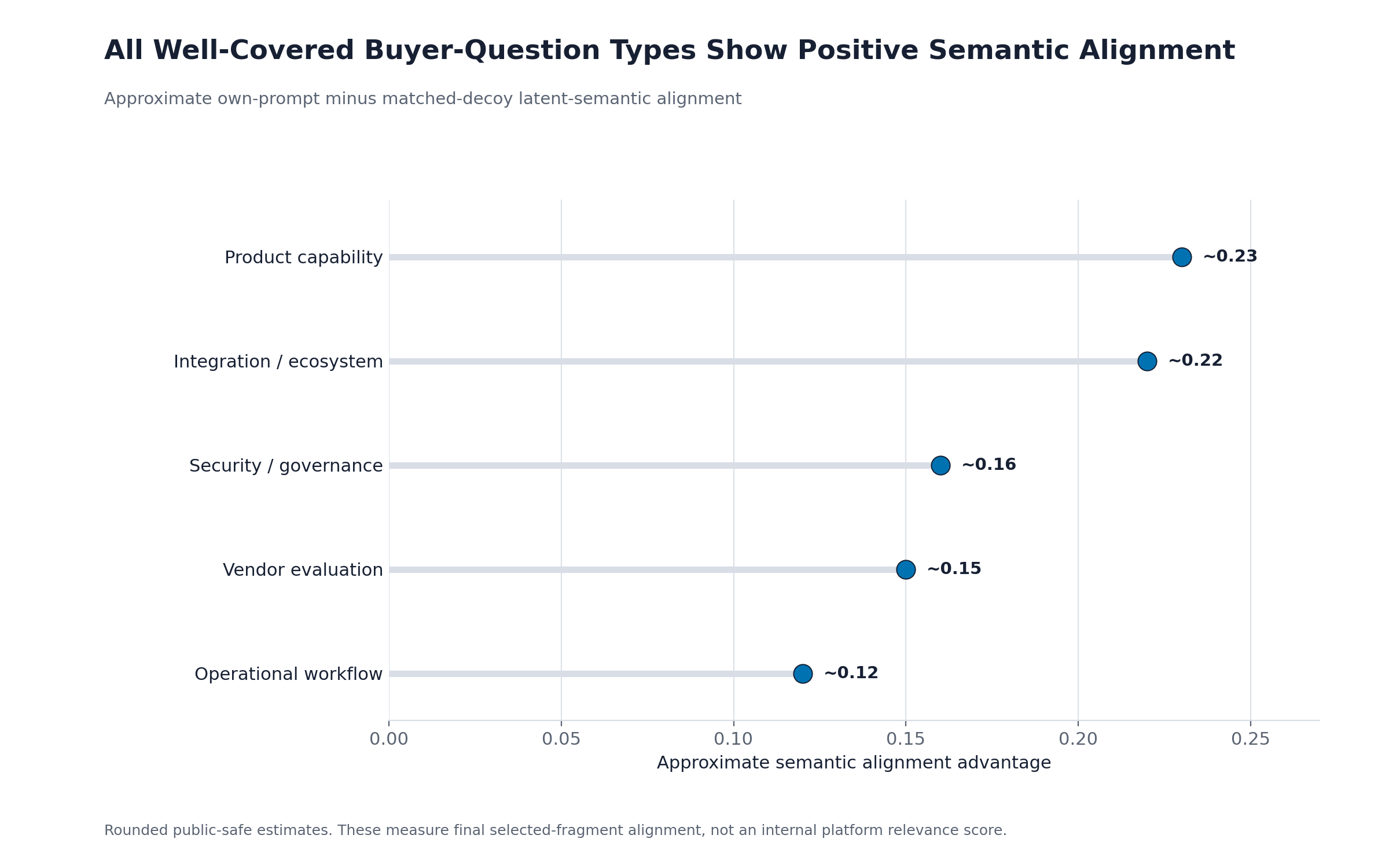
| Buyer-question type | Approx. semantic alignment advantage |
|---|---|
| Product capability | ~0.23 |
| Integration / ecosystem | ~0.22 |
| Security / governance | ~0.16 |
| Vendor evaluation | ~0.15 |
| Operational workflow | ~0.12 |
The important result is that all five well-covered categories are positive, not that their exact ordering represents a durable ranking. Narrower query types do not have enough fragment-covered evidence for strong route-specific conclusions.
Robustness
Longer observable fragment text does not reverse the result
The positive semantic separation remains as the minimum amount of decoded fragment text increases and generally becomes stronger. Longer anchors give the analyst-created representation more evidence about what the cited text discusses.
This is a robustness check, not evidence of a hidden platform threshold. Fragment length is itself selected and may vary with query type, source type, answer format, interface behaviour or other unobserved factors.
Measurement boundary
Final-output relevance does not prove the hidden relevance gate
Highly relevant selected fragments tell us something important about the final output. They do not reveal how those fragments arrived there. Final citations may reflect semantic relevance, source authority, quality, freshness, duplication control, policy, formatting, answer usefulness and presentation logic.
Decision 6 does not measure Gemini's relevance model, does not show that Gemini uses either analyst-created representation and does not establish a reranker or threshold. The matched decoys are not observed candidates and were not observed being rejected by Gemini.
Missing denominator
We observe selected fragments, not the candidate population
The study begins at the final emitted citation. Rejected candidate passages are missing. This is survivor bias: we see passages that made it through the system, but not the population from which they were selected.
Without rejected candidates, the analysis cannot estimate sensitivity, specificity, false-positive rates, false-negative rates, threshold calibration, candidate-survival odds or the causal effect of semantic relevance on selection.
Supported conclusions
What Decision 6 establishes
-
A testable passage proxy
Gemini text-fragment pointers expose a selected-text proxy for a subset of final citations.
-
Material own-prompt alignment
Under the primary semantic representation, own-prompt similarity is roughly three times the matched-decoy level.
-
Identification above chance
Selected fragments rank first against five alternatives about 54% of the time, versus approximately 17% by chance.
-
Independent directional support
A simpler lexical analysis confirms the direction of the main result.
-
Breadth across major categories
All five well-covered buyer-question categories show positive semantic alignment.
Claim boundary
What Decision 6 does not establish
-
Internal ranking mechanics
The study does not observe Gemini's internal relevance score, candidate set, reranker, threshold or rejected passages.
-
Causal selection
It does not show that semantic relevance caused a citation to survive rather than another source or answer-quality factor.
-
Complete retrieved passage
A decoded text fragment may not equal the complete passage retrieved or placed in model context.
-
Cross-platform generalisation
The result does not apply to ChatGPT, Perplexity or Gemini citations without observable text-fragment evidence.
-
Evidence quality
Passage relevance does not prove authority, quality, completeness or answer readiness.
Required telemetry
A direct test requires the candidate-level denominator
A direct candidate-level study would need every passage considered for each retrieval opportunity, along with its source identity, pre- and post-rerank position, retrieval and relevance scores, threshold status, survival decision, rejection reason, blinded human relevance label and final-answer outcome.
- Candidate population
- Every passage considered within a retrieval run, including the rejected passages missing from final-output data.
- Ranking telemetry
- Retriever and reranker scores, order changes, thresholds and structured pass-or-fail outcomes.
- Independent labels
- Blinded human relevance judgements that can be compared with platform scores and survival decisions.
- Downstream outcome
- Whether the candidate later appeared in the final answer and supported a useful response.
Stronger experiment
A confirmatory study should preserve complete candidate sets
-
Sample distinct questions
Cover the major buyer-question categories without treating repeated answers as independent evidence.
-
Record every candidate
Preserve passages before semantic filtering, including those that do not survive.
-
Add blinded relevance labels
Compare human judgements with retrieval scores, reranking and passage survival.
-
Separate later filters
Distinguish semantic relevance from source quality and answer readiness.
-
Use interventions for causality
Controlled changes are required to establish whether semantic match itself causes candidate survival.
AI visibility, AEO and GEO
A cited page should contain query-specific evidence
Citation presence is not enough. Teams should test whether important pages contain explicit passages that directly answer target buyer questions, use language aligned with how buyers ask them and retain their meaning when separated from surrounding marketing copy.
Important concepts should not be buried under unrelated material. Query-specific proof should be clear enough to stand on its own. These practices improve passage usefulness, but they do not guarantee citation, ranking or recommendation in a third-party AI system.
Semantic alignment is one layer of answer readiness. It is not a substitute for authority, factual quality, completeness or persuasive strength.
Relationship to Decision 5
Final-output properties remain downstream evidence
Decision 5 establishes that final citation output cannot prove historical page access or extraction. Decision 6 goes one step further: where passage-like final-output text is observable, it tests whether that selected text aligns with the query.
The same observability principle remains. A property of the final selected output is not automatically evidence of the hidden rule that selected it. Decision 5 applies that principle to extraction; Decision 6 applies it to semantic relevance.
Downstream diagnosis
Relevance is followed by quality and answer readiness
Once a passage is semantically relevant, later stages must ask whether the source is sufficiently authoritative, current, specific and trustworthy, and whether the surviving evidence can support a complete and useful answer.
A passage may be relevant but weak. A high-quality source may not answer the exact question. Relevant, authoritative evidence may still omit information needed for a final answer. The later answer-readiness stage remains conceptual and is not linked until its production publication exists.
Study boundaries
Limitations
-
Selected Gemini subset
Passage-like evidence is unavailable for most observed citations and was not observed in the corresponding ChatGPT or Perplexity exports.
-
Changing availability
Text-fragment availability changed sharply across the historical collection, so the subset is not representative of all Gemini citations.
-
No rejected candidates
Internal retrieval scores, reranker scores, thresholds and rejected passages are absent.
-
Imperfect passage proxy
Decoded URL fragments may not equal the complete passage used internally or all surrounding context that affected selection.
-
Analyst-created controls
The matched decoys and both text representations are public analytical proxies, not actual platform candidates or internal scoring systems.
Method and governance
Public-safe research details
This publication preserves the substantive matched-decoy finding while reporting rounded public-safe values. It describes roughly 6,000 usable Gemini prompt-fragment pairs across around 300 prompt templates without exposing reconstructive platform counts, fragment totals, route samples, collection trajectories, intervals or significance values.
The primary analysis uses an analyst-created latent-semantic representation. The secondary analysis uses an analyst-created lexical word-and-phrase representation. Neither should be attributed to Gemini, and neither reveals proprietary candidate-ranking logic.
Internal field names, file paths, analysis scripts, implementation details, collection-provider identity and customer-specific details are omitted. Structured data follows the same disclosure boundary as the visible article. No public candidate-level dataset accompanies the publication.
FAQ
Frequently asked questions
Do final AI citation passages match the query?
For the observable Gemini text-fragment subset, yes. Selected citation fragments are materially more aligned with their own prompts than with plausible matched alternatives, but this final-output result does not prove Gemini's hidden candidate-level relevance gate.
What is a passage-like text-fragment pointer?
It is a browser URL directive that points to selected text on a cited page. It provides a passage-like final-output anchor, but it does not prove what complete passage was retrieved, placed in model context or evaluated internally.
What did the matched-decoy analysis test?
It compared each selected Gemini fragment with its originating prompt and with five analyst-created fragments associated with different, contextually plausible prompt templates. The test asks whether selected final-output text is query-specific.
How much more aligned were selected fragments with their own prompts?
Under the analyst-created latent-semantic representation, own-prompt similarity was approximately 0.27 and matched-decoy similarity was approximately 0.09, an alignment advantage of about 0.18. The lexical alignment advantage was about 0.04.
How often did the selected fragment rank first against matched alternatives?
The selected fragment ranked first against five matched alternatives in roughly 54% of template-level comparisons under the latent-semantic representation and roughly 51% under the lexical representation, versus approximately 17% expected by chance. These are analyst-created comparisons, not Gemini candidate rankings.
Does this prove Gemini's internal relevance gate?
No. Rejected candidate passages, internal scores, thresholds and pass-or-fail decisions are unavailable, so the study cannot validate the hidden candidate-level relevance gate or show that semantic relevance caused final citation selection.
Why does the study use matched decoys?
Matched decoys provide plausible alternatives from comparable buyer-question and collection contexts. They create a harder benchmark than unrelated text and test whether the selected fragment retains query-specific meaning.
Does the result apply to ChatGPT and Perplexity?
No. The passage-like text-fragment convention was not observed in the corresponding ChatGPT or Perplexity exports, so the matched-decoy result is limited to the selected Gemini subset and does not describe how the other platforms perform passage selection.
Why is the Gemini fragment subset not representative of all citations?
Text-fragment availability changed sharply across the historical collection. The observable subset is selected by changing citation formatting, interface behaviour, collection conditions or related system behaviour and should not be treated as a random sample of all Gemini citations.
How does Decision 6 connect to Decisions 1–5?
Decision 1 studies retrieval need, Decision 2 studies buyer-question context, Decision 3 examines ecosystem source availability, Decision 4 examines selected-source composition, Decision 5 defines content-access and extraction observability, and Decision 6 tests passage-level semantic alignment in selected final citations.