Kojable research · Decision 5 · Content access and extraction
Can AI-Cited Content Be Accessed and Converted Into Usable Text?
Final citation URLs reveal the structure of an AI answer's cited evidence, but they do not show whether the platform fetched the live page, parsed it or converted it into usable text.
Key finding
Historical content access and text extraction are not identifiable from final citation-output data alone.
Qualification: Citation URLs, page breadth and text-fragment pointers are downstream evidence—not platform fetch or extraction telemetry.
- AI content access
- Text extraction
- Retrieval observability
- 14 min read
Study overview
Executive summary
When an AI answer cites a source, it is tempting to assume that the platform fetched the live page, extracted the text, divided it into passages and used those passages to construct the answer. Decision 5 tests whether the available historical data support that conclusion. They do not.
The dataset contains final answer text and emitted citation URLs. It can describe final citation structure in considerable detail, but it does not contain internal fetch attempts, HTTP outcomes, parser results, extracted text, passage windows, extraction failures or rejected candidate pages.
Across more than 55,000 AI responses, ChatGPT generally exposes a narrower final cited-page and domain footprint. Gemini and Perplexity expose broader citation portfolios, and roughly one-third of cited Gemini answers contain passage-like browser text-fragment pointers. These are useful downstream signals, not measurements of historical extraction success.
Historical content access and text extraction are not identifiable from the available final-answer data. Direct access and extraction require separate measurement.
Direct answer
Does an emitted AI citation prove content access and extraction?
-
No
The available historical data describe final citation structure, but do not contain the internal fetch, parsing or extraction telemetry required to establish historical content access and text extraction. The correct status is not demonstrated from final citation output alone.
Research lineage
Decision 5 follows the citation pathway into observability
-
Decision 1
Retrieval need and citation exposure: when is a visible citation more likely to appear?
-
Decision 2
Buyer-question type and citation exposure: how does question context change the pattern?
-
Decision 3
Source availability when citations are absent: did citable material exist elsewhere when one platform missed?
-
Decision 4
Which source families survive into final citations: what evidence mix reaches the visible answer?
-
Decision 5
Content access and extraction observability: can final citation output establish that cited content was accessed and converted into usable text?
Measurement boundary
Citation output is not retrieval telemetry
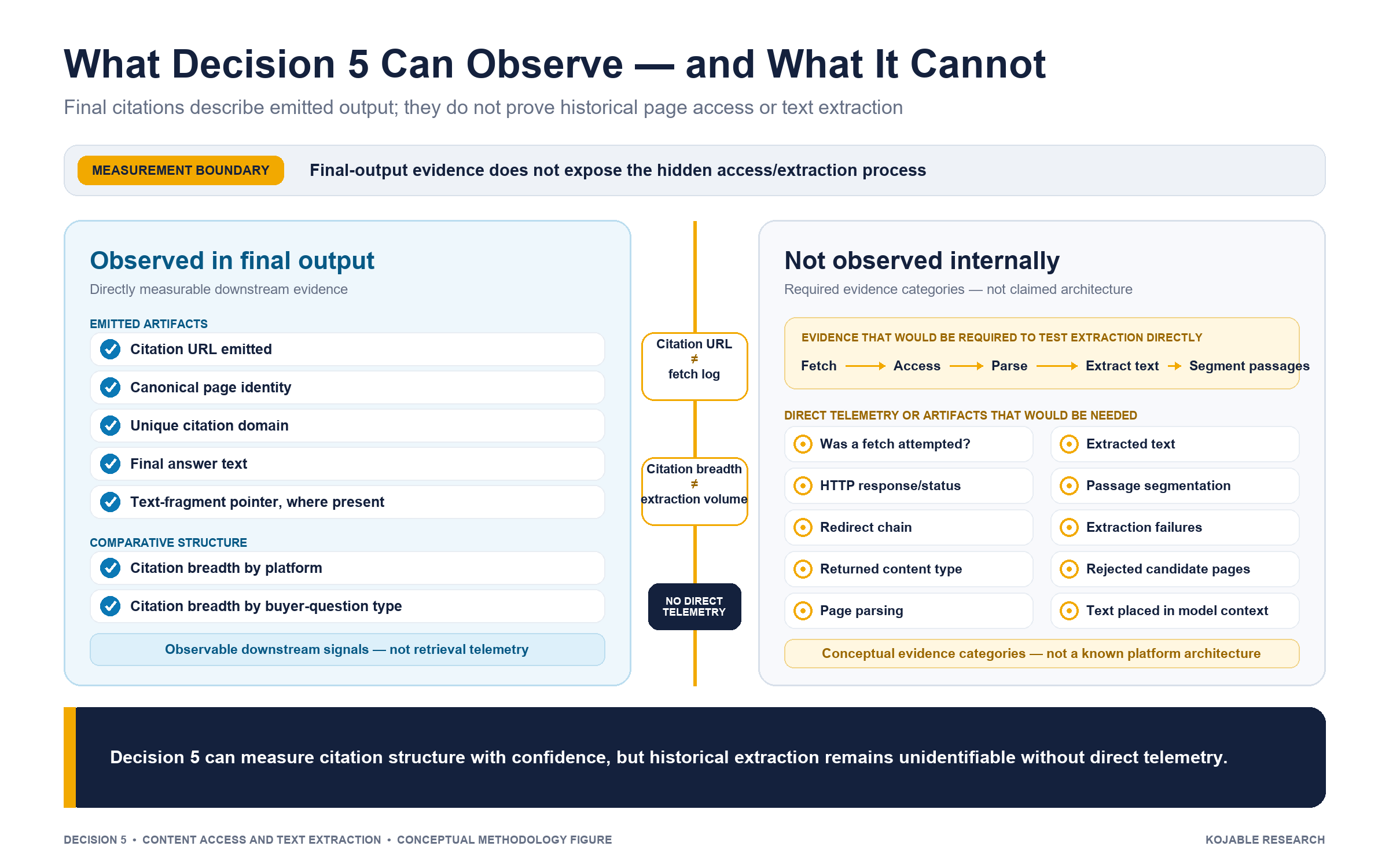
A citation is a downstream artifact. It tells us that a source reference reached the final answer interface, but it does not reveal every earlier step. The same URL could follow a live-page fetch, a cached representation, a search-index passage, a snippet, an upstream retrieval service or another document representation.
- Observed evidence
-
Emitted citation URLs, canonical page identities, unique domains, final answer text and text-fragment pointers where present.
- Unobserved evidence
-
Fetch attempts, HTTP outcomes, redirects, returned content, parser results, extracted text, passage segmentation and rejected candidates.
- Valid inference
-
Final citations support measurement of visible citation architecture by platform and buyer-question context.
- Invalid inference
-
Visible citation breadth cannot be promoted into a claim about pages fetched, text extracted or source material placed in model context.
The evidence categories shown in Figure 3 are requirements for a direct extraction test. They are not a claim about proprietary AI platform architecture.
Measurement lineage
Corrected URL splitting improved the observable evidence
Some citation strings contained multiple URLs. Earlier parsing did not always separate those URLs before deriving page and domain identities, which understated observed page and domain breadth.
The corrected analysis separates emitted URLs before deriving canonical pages, unique domains and text-fragment pointers. This improves measurement of what the final answer emitted.
Final citation architecture
What final citation breadth shows
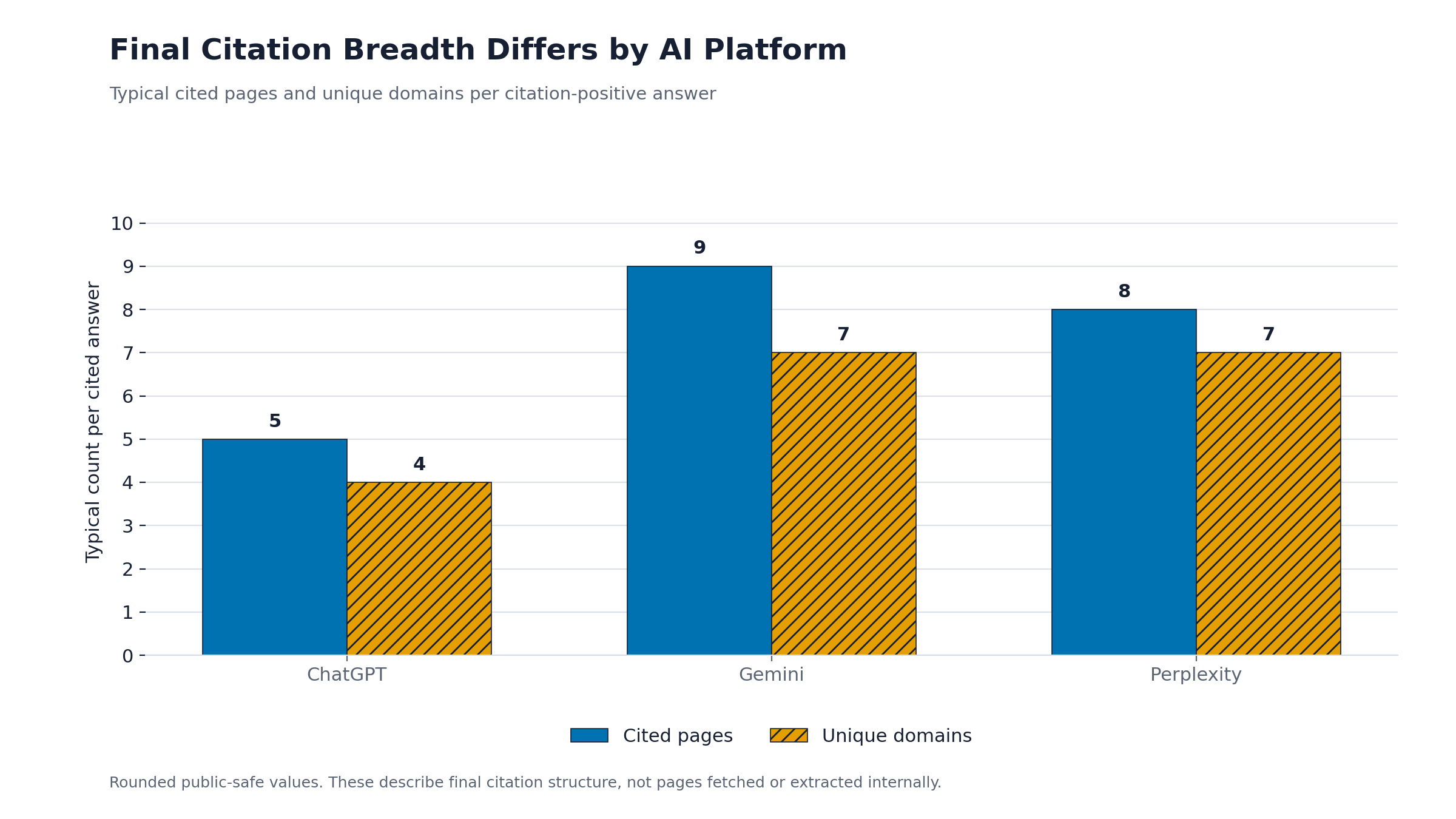
Among citation-positive responses, the three platforms expose noticeably different final citation structures. The values below are deliberately rounded. They describe emitted pages and domains, not fetched, retrieved or extracted pages.
| Platform | Typical cited pages | Typical unique domains |
|---|---|---|
| ChatGPT | ~5 | ~4 |
| Gemini | ~9 | ~7 |
| Perplexity | ~8 | ~7 |
Platform differences
Different interfaces expose different citation footprints
ChatGPT: a narrower final citation structure
A typical cited ChatGPT answer contains roughly five cited pages and four unique domains. This narrower visible footprint does not reveal how many pages were searched, fetched or rejected internally.
Gemini: broader and more passage-like
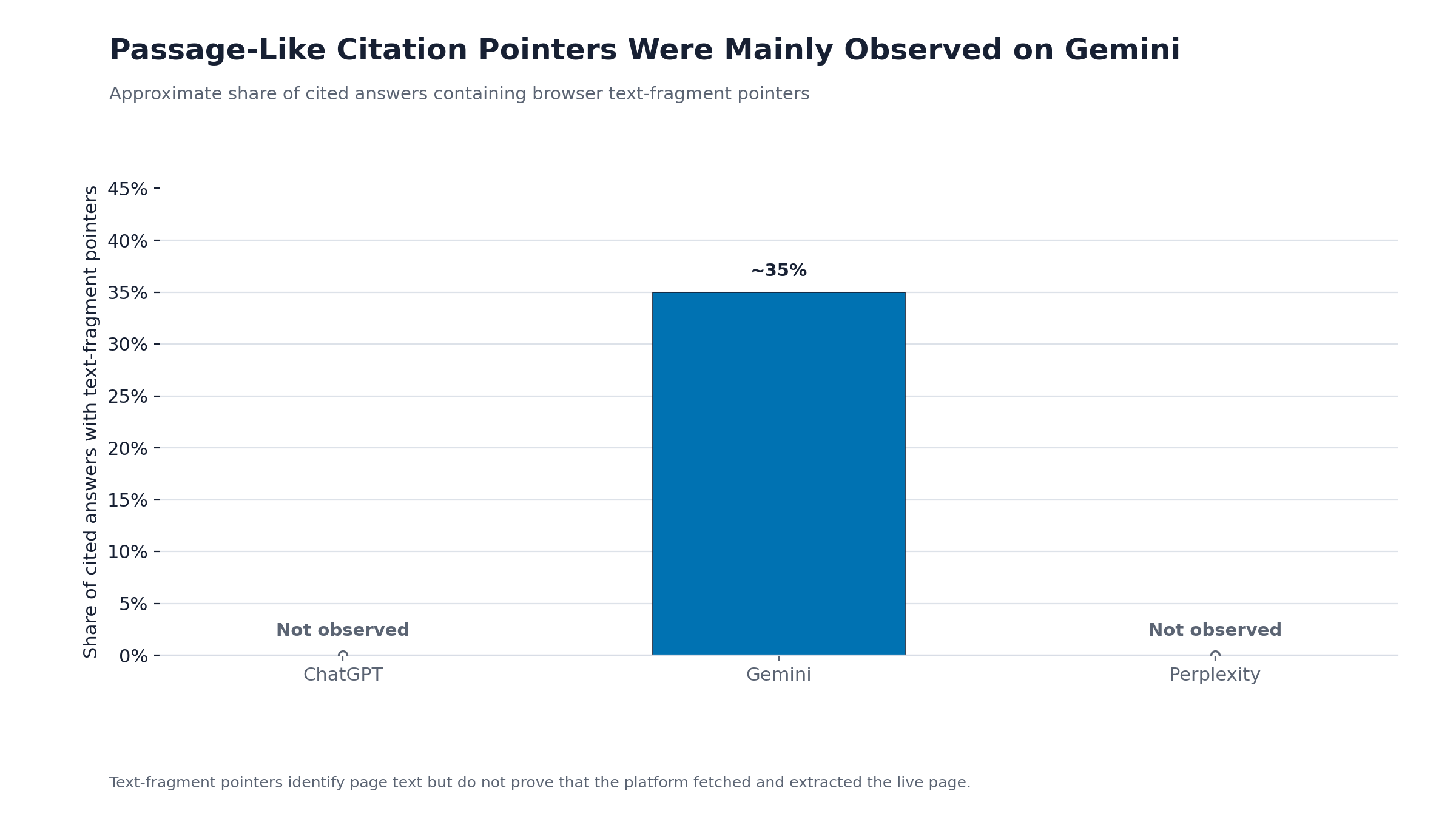
A typical cited Gemini answer contains roughly nine cited pages and seven unique domains. Gemini also frequently emits URLs containing browser text-fragment pointers.
Perplexity: broad and comparatively stable
A typical cited Perplexity answer contains roughly eight cited pages and seven unique domains. Its broad final portfolio remains evidence about visible citation output rather than hidden extraction breadth.
Passage-like evidence
Text-fragment pointers are suggestive, not decisive
Roughly one-third of cited Gemini answers in the observed export contain at least one browser text-fragment pointer. These links can identify specific text on a page, making them more passage-like than a page-level URL. They still do not prove that the platform fetched and extracted the live page at answer time.
| Platform | Passage-like text-fragment pointers |
|---|---|
| ChatGPT | Not observed in this export |
| Gemini | ~35% |
| Perplexity | Not observed in this export |
Proxy boundary
Citation count is not an extraction measure
Citation-item counts are naturally associated with canonical-page and unique-domain breadth because all three describe final citation structure. That relationship does not validate citation count as a proxy for extracted text.
The historical data contain no direct measure of extracted characters, words, paragraphs, passages, source tokens placed in model context or rejected passages. Without a genuine extraction measure, extraction volume remains unidentifiable.
Measurement discipline
A metric's construction determines its interpretation
Measurement labels can create false confidence. A label that sounds like a token, passage or extraction measure may still have been derived from final citation items. Interpretation should follow how a metric was constructed, not what its label appears to imply.
Public reporting therefore uses the observable concepts directly: citation-item count, canonical-page count, unique-domain count and text-fragment-pointer count. The governing question is: what observable event was actually counted?
Dynamic output
Citation structure changes over time and by buyer question
Final cited-page and domain breadth changes over time, and the direction and magnitude differ by platform. Citation structure is also contextual: workflow, technical and documentation questions can expose different page portfolios from other buyer-question types.
Platform differences are generally larger than most query-type differences. ChatGPT remains comparatively compressed, Gemini varies more substantially, and Perplexity remains broadly cited across major query categories.
These patterns show that final citation architecture is dynamic. They do not reveal how many pages were attempted, how many fetches or parsers failed, or how many passages were rejected before answer generation.
Hypothesis assessment
Historical extraction is not demonstrated
The hypothesis is that sources reaching the citation pipeline were accessible and could be converted into clean, usable text passages. Several observations are consistent with successful extraction, including parseable URLs, multiple canonical pages and domains, and Gemini's passage-like text fragments.
None of those observations is unique to live-page extraction. The same output could arise from cached content, search snippets, pre-indexed passages, metadata services, internal document stores or other retrieval infrastructure.
The hypothesis is neither proven true nor proven false. It is not identifiable from the current historical data and, if a binary status is required, is not demonstrated.
Separate experiment
A present-day access audit measures current conditions
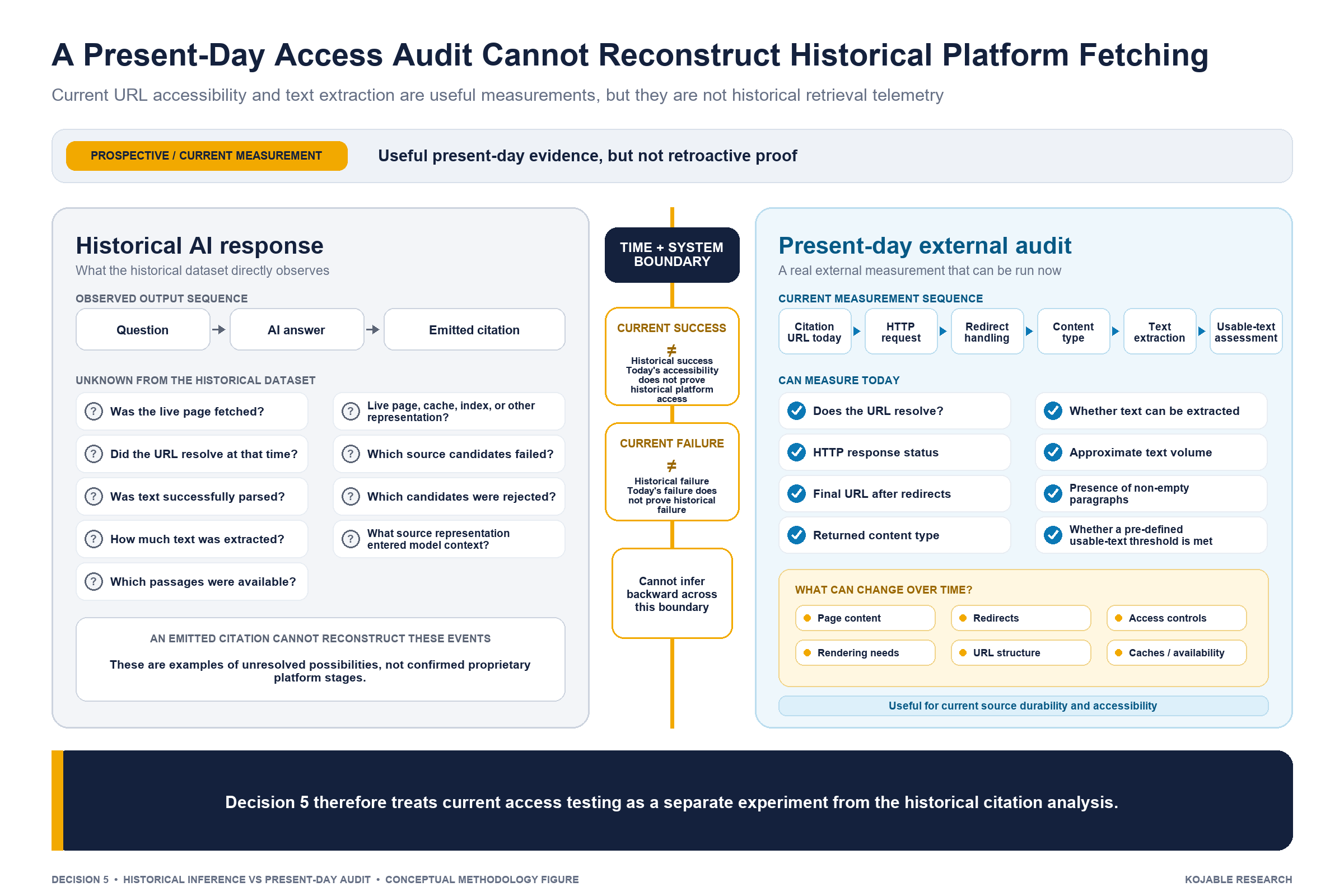
A separate external audit can test whether sampled citation URLs resolve now, how redirects behave, what content type is returned, whether page text can be extracted, approximately how much text is available, whether non-empty paragraphs exist and whether a pre-defined usable-text threshold is met.
That answers a valuable but narrower question: are sampled citation URLs accessible and extractable today? It does not establish what an AI platform fetched or represented when the historical response was produced.
Supported conclusions
What Decision 5 establishes
Observable boundary: the historical dataset observes final citation structure, not access or extraction.
Metric boundary: citation-volume measures should not be interpreted as extracted-text measures.
Platform difference: ChatGPT exposes a narrower final citation footprint, while Gemini and Perplexity generally expose broader source portfolios.
Passage-like evidence: roughly one-third of cited Gemini answers contain text-fragment pointers in the observed export.
Contextual variation: final citation breadth changes over time and by buyer-question type.
Claim boundary
What Decision 5 does not establish
The analysis does not establish whether any platform fetched each emitted URL, accessed a live page rather than another representation, followed redirects, handled restrictions, parsed a document, extracted clean text, segmented passages, selected a particular passage, rejected alternative pages or experienced an extraction failure.
It also does not establish historical source durability. A page accessible today may have behaved differently then, while a page unavailable today may have been accessible when the answer was produced.
AEO and GEO implications
Test content accessibility directly
A visible citation proves less about the retrieval pipeline than it appears to. Likewise, an uncited source cannot automatically be diagnosed as inaccessible. Content access should be measured through direct technical checks rather than inferred from citation presence or volume.
Useful operational questions include whether a page returns a normal response, redirects predictably, exposes meaningful server-rendered or indexable text, avoids unintended access controls and contains enough clean evidence to support the relevant buyer question.
Downstream diagnosis
The next stage examines passage semantic relevance
Decision 5 separates content availability from content usefulness. A page can be accessible and extractable while still containing irrelevant, weak, outdated or insufficient evidence.
-
Passage relevance
Does the extracted or selected text match the meaning of the user's question?
-
Finalist quality
Does the surviving source meet the evidence-quality threshold?
-
Answer readiness
Can the surviving evidence support a useful final response?
The later finalist-quality and answer-readiness stages are not linked until their production publications exist.
Study boundaries
Limitations
-
Final-output data
The study has no platform fetch logs, historical HTTP outcomes, parser traces, extracted page text or passage segmentation.
-
No rejected candidates
Rejected pages and direct extraction-failure labels are not observed.
-
Historical ambiguity
A visible URL does not prove a live-page fetch or reveal a proprietary cache, index or document representation.
-
Changing interfaces
Platform citation behaviour and source accessibility can change over time.
Method and governance
Public-safe research details
The study uses a large cross-platform cohort spanning ChatGPT, Gemini and Perplexity in a consistent English-language setting. The publication reports deliberately rounded platform-level citation breadth and qualitative temporal patterns.
It omits exact response and citation-positive counts, exact URL totals, platform sample sizes, collection periods, query-route samples, internal measurement labels, commercial collection-provider identity, customer identity, private analysis paths and implementation details. Structured data follows the same disclosure boundary as the visible article.
No public historical reproducibility dataset accompanies the publication because exact underlying measurements are not required to understand the observability conclusion.
FAQ
Frequently asked questions
Does an AI citation prove the source was fetched?
No. An emitted citation shows that a source reference reached the final answer interface. It does not reveal whether the platform fetched the live page, used another representation or extracted the page's text.
What does Decision 5 actually observe?
Decision 5 observes emitted citation URLs, canonical page identities, unique citation domains, final answer text, text-fragment pointers where present, and differences in final citation breadth by platform and buyer-question context.
What evidence would be needed to prove text extraction?
Direct testing would require evidence such as fetch attempts, HTTP outcomes, redirects, returned content types, parser results, extracted text, passage segmentation, extraction failures, rejected candidates and source text placed in model context.
Why is citation count not an extraction measure?
Citation count measures references emitted in the final answer. It does not measure extracted characters, words, paragraphs, passages or source material placed in model context.
Why does Gemini show passage-like text-fragment pointers?
The observed Gemini export often contains browser text-fragment pointers that identify specific page text. The final output does not reveal which retrieval or citation mechanism produced those pointers.
Do text-fragment pointers prove live-page extraction?
No. A fragment can identify page text without proving that the platform fetched the live page and converted it into clean model-ready passages when the historical answer was produced.
Why does citation breadth differ across AI platforms?
The final citation interfaces expose different page and domain portfolios. Those differences may reflect several mechanisms, but the historical output does not identify the underlying cause or extraction breadth.
Can a present-day accessibility audit prove historical access?
No. A present-day audit measures whether a URL resolves and exposes extractable text now. It cannot reconstruct how a platform accessed or represented the source when the historical answer was produced.
What is the difference between current accessibility and historical platform access?
Current accessibility is an external measurement made today. Historical platform access concerns a past event inside another system. Current success does not prove historical success, and current failure does not prove historical failure.
How does Decision 5 connect to Decisions 1–4?
Decision 1 studies retrieval need, Decision 2 studies buyer-question context, Decision 3 examines ecosystem source availability, Decision 4 examines selected source composition, and Decision 5 defines what final citations can reveal about content access and extraction.