Kojable research · Decision 3 · Source availability and candidate sufficiency
AI Citation Misses Often Occur Even When Citable Sources Exist Elsewhere
When one AI platform produced no visible citation, another often cited the same contemporaneous question—weakening broad source absence as the default explanation while leaving the focal platform’s internal candidate pool unknown.
Key finding
More than three-quarters of citation misses had a contemporaneous citation elsewhere.
Qualification: This stress-tests the wider source environment; it does not reveal which candidates the non-citing platform discovered, accessed, ranked or rejected.
- AI citation misses
- Source availability
- Candidate sufficiency
- 17 min read
Study overview
Executive summary
When an AI answer contains no visible citation, one possible explanation is that nothing suitable existed to cite. Decision 3 tests how credible that broad explanation is using contemporaneous cross-platform comparisons.
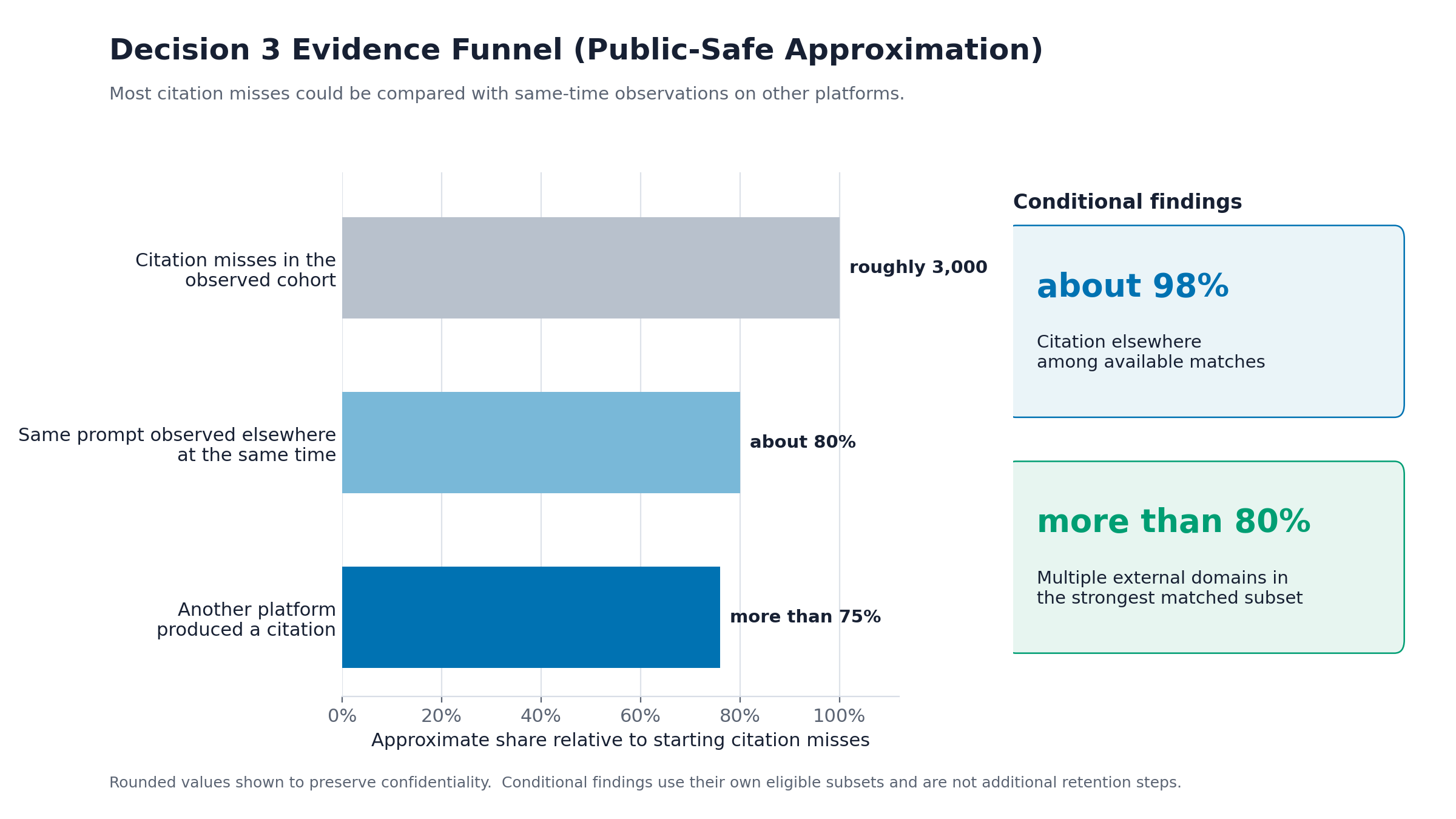
Across a large cohort containing more than 55,000 responses, roughly 3,000 contained no visible citation. More than three-quarters of those misses had the same prompt cited by another included platform at the same observation point. Among misses with an available comparison, about 98% had a citation elsewhere.
In the strongest matched subset, where all three included platforms were observed contemporaneously, more than four-fifths of citation misses exposed at least two distinct external citation domains in the counterpart answers.
Broad source unavailability is therefore weakened as the general explanation for observed citation misses. The non-citing platform’s internal candidate sufficiency remains unknown.
Research lineage
Decision 3 moves the diagnostic downstream
Decision 1 examines retrieval need and AI citation exposure. It asks where citation behaviour changes as questions appear to require more or less external evidence.
Decision 2 examines AI citations by query type. It asks where buyer-question categories add useful diagnostic structure after retrieval need is considered.
Decision 3 asks whether broad source absence explains the remaining citation misses. It is a standalone source-availability study and the third stage in Kojable’s diagnostic research framework: retrieval need → query type → source availability → selected sources → content access → passage relevance → finalist quality → answer readiness. This sequence is a diagnostic model for locating citation failures, not a confirmed internal architecture of an AI platform.
Core distinction
Ecosystem availability is not platform candidate sufficiency
- Ecosystem availability
-
Did apparently citable material exist elsewhere for the same contemporaneous question? Decision 3 can stress-test this using other platforms’ final citations.
- Platform candidate sufficiency
-
Did the focal non-citing platform itself retrieve enough usable candidates? Its private retrieval, ranking and rejection evidence is not observed.
- Observed outcome
-
A binary visible-citation indicator records whether the final answer contained at least one detected citation.
- Comparison design
-
The same prompt is compared at the same contemporaneous observation point across ChatGPT, Gemini and Perplexity.
Other-platform citations provide evidence that the broader information environment was non-empty. They do not reveal the private candidate set of the focal platform.
Claim boundary
What Decision 3 can and cannot observe
The observable evidence includes the final answer, prompt, contemporaneous cross-platform coverage, visible citation presence and citation domains exposed in counterpart answers. These fields support a useful external counterfactual.
The study does not reveal whether retrieval was triggered, which candidates were discovered, how they ranked, whether pages loaded, whether relevant passages were extracted, why sources were rejected or whether retrieved information was used without a visible citation.
Other-platform citations are evidence of ecosystem availability. They are not the hidden candidate set of the focal platform.
Central evidence
The contemporaneous evidence funnel remains strong
A permissive monthly comparison could be affected by page changes, new documents, indexing changes and platform drift. Decision 3 instead asks whether the same prompt was cited elsewhere at the same observation point.
This stricter contemporaneous comparison reduces temporal mismatch and naturally retains less coverage than a broad monthly match. Even under this stricter contemporaneous comparison, citation elsewhere remains extremely common.
| Evidence stage | Approximate result | Interpretation |
|---|---|---|
| Citation misses | ~3,000 | Starting observed miss population |
| Same prompt observed elsewhere contemporaneously | ~80% | Most misses had a comparator |
| Citation elsewhere | >75% of all misses | Strong counterevidence to broad source absence |
| Citation elsewhere among available matches | ~98% | Almost every matched miss was cited somewhere else |
| Multiple external domains in strongest subset | >80% | Wider evidence often had breadth |
The scientific result is the shape of the funnel, not the exact row counts retained at each stage. Once a contemporaneous comparator exists, a citation elsewhere is extremely common.
Across platforms
The counterevidence is not confined to one platform
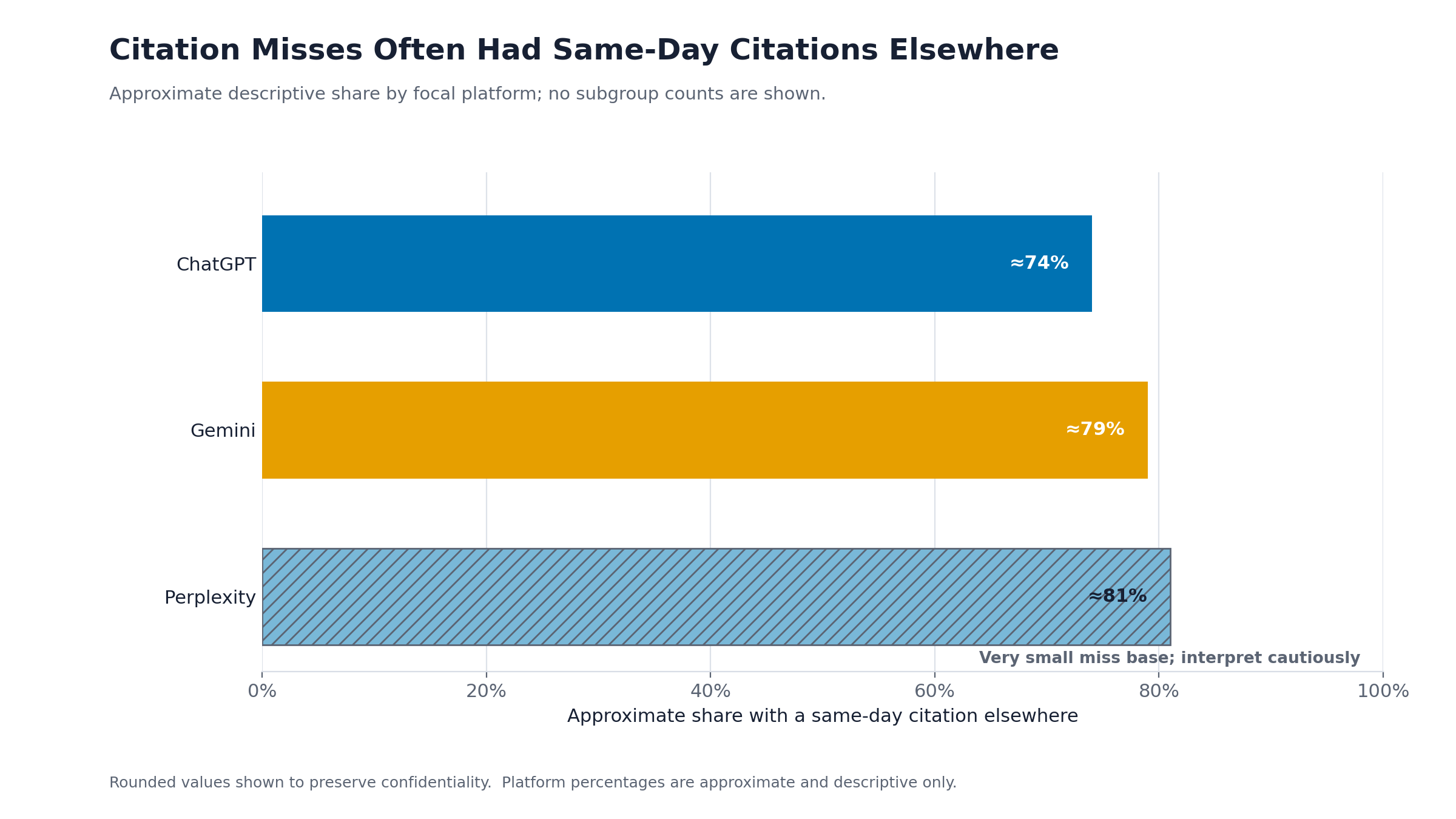
Roughly three-quarters or more of ChatGPT and Gemini citation misses have a contemporaneous citation elsewhere. Perplexity has very few citation misses because its overall exposure is close to saturation, so its miss-specific percentage is directionally useful but much less stable.
Counterpart answers
Many misses are cited by both other platforms
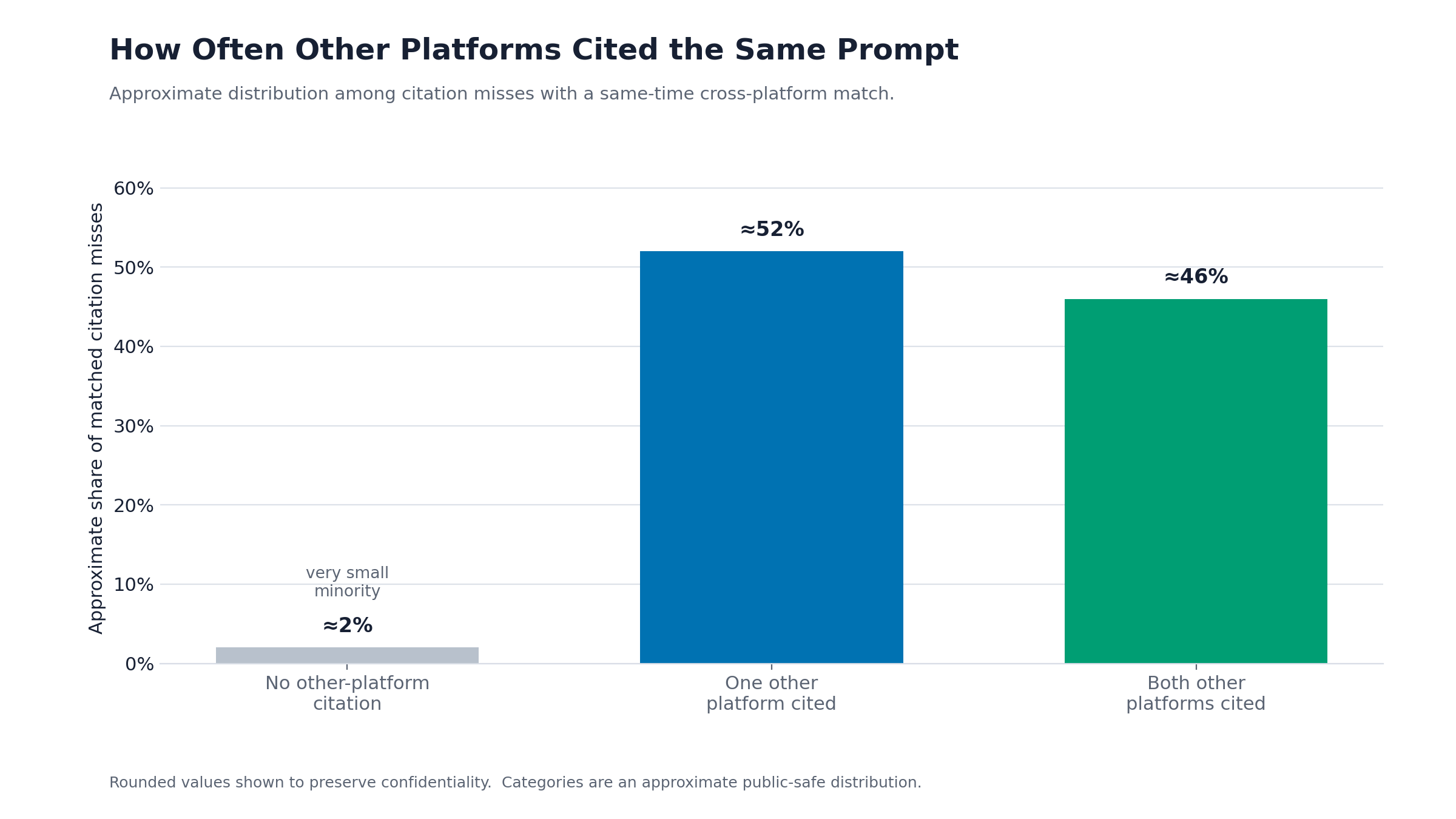
A single citation elsewhere could be an idiosyncratic result. When two independent final-answer pipelines cite the same contemporaneous prompt while the focal platform does not, broad source absence becomes still less plausible.
Source breadth
The strongest matched cases usually expose multiple domains
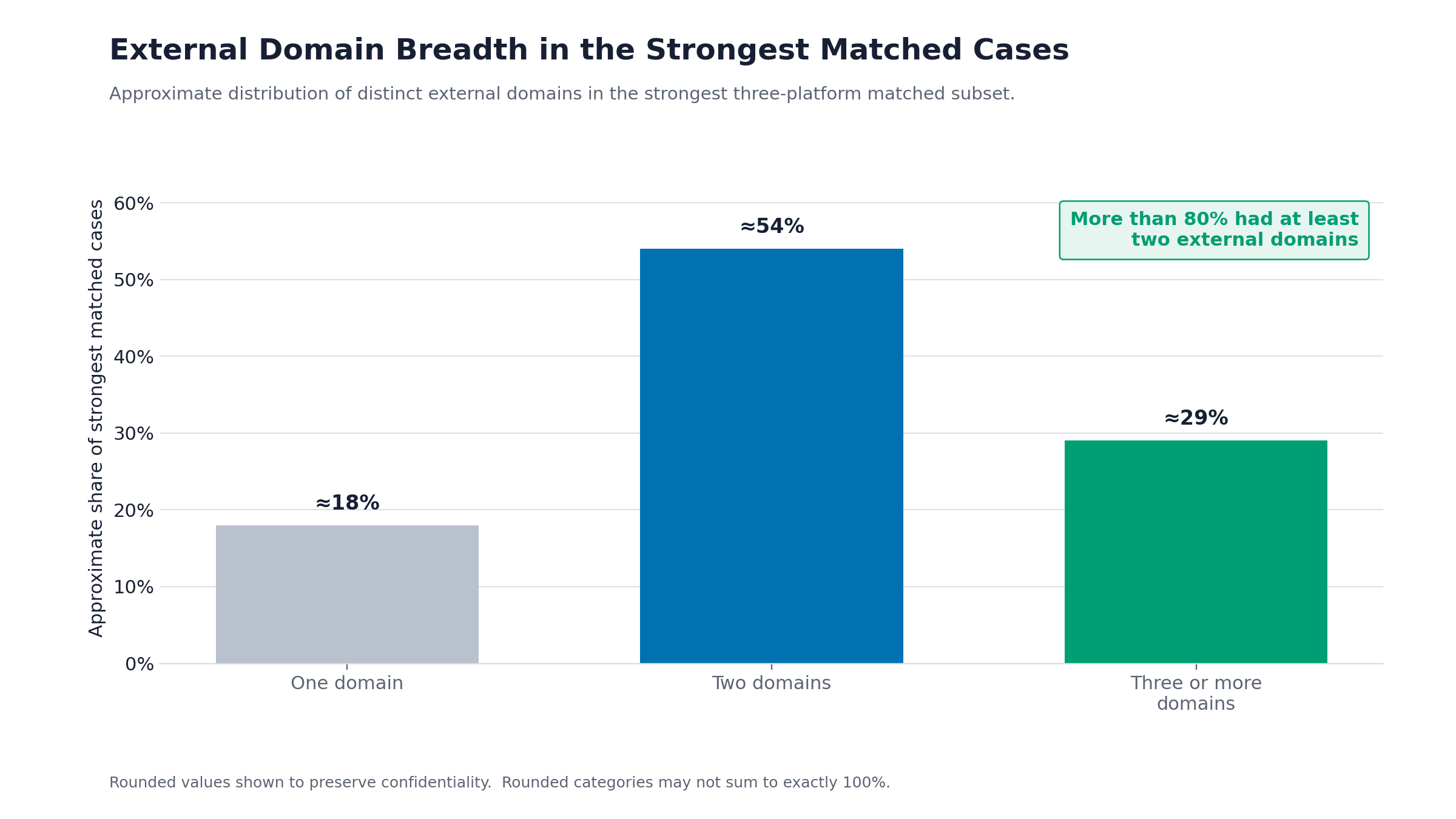
Multiple external domains strengthen the ecosystem-availability counterargument, but they remain post-selection citation outputs from other platforms. Relevance, authority, accessibility, freshness and platform eligibility may still differ.
Retrieval context
Retrieval need does not reverse the conclusion
High-retrieval-need misses still frequently have contemporaneous citations elsewhere. The Low-retrieval-need Gemini segment also shows strong external counterevidence.
This does not prove that the focal platform had the same candidates. It shows that prompts appearing to require external evidence were commonly asked in a wider evidence environment that was not empty.
Missing comparators remain unresolved rather than source-unavailable. Incomplete cross-platform coverage is a design limitation, not positive evidence of scarcity.
Coverage boundary
Missing comparators are unresolved, not source-unavailable
A citation miss without a suitable contemporaneous comparator is unresolved by this design—not evidence that sources were unavailable.
The counterpart observation may be absent, the counterpart may also be uncited, or cross-platform coverage may be incomplete. Missing counterfactual coverage is a limitation of the comparison and must not be converted into evidence of source scarcity.
Open mechanisms
What remains possible after broad source absence is weakened
Decision 3 does not identify which downstream gate failed. A citation miss may still reflect any of the following platform-specific mechanisms:
- Retrieval was not triggered.
- Discovery or search behaviour did not surface the same evidence.
- Useful candidates ranked too low.
- Candidate content could not be accessed.
- Available passages did not align closely enough with the question.
- Quality or policy rules rejected otherwise relevant evidence.
- Duplicate or freshness constraints changed source eligibility.
- Information was used without a visible citation.
- Answer or citation-presentation policy suppressed the citation.
Supported conclusions
What Decision 3 establishes
-
Broad source absence is not a credible default
More than three-quarters of observed citation misses had a contemporaneous citation elsewhere.
-
The stricter match preserves the result
Same-prompt, same-time comparison still produces strong external counterevidence.
-
External evidence often has breadth
More than four-fifths of the strongest matched cases expose at least two citation domains.
-
Internal candidate sufficiency is unresolved
The study cannot observe what the focal platform retrieved, ranked, rejected or used.
AEO and GEO implications
Investigate a citation miss before prescribing more content
A missing citation should not automatically be interpreted as a content-supply problem. If another platform cites the same contemporaneous question, the remediation question should move downstream.
- Source-environment problem
-
Relevant evidence genuinely does not exist or is too sparse.
- Platform-discovery problem
-
Evidence exists, but the focal platform does not discover or surface it.
- Selection or answer-policy problem
-
Evidence is found but rejected, suppressed or not visibly cited.
Citation misses can arise from a sparse source environment, platform discovery and retrieval differences, content-access failures, semantic mismatch, evidence-quality thresholds or answer and citation policy. Those problem classes require different interventions.
-
Check the wider evidence environment
Establish whether relevant, current and citable material exists for the buyer question.
-
Compare platform-specific outcomes
Separate a global content gap from a focal-platform divergence.
-
Inspect discoverability and access
Review whether important evidence is indexable, extractable and clearly connected to the question.
-
Retest comparable prompts
Use AI citation monitoring to distinguish persistent misses from unstable one-off outcomes.
Decision 3 shifts the next analytical stage toward Decision 4 on which source families survive into final AI citations. Later stages examine content access, passage relevance, finalist quality and answer readiness.
Study boundaries
Limitations
-
External counterfactual
Same-prompt, same-time comparison is stronger than a broad temporal match but is not an internal retrieval trace.
-
Different platform systems
Platforms may use different indexes, access rules, quality thresholds and citation policies.
-
Survivor evidence
Final citations are selected outputs, not the full candidate pool considered by another platform.
-
Incomplete matching
Some citation misses have no suitable contemporaneous comparator and remain unresolved by this design.
-
Observational scope
Platform behaviour changes over time, and the observed prompt inventory cannot represent every buyer question.
Method and governance
Public-safe research details
The analysis uses a large multi-platform cohort spanning ChatGPT, Gemini and Perplexity in a consistent English-language market setting. One additional environment was excluded because its citation data did not meet the validation standard for this study.
This publication intentionally uses rounded cohort scale, rounded subgroup results, neutral collection language and no exact collection window, provider identity, internal field names or analysis-file paths. No public reproducibility dataset accompanies the article.
Exact values were used internally for computation and validation, but they are not required to understand the public conclusion.
Diagnostic research framework
Follow the Decisions 1–8 sequence
The sequence is retrieval need → query type → source availability → selected sources → content access → passage relevance → finalist quality → answer readiness. It is a diagnostic model for locating citation failures, not a confirmed internal platform architecture.
- Decision 1
- Decision 2
- Decision 3
- Decision 4
- Decision 5
- Decision 6
- Decision 7
- Decision 8
FAQ
Frequently asked questions
What does Decision 3 test?
It tests whether apparently citable material existed elsewhere for the same contemporaneous question. It does not inspect the focal platform’s private retrieval or candidate-selection process.
Do AI citation misses usually mean no citable sources existed?
No. More than three-quarters of observed misses had the same contemporaneous prompt cited elsewhere, weakening broad source absence as the default explanation.
How often was the same prompt cited elsewhere?
More than three-quarters of all observed citation misses had a citation elsewhere, and about four-fifths had a suitable contemporaneous comparator.
Why does contemporaneous cross-platform matching matter?
Matching the same prompt at the same observation point reduces temporal mismatch from page, index and platform changes, making the external comparison stricter.
What does the roughly 98% matched result mean?
Among misses with an available same-time comparison, about 98% were cited by at least one other included platform. Missing comparators remain unresolved rather than source-unavailable.
Why do multiple external domains matter?
More than four-fifths of the strongest matched cases exposed at least two external domains, showing that wider evidence often extended beyond one isolated citation target.
Does another platform citing prove the focal platform retrieved the same source?
No. It shows ecosystem availability, not that the focal platform discovered, accessed, ranked or accepted the same source.
What does platform candidate sufficiency mean?
It asks whether the focal platform retrieved enough usable, relevant and eligible candidates before answering. Decision 3 cannot observe that private candidate pool.
How should a company diagnose an AI citation miss?
Separate source-environment, platform-discovery and selection or answer-policy problems before assuming that publishing more content is the right remedy.
How does Decision 3 connect Decisions 1–2 with Decision 4?
Decisions 1 and 2 segment citation exposure by retrieval need and buyer-question type. Decision 3 tests ecosystem availability, and Decision 4 examines the source families that survive into final citations.