Kojable research · Decision 4 · AI citation source analysis
Which Sources Appear in Final AI Citations?
Final AI answers draw from overlapping Brand-owned, Comparable-vendor, community, official and third-party sources. The balance changes substantially by AI platform and buyer-question type.
Key finding
Brand-owned sources appeared in roughly two-thirds of observed answers, while Comparable-vendor sources appeared in about half.
Qualification: These findings describe final emitted citations, not the hidden candidate sources a platform discovered, ranked or rejected.
- AI citation sources
- Source-family composition
- Platform routing
- 15 min read
Study overview
Executive summary
Decision 4 examines which source families survive into final citations across ChatGPT, Gemini and Perplexity. Across a large multi-platform cohort containing more than 55,000 AI responses, final source composition differs substantially by platform and by buyer-question type.
Brand-owned sources appear in roughly two-thirds of observed answers. Comparable-vendor sources appear in about half. Gemini is unusually community-heavy, while Perplexity exposes Brand-owned and Comparable-vendor evidence at relatively high rates. ChatGPT generally shows a narrower final cited-domain footprint.
The source families overlap. One answer can cite first-party evidence, another vendor, an official reference and a community discussion together. The useful analytical question is therefore how the portfolio changes, not which single family won.
These are descriptive final-output patterns. They do not reveal hidden retrieval candidates or establish causal source selection.
Direct answer
Which kinds of sources appear in final AI citations?
-
Broad, overlapping source portfolios
Final AI citations combine Brand-owned, Comparable-vendor, community, Official-documentation and other third-party sources. Brand-owned evidence is highly visible, Comparable-vendor evidence is material, and the balance changes by platform and buyer-question type.
Research lineage
Decision 4 follows the citation pathway downstream
-
Decision 1
Retrieval need and citation exposure: does apparent need for external evidence change whether a citation appears?
-
Decision 2
Citation exposure by buyer-question type: does the kind of question add useful diagnostic structure?
-
Decision 3
Whether citation misses reflect broad source unavailability: did citable material exist elsewhere when one platform missed?
-
Decision 4
Which source families survived into the final cited answers?
Observable outcome
What final source composition means
- Observed evidence
-
URLs and domains presented in the final answer, grouped into public-safe source families.
- Source portfolio
-
The set of overlapping source families exposed within one final response.
- Comparison unit
-
Source exposure compared across platform, buyer-question type and their interaction.
- Unobserved process
-
Private discovery, retrieval, ranking, filtering and rejection remain outside the evidence boundary.
Measurement correction
Citation parsing quality materially changes source-composition measurement
The original parser incorrectly treated some citation strings containing multiple URLs as though they contained one URL. That materially understated domain breadth and could make final answers look more concentrated than they were.
The corrected parser separates every emitted URL before extracting and classifying its domain. The revised analysis shows broad, multi-domain citation portfolios and keeps citation presence, page count, domain count and source-family exposure analytically distinct.
Two related metrics
Response exposure and source-domain share answer different questions
Response exposure
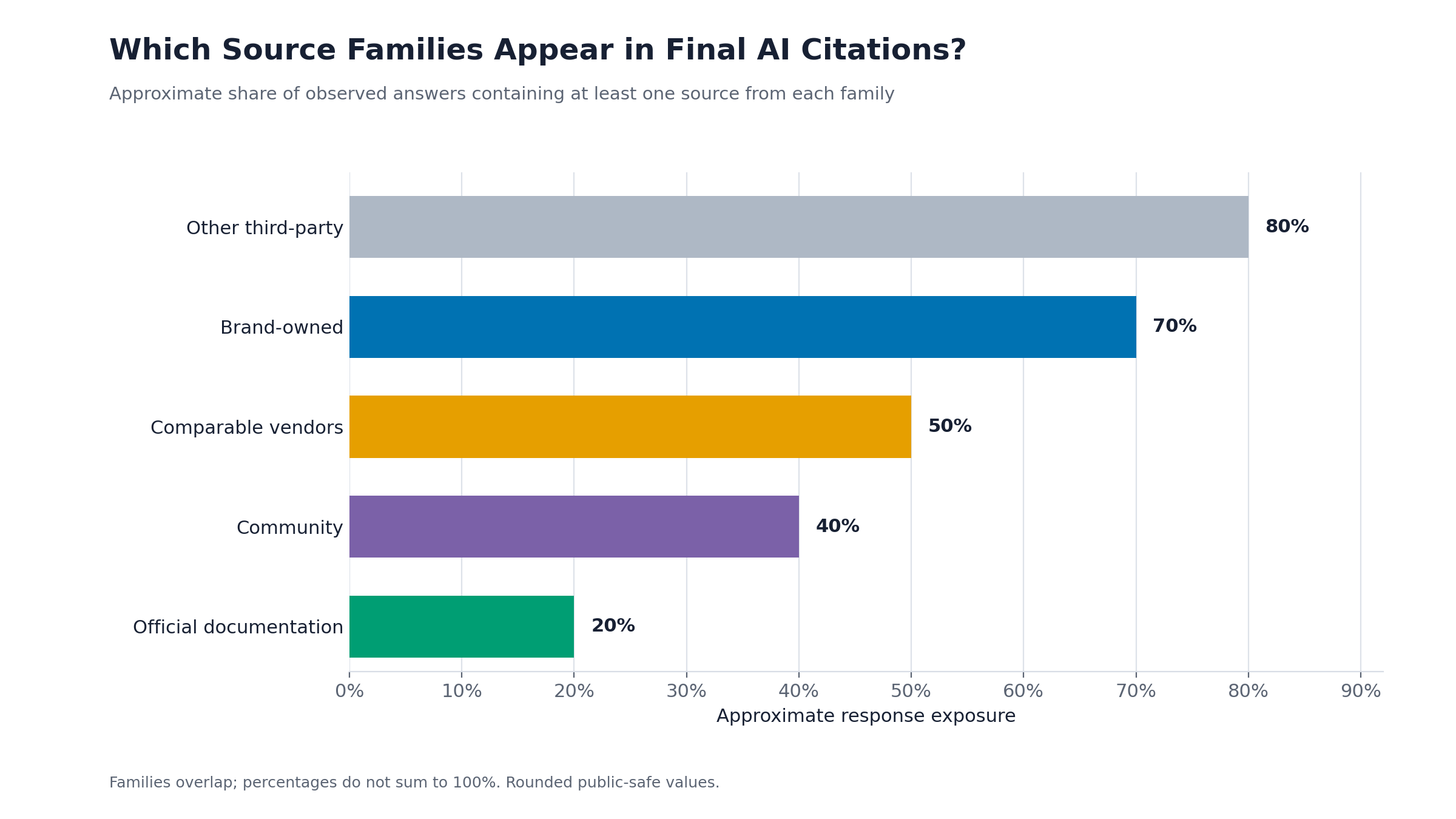
Response exposure asks what share of answers contain at least one source from a family. Because one answer can contain several families, these percentages are not parts of a single 100% total.
Source-domain share
Source-domain share asks what proportion of all observed response-domain instances belongs to each family. It describes the cited-source inventory, not the probability that an answer contains that family.
Overall landscape
Which source families appear in final AI citations?
The overall landscape is broad rather than exclusive. A heterogeneous third-party long tail is the largest family, while Brand-owned and Comparable-vendor sources are both frequent. Community and Official-documentation sources become especially important in particular platform and query contexts.
| Source family | Approximate exposure | Interpretation |
|---|---|---|
| Other third-party | ~80% | Broad heterogeneous publisher long tail |
| Brand-owned | ~70% | Frequently represented first-party evidence |
| Comparable vendors | ~50% | Material competitive evidence environment |
| Community | ~40% | Important overall, especially on Gemini |
| Official documentation | ~20% | Stronger for documentation-oriented questions |
Note: Source families overlap; percentages therefore do not sum to 100%.
First-party visibility
Brand-owned evidence is highly visible
Brand-owned sources appear in roughly two-thirds of observed answers. That means first-party websites, documentation and other owned properties frequently survive into final citations.
This is a visibility signal, not proof of market share, recommendation probability, favourability, authority or causal influence. The defensible conclusion is narrower: Brand-owned information is often represented in this observed query environment.
Comparative environment
Comparable-vendor evidence is also material
Comparable-vendor sources appear in about half of observed answers under the broader public-safe taxonomy. Strong Brand-owned exposure therefore does not eliminate competitive-source presence; many answers contain both.
Comparable-vendor presence should not be interpreted as competitor influence. It establishes that comparative evidence survived into the final citation portfolio, not why it was selected or how it shaped the answer.
Classification boundary
Source-family magnitude depends partly on taxonomy
A narrow Comparable-vendor definition includes only the most direct alternatives. A broader definition can include adjacent products and partially overlapping solutions. Exposure increases as that family expands.
The stable conclusion is qualitative: Comparable-vendor sources remain a material part of final citations across reasonable classification choices. The exact magnitude is taxonomy-sensitive.
Platform comparison
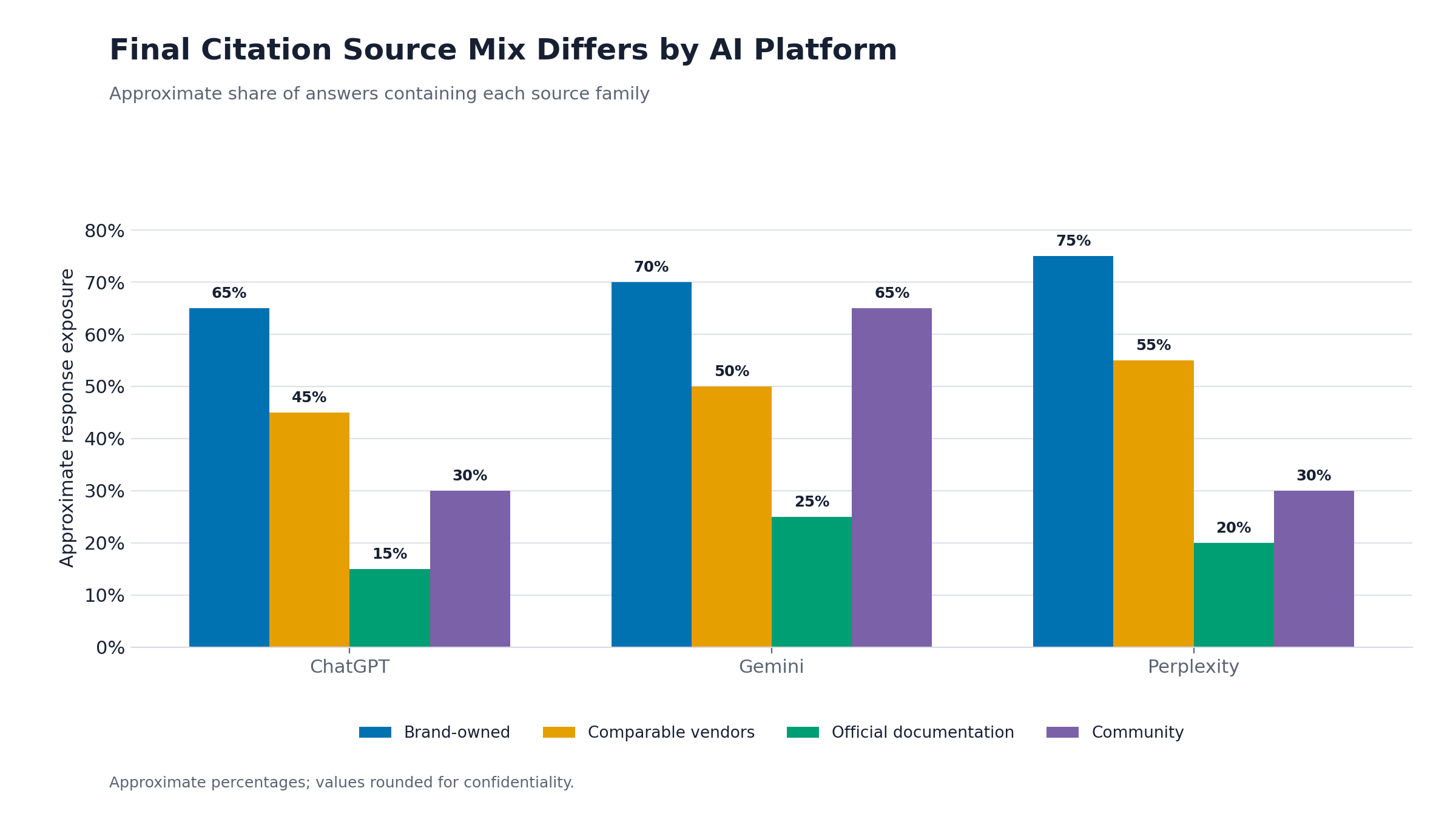
Source portfolios differ substantially by AI platform
| Platform | Brand-owned | Comparable vendors | Official docs | Community |
|---|---|---|---|---|
| ChatGPT | ~65% | ~45% | ~15% | ~30% |
| Gemini | ~70% | ~50% | ~25% | ~65% |
| Perplexity | ~75% | ~55% | ~20% | ~30% |
ChatGPT: a comparatively narrower source footprint
ChatGPT generally exposes fewer distinct domains in final cited answers. That does not establish narrower internal search because discovery, ranking, filtering and citation presentation remain unobserved.
Gemini: unusually community-heavy
Community evidence appears in roughly two-thirds of Gemini responses in this study, substantially more often than on ChatGPT or Perplexity. Community frequency is not itself evidence of either quality or lack of quality.
Perplexity: high Brand-owned and Comparable-vendor exposure
Perplexity exposes both families relatively often. Because visible citations are common in its observed answers, composition is more diagnostic than citation presence alone.
Query context
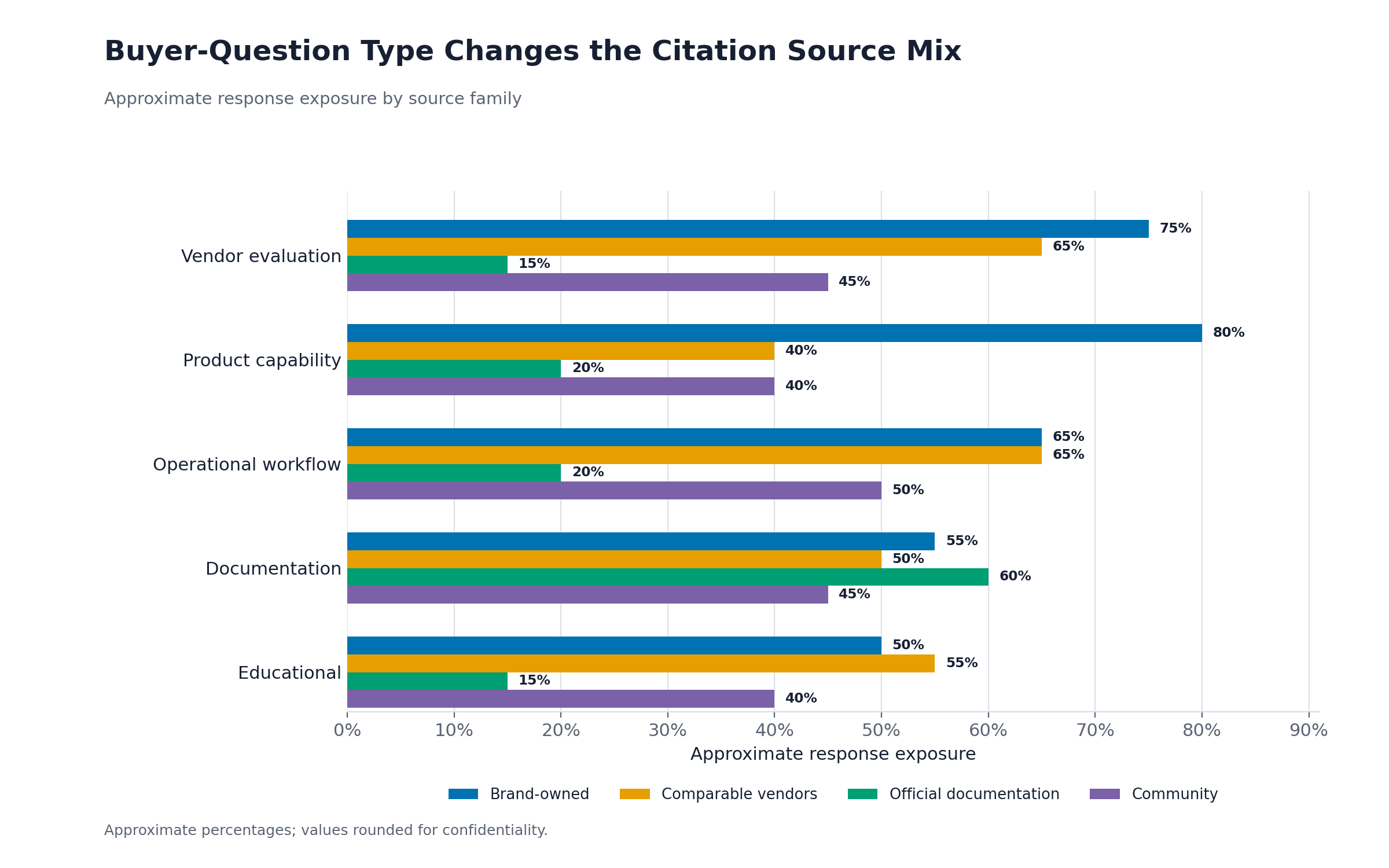
Buyer-question type changes the source-family balance
-
Vendor evaluation
Brand-owned and Comparable-vendor sources frequently coexist, reflecting the comparative evidence need.
-
Product capability
Brand-owned evidence is especially prominent, making clear and indexable capability material strategically important.
-
Operational workflow
Brand-owned and Comparable-vendor evidence are more balanced, with community and third-party material also relevant.
-
Documentation
Official documentation becomes substantially more prominent as the information need turns technical and reference-oriented.
-
Educational
Explanatory questions use a broad mix spanning Brand-owned, Comparable-vendor, community and third-party evidence.
Interaction
Platform and buyer-question type interact
Pooled averages can hide important routing differences. The same buyer-question type may produce a more community-heavy portfolio on Gemini, more Brand-owned exposure on Perplexity, or fewer distinct final domains on ChatGPT.
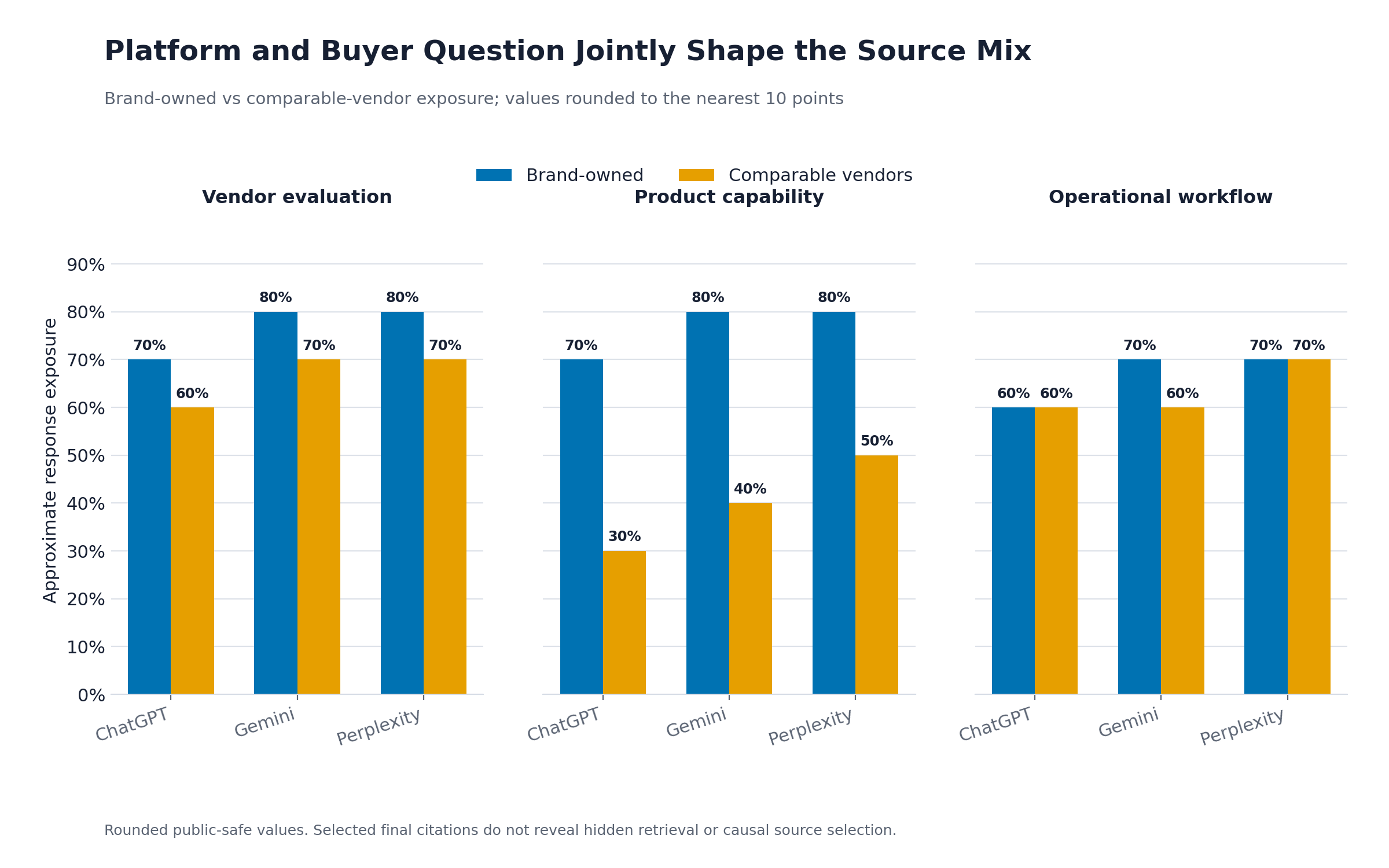
The useful operational unit is therefore platform × buyer-question type × source family, not one universal source-exposure score.
Portfolio logic
Source-family overlap matters more than winner-take-all thinking
Brand-owned and Comparable-vendor sources do not compete for one exclusive citation slot. A mature answer can combine first-party documentation, a comparable product page, a neutral official reference and a community discussion.
Measuring coexistence produces a more realistic view of the final evidence environment than asking which single family won.
AEO and GEO implications
Visibility strategy should follow the evidence environment
-
Protect first-party evidence quality
Brand-owned material appears often, so clarity, extractability and evidence density remain important.
-
Measure competitive coexistence
Track which Comparable-vendor sources appear alongside the brand rather than treating visibility as binary.
-
Map channels to platforms
Community environments may matter disproportionately for Gemini, while other platforms expose different portfolios.
-
Map evidence to buyer questions
Documentation, vendor evaluation and workflow questions need different publishing and distribution strategies.
Supported conclusions
What Decision 4 establishes
Broad portfolios: final citations commonly contain evidence from multiple domains and source families.
Brand visibility: Brand-owned evidence is highly visible in the observed cohort.
Comparative evidence: Comparable-vendor sources are materially present.
Platform difference: Gemini has a distinctive community-heavy final source mix.
Question context: buyer-question type changes source-family composition.
Taxonomy sensitivity: classification affects magnitude more than the direction of the result.
Claim boundary
What Decision 4 does not establish
Final citations are observable outputs, not a complete candidate-source pool. The data do not show which pages were discovered, ranked, rejected, inaccessible or considered authoritative inside a platform.
Source frequency does not prove authority, quality, causal influence, market share, recommendation probability or support for a specific claim. Community frequency likewise proves neither quality nor lack of quality.
Residual family
The third-party long tail is not one quality category
Other third-party sources include specialist publishers, niche references, tutorials, blogs and commercial pages. Grouping them is useful for an overall landscape, but not for judging quality.
A later audit should stratify this long tail by technical depth, independence, recency, evidence quality, commercial bias and query relevance.
Downstream diagnosis
The next stages move from source identity to source usability
Decision 4 identifies source families in final answers. It does not determine whether a source was easy to access, semantically relevant or sufficiently strong for the final response.
-
Content access and extraction
Can the cited or candidate material be converted into usable text?
-
Passage relevance
Does the extracted material match the buyer question's meaning?
-
Finalist evidence quality
Does the surviving source meet the required evidence threshold?
-
Answer readiness
Is the evidence usable in the final response?
These later stages are not linked until their production publications exist.
Study boundaries
Limitations
-
Observational output
Final citations are survivors, not the full set of candidates a platform may have considered.
-
Taxonomy judgement
Source-family definitions require judgement, and Comparable-vendor exposure changes with classification breadth.
-
Within-domain variation
One domain can contain pages with very different quality, recency and relevance.
-
Prompt dependence
Repeated prompt templates introduce dependence, and the observed inventory cannot represent every buyer question.
-
Changing systems
Platform behaviour and accessible source environments change over time.
Method and governance
Public-safe research details
The study uses a large multi-platform cohort spanning ChatGPT, Gemini and Perplexity in a consistent English-language market setting. The public analysis groups final emitted citation domains into generic source families and reports deliberately rounded values.
This publication omits the underlying organisation, named alternatives, exact domains, precise subgroup sizes, exact collection dates, provider identity, internal field names and analysis-file paths. No public reproducibility dataset accompanies the article.
FAQ
Frequently asked questions
What kinds of sources appear in final AI citations?
Final citations combine overlapping Brand-owned, Comparable-vendor, community, official-documentation and other third-party evidence. One answer can contain several source families.
How often do Brand-owned sources appear?
Brand-owned sources appear in roughly two-thirds of observed answers. This is evidence of frequent representation, not market share, recommendation probability or favourability.
How common are Comparable-vendor sources?
Comparable-vendor sources appear in about half of observed answers under the broader public-safe taxonomy. The precise magnitude changes with classification breadth, but their material presence remains.
Which AI platform uses community sources most heavily in this study?
Gemini is the most community-heavy of the three included platforms, with community evidence appearing in roughly two-thirds of its observed responses.
Why does buyer-question type change the source mix?
Different questions create different evidence needs. Vendor evaluation invites comparative material, product capability favours Brand-owned evidence, and documentation questions lean toward Official documentation.
Do Brand-owned and Comparable-vendor sources compete for one citation slot?
No. Source families overlap within answers, so Brand-owned and Comparable-vendor evidence can coexist with community, official and third-party sources in the same final portfolio.
Does source frequency prove authority or influence?
No. Frequency describes final citation exposure. It does not prove authority, quality, causal influence, market share, recommendation probability or support for a specific claim.
What did the citation-parser correction change?
The corrected parser separates each emitted URL before extracting domains. This fixed an understatement of domain breadth and revealed broader multi-domain citation portfolios.
Does Decision 4 reveal the platform's hidden retrieval candidates?
No. Decision 4 observes final emitted citations only. It cannot show which sources were discovered, ranked, rejected or unavailable inside a platform's private retrieval process.
How does Decision 4 connect to Decisions 1–3?
Decision 1 studies retrieval need, Decision 2 studies buyer-question type, Decision 3 tests broad source availability, and Decision 4 examines which source families survive into final cited answers.