Kojable research · Narrative fidelity · Article 4
A Citation Is Not an Endorsement: Why Higher Citation Rank Did Not Translate Into Recommendation
Article 3 found a source-entity visibility gradient and earlier mentions at higher citation positions. Article 4 tests whether that visibility advantage carries through to explicit recommendation.
Key finding
Rank-1 source entities were not credibly more likely to be recommended than entities at Ranks 3–5.
Qualification: Only 25 positive recommendation events were observed across 1,576 eligible response–entity candidates, limiting precision for small rank differences.
- Narrative fidelity
- AI recommendation
- Citation rank
- Endorsement
- Article 4 of 5
- 14 min read
Series connection
Article 4 tests the strongest downstream outcome
Article 1 established the broad study pattern. Article 2 isolated semantic reflection, and Article 3 measured entity visibility and first-mention position. Those intermediate associations do not establish endorsement.
-
Source inclusion
Evidence enters the cited set.
-
Citation position
The source receives an observed position in the cited answer.
-
Semantic reflection
Source meaning is locally reflected in the response.
-
Entity visibility
The associated entity is named.
-
Narrative position
A mentioned entity enters earlier or later.
-
Comparative framing
The answer evaluates entities against criteria.
-
Explicit recommendation
The answer recommends an entity for a stated need.
Direct answer
Does appearing at Rank 1 make a source entity more likely to be recommended?
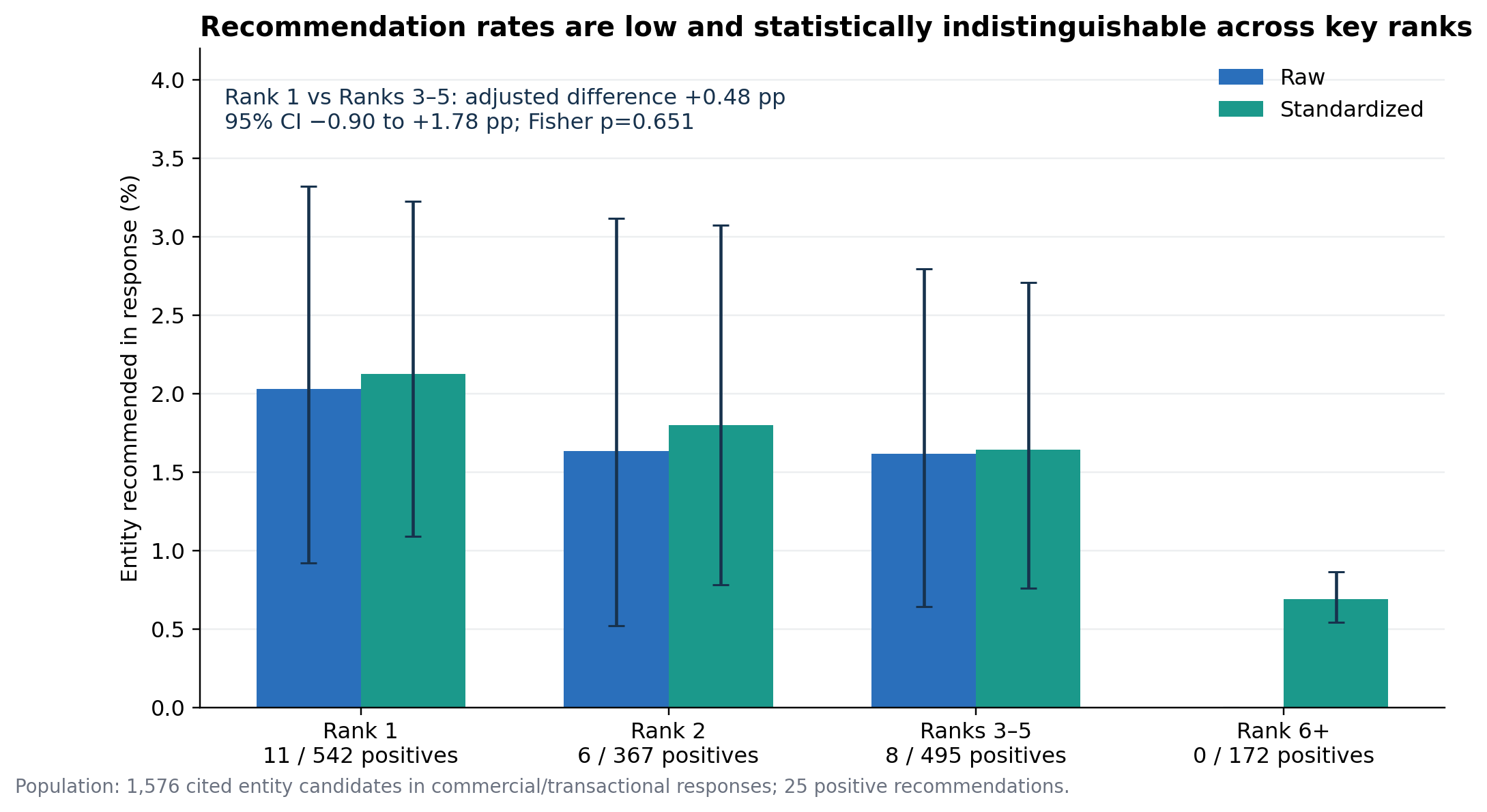
Not on the available evidence. Rank-1 source entities had an adjusted recommendation probability of 2.13% versus 1.64% at Ranks 3–5, a difference of only 0.48 percentage points. The 95% interval ranged from −0.90 to 1.78 points, and only 25 positive recommendations were observed overall.
Outcome distinction
Citation, mention and recommendation are separate outcomes
A source can be cited highly, its entity can be visible, and the entity can appear early while the answer still declines to recommend it. These observations become progressively stronger and should not be treated as interchangeable.
-
Cited or named
An entity may supply evidence, illustrate a market, or appear as a neutral comparison point.
-
Described or compared
Positive or comparative language still may not select an entity for the user.
-
Recommended
The answer makes an evaluative judgment about suitability for a stated need.
Report a recommendation only when the generated answer actually makes one.
Eligible frame
Recommendation was evaluated only where it was plausible
Informational and educational answers were not counted as recommendation failures merely because they did not recommend an entity. The analysis was restricted to commercial and transactional responses with at least one cited entity candidate.
- 542 responses
- Eligible commercial or transactional responses.
- 1,576 candidates
- Eligible response–entity candidates.
- 25 events
- Positive recommendations.
- Approximately 1.6%
- Positive rate across eligible candidate rows.
Raw results
Recommendation was rare at every citation rank
| Best cited-source rank | Positive recommendations | Candidate rows | Raw rate |
|---|---|---|---|
| Rank 1 | 11 | 542 | 2.03% |
| Rank 2 | 6 | 367 | 1.63% |
| Ranks 3–5 | 8 | 495 | 1.62% |
| Rank 6+ | 0 | 172 | 0.00% |
- Only 25 positive recommendations occurred
Recommendation appeared in approximately 1.6% of eligible rows. This sparse event count limits precision for small rank differences and strong entity-specific conclusions.
Central comparison
Rank 1 and Ranks 3–5 had similar raw rates
The raw recommendation rate was 2.03% at Rank 1 and 1.62% at Ranks 3–5. Rank 2 was similarly low at 1.63%. The raw Rank-1-versus-Ranks-3–5 Fisher exact p-value was 0.651, providing no credible evidence of a top-rank advantage.
Standardized analysis
Adjustment did not establish a recommendation advantage
Probabilities were standardized for evidence brand or entity density, finance topic, query intent and base query.
- Rank 1
- 2.13%
- Rank 2
- 1.80%
- Ranks 3–5
- 1.64%
- Rank 6+
- 0.69%
- Rank 1 minus Ranks 3–5: +0.48 percentage points
The 95% interval was −0.90 to 1.78 percentage points. Because it crosses zero, the contrast is unsupported and statistically inconclusive.
Statistical interpretation
Not supported does not mean proven equal
The available data do not provide credible evidence of a Rank-1 recommendation advantage. They do not prove that citation rank has zero relationship with recommendation or that every rank has an identical probability.
-
What is supported
The observed Rank-1 contrast was small, uncertain and crossed zero.
-
What remains uncertain
With only 25 events, a modest association could remain too imprecise to detect.
Sparse-data boundary
The Rank-6+ zero is not a deterministic rule
No positive recommendations occurred among 172 observed Rank-6+ candidates, producing a raw rate of 0.00%. That does not mean lower-ranked entities can never be recommended. Sparse outcomes can produce unstable extremes, while the standardized probability was 0.69%.
Explanatory hypotheses
Why visibility may not become endorsement
These are plausible explanations, not experimentally established mechanisms.
- Evaluative judgment
- Recommendation is stronger than descriptive mention.
- User fit
- Useful evidence does not establish provider suitability.
- Comparative evidence
- Price, capability, risk, geography and implementation constraints may matter.
- Cautious behavior
- Finance answers may avoid explicit endorsement, but this cause was not proven.
Outcome strength
Recommendation is an evaluative outcome
A source may be useful for evidence without its associated provider being suitable for the user. Recommendation requires the answer to move beyond representation and make a judgment about fit. Neither semantic alignment nor earlier visibility establishes that step.
Within-entity check
Entity-level comparisons were also inconclusive
Most entity-level cells contained zero positive recommendations in both conditions. A move from 0 recommendations in 3 observations to 1 recommendation in 5 observations creates an apparent 20-percentage-point difference, but it represents only one event.
- Large percentages from tiny denominators are hypothesis-generating, not confirmatory
Sparse entity cells do not establish stable recommendation effects.
Series finding
The observed rank signal stops before recommendation
Articles 2 and 3 found intermediate associations in semantic reflection, entity visibility and narrative position. Article 4 does not find a statistically credible extension to explicit recommendation. A high citation rank is a visibility signal, not evidence of endorsement.
Reporting implications
Measure downstream outcomes separately
-
Upstream exposure
Report citation coverage, citation position and source-to-answer semantic reflection.
-
Narrative presence
Report entity inclusion, first-mention position and comparative framing.
-
Recommendation
Record explicit recommendation directly rather than inferring it from a generic “AI visibility” score.
Next measurement layer
Stronger evidence needs more labeled events
A larger human-labeled study should distinguish whether an entity is:
-
Merely named
Present without evaluation.
-
Described positively
Framed favorably without a selection.
-
Included in a shortlist
Presented as one plausible option.
-
Comparatively preferred
Selected against alternatives.
-
Explicitly recommended
Recommended for a stated user need.
Repeated generations for the same prompt and source set would also expose stochastic variability around this rare outcome.
Causal design
Randomize citation order for the same entity
-
Hold inputs fixed
Keep the prompt, source set and source content unchanged.
-
Manipulate position
Randomize source order and generate repeated responses.
-
Measure the same entity
Separate recommendation from mention and positive description across randomized positions.
Key causal question: Does the same entity become more likely to be recommended when its source is moved to Rank 1?
The current observational study cannot answer that question.
Conclusion
A high citation rank is not evidence of endorsement
Rank-1 entities were not credibly more likely to be recommended than entities at Ranks 3–5. The adjusted difference was +0.48 percentage points, its 95% interval was −0.90 to 1.78 points, and the raw Fisher exact p-value was 0.651. With only 25 positive events, the defensible rule is to measure citation, mention and recommendation directly and separately.
Research details
How explicit recommendation was evaluated
The broad 1,500-response study design is documented in Article 1. This analysis used best, or minimum, observed cited-source rank as the exposure for each response–entity candidate.
- Eligible context
- Commercial and transactional responses with at least one cited entity candidate.
- Population
- 542 responses and 1,576 response–entity candidates.
- Standardization
- Evidence entity density, finance topic, query intent and base query.
- Inference
- Adjusted Rank-1-versus-Ranks-3–5 contrast plus a raw Fisher exact comparison.
Boundaries
Limitations
-
Observational design
Source position was not randomized, and adjustment does not eliminate unmeasured confounding.
-
Sparse events
Only 25 positive recommendations limit precision for small effects and entity-specific comparisons.
-
Explicit classification
Recommendation captures explicit selection rather than every form of positive sentiment.
-
Restricted population
Commercial and transactional eligibility changes the population under analysis.
-
Finance scope
Results may not generalize to other domains, platforms or collection conditions.
Narrative Fidelity series
Article 4 separates visibility from recommendation
-
Article 1 — Flagship synthesis
Do Top-Ranked Citations Shape AI-Generated Finance Answers?
-
Article 2 — Semantic alignment
Citation Rank and Semantic Alignment: Why Shared Sources Don’t Make AI Answers Converge
-
Article 3 — Brand visibility
Citation Rank and Brand Visibility: Why Higher-Ranked Source Entities Appear More Often and Earlier
-
Article 4 — Recommendation
A Citation Is Not an Endorsement
-
Article 5 — Research governance
What This Study Can—and Cannot—Prove About Citation Rank in AI Answers
Continue through the Kojable Research library. Article 5 closes the series with the governing denominators, causal boundaries and randomized source-order experiment.
FAQ
Frequently asked questions
Does a Rank-1 citation mean the AI recommends the company?
No. Rank-1 source entities had an adjusted recommendation probability of 2.13%, and the study did not establish a credible Rank-1 advantage over Ranks 3–5.
How many positive recommendations were observed?
Only 25 positive recommendation events occurred across 1,576 eligible response–entity candidates.
Was Rank 1 more likely to be recommended than Ranks 3–5?
The adjusted difference was +0.48 percentage points, but the 95% interval ranged from −0.90 to 1.78 points and crossed zero.
Does the result prove citation rank has no recommendation effect?
No. The study does not establish a credible Rank-1 recommendation advantage, but the sparse event count limits precision for small effects.
Does the zero Rank-6+ recommendation rate mean lower-ranked entities cannot be recommended?
No. No positive events occurred among the 172 observed Rank-6+ candidates, but sparse data should not be interpreted as a deterministic rule.