Kojable research · Narrative fidelity · Article 2
Citation Rank and Semantic Alignment: Why Shared Sources Don’t Make AI Answers Converge
Article 1 established the broad pattern. This technical continuation explains why shared Rank-1 sources did not make whole finance answers meaningfully more similar, even though Rank 1 received a small within-response semantic-alignment premium.
Key finding
Rank 1 showed a modest local alignment association without producing global answer convergence.
Qualification: This observational analysis does not establish that changing citation order would cause semantic alignment to change.
- Narrative fidelity
- Semantic alignment
- Citation rank
- Article 2 of 5
- 13 min read
Technical continuation
Article 1 established the pattern; Article 2 explains the tension
Article 1 of the Narrative Fidelity series separated four possible citation-rank outcomes across 1,500 generated finance responses. It found a modest semantic-alignment advantage and a clearer entity-visibility association at Rank 1, but no credible whole-answer similarity or recommendation effect.
This page addresses the apparent tension inside that result. How can Rank 1 align slightly more strongly with an answer without making answers that share the same Rank-1 source converge?
The answer is that the analyses estimate different relationships: whole-answer convergence versus within-answer evidence reflection.
Answer first
Can Rank 1 align locally without controlling the whole answer?
-
A modest local signal, not narrative control
Rank 1 was associated with a small within-response semantic-alignment premium. Sharing a Rank-1 source did not make complete answers meaningfully more similar. Those findings are compatible because one concerns local evidence reflection and the other concerns global answer convergence.
Rank 1 is associated with a small within-response semantic-alignment premium, but sharing a Rank-1 source does not make whole answers meaningfully more similar.
Estimands
Two questions that sound similar but are not
The distinction begins with the unit of analysis.
-
Global convergence compares answers with answers
If two responses cite the same source at Rank 1, are those two complete responses more semantically similar than a lower-ranked shared-source comparison group?
-
Local reflection compares evidence within one answer
Given the evidence opportunities inside a response, does the source at Rank 1 receive more alignment share than it would under random reassignment of those same source ranks?
Treating these estimands as interchangeable would turn a modest local association into an unsupported claim about global narrative control.
Finding 1 · Unsupported effect
Shared Rank-1 sources did not make whole answers more similar
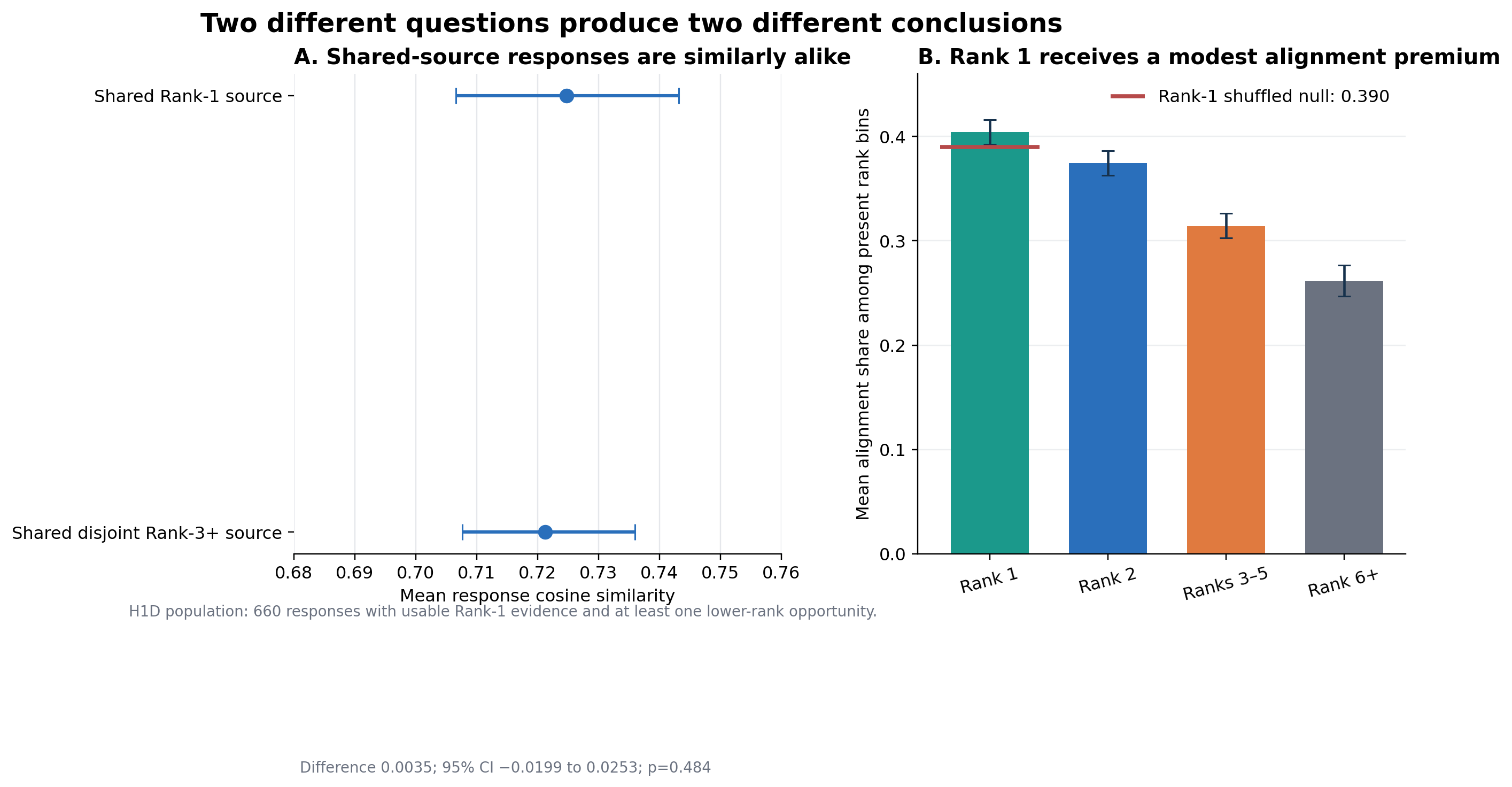
The Rank-1 comparison included 155 response pairs across 64 source-and-base-query cells. The lower-rank comparison included 200 pair occurrences—187 unique pairs—across 106 source-and-query cells.
Source/query cells received equal weight so that a highly common source could not dominate the estimate simply by producing many overlapping response pairs.
- Shared Rank-1 source
- Mean whole-answer cosine similarity: 0.7247.
- Shared Rank 3-or-lower source
- Mean whole-answer cosine similarity: 0.7213.
- Estimated difference
- 0.0035; 95% interval −0.0199 to 0.0253.
- Inference
- Directional permutation p-value 0.484; standardized effect approximately 0.045.
This is an effectively null result. The interval remains compatible with a small negative effect, no effect or a small positive effect. It does not support the claim that sharing the same first cited source meaningfully increases whole-answer similarity.
Interpretation
Why whole-answer similarity can stay flat
A shared source is only one input to a generated response. Two answers can cite the same source first and still diverge because of:
-
Other evidence
The answer can include different sources alongside the shared source.
-
Claim selection
Each response can emphasize different claims from the same source.
-
Answer structure
Organization and level of detail can remain substantially different.
-
User need
Scope, intent and domain context can change what the answer prioritizes.
-
Generative variability
Framing, synthesis and wording can vary across generations.
The null similarity result does not mean that the source contributes nothing. Whole-answer similarity is a demanding outcome: it asks whether two complete responses converge, not whether a particular piece of evidence leaves a detectable footprint inside each answer.
Finding 2 · Modest association
Rank 1 showed a modest within-response alignment advantage
The second analysis treated each response as its own evidence opportunity set. Evidence text was divided into chunks, response text into sections, and the strongest chunk-to-section similarities were summarized before sources were combined into the rank bins present in that response.
Exact source ranks were then shuffled within the same response while its answer, source set and source-level semantic scores stayed fixed.
Among 660 eligible responses, observed Rank-1 alignment share was 0.4043. The shuffled expectation was 0.3896. The difference was 0.0147, equivalent to 1.47 percentage points.
The 95% response-block interval was 0.0052 to 0.0241. The directional permutation p-value was 0.001, and the two-sided p-value was 0.004.
The association is statistically discernible but modest. It does not show that Rank 1 dominates the narrative, and it does not establish that moving a source into first cited position would cause stronger alignment.
Eligibility
The opportunity set is part of the result
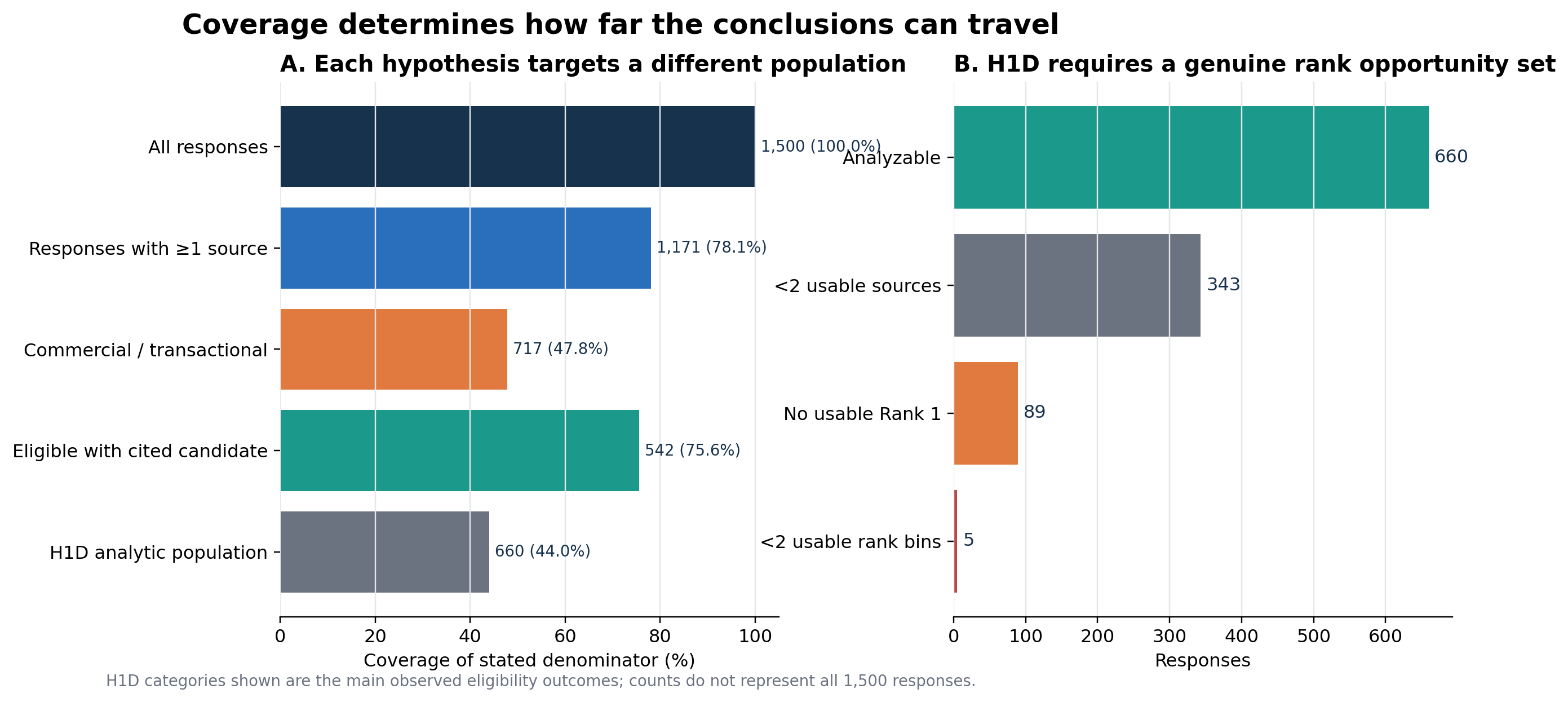
The 1.47-point estimate only has meaning where Rank 1 had usable lower-ranked evidence to compete against. The primary alignment population required:
-
Competing sources
At least two usable cited sources had to be present.
-
Rank-1 evidence
The first cited-source position needed usable evidence.
-
Lower-rank opportunity
At least one usable lower-rank bin had to be available.
-
Comparable text
The evidence needed enough chunks and the answer enough sections to calculate alignment.
The main outcomes were 660 analyzable responses, 343 with fewer than two usable sources, 89 without usable Rank-1 evidence and 5 with fewer than two usable rank bins.
Central distinction
Local evidence reflection is not global narrative convergence
Two answers can share the same first cited source while incorporating different additional evidence, choosing different claims, organizing those claims differently, serving different user needs and varying in framing or wording.
The shared source can therefore leave a modest local footprint without imposing a shared whole-answer narrative.
Interpretation
Narrative fidelity can increase locally without producing answer-level convergence.
Citation position is not meaningless, but it is not a reliable proxy for narrative control.
Measurement
Why this matters for AI-search measurement
A single rank compresses multiple stages into one number. A more useful measurement stack keeps them separate:
-
Source inclusion
Was the source cited at all?
-
Citation position
Where did it appear in the observed citation order?
-
Evidence reflection
How strongly did its evidence align with the answer?
-
Downstream outcomes
Did associated entities or claims appear, and did the answer move into comparison or recommendation?
Rank can remain one useful feature. It should not be treated as a complete measure of narrative impact or answer alignment.
Inference boundary
What this analysis does not prove
“Rank 1” means the first cited-source position in the observed answer. It is not a search-engine ranking and it does not directly reveal the model’s internal retrieval order.
The observed premium could reflect underlying source relevance, the match between evidence and the emerging answer, retrieval or citation-selection characteristics, citation position itself, or a combination of those factors.
-
No position causality
The study does not show that moving the same source to Rank 1 would cause its alignment share to increase.
-
No internal-order claim
Observed citation position should not be relabelled as internal retrieval rank.
-
No narrative-control claim
The small local association does not establish control over whole-answer wording, structure or interpretation.
Causal test
What would establish a citation-order effect?
A stronger experiment would hold substantive information constant and manipulate source order directly:
-
Fix prompt and source set
Use the same question and the same evidence in every condition.
-
Randomize source order
Move the same source between cited positions rather than comparing naturally different sources.
-
Repeat generations
Separate the order effect from ordinary generative variation.
-
Measure multiple outcomes
Evaluate source-to-answer alignment, entity and first-mention position, recommendation, factual accuracy and blinded human review where useful.
Conclusion
The narrower conclusion is the stronger one
The whole-answer similarity analysis provides little evidence that a shared Rank-1 source makes separate responses converge. The within-response analysis shows something subtler: first cited evidence received a small alignment premium relative to the opportunities available inside the same answer.
Those findings coexist because they operate at different levels. Rank 1 is associated with a modest local signal—not narrative control.
Research details
How the two analyses were constructed
For the full study design, dataset and four-outcome framework, see Article 1’s research details. Article 2 focuses on the methods needed to interpret similarity and alignment independently.
- Pair construction
- Whole responses were paired when they shared a source, with a Rank-1 group and a disjoint Rank-3-or-lower comparison group.
- Cell weighting
- Source/query cells received equal weight to prevent common sources from dominating through overlapping pairs.
- Whole-answer measure
- Cosine similarity summarized semantic resemblance between each complete response pair.
- Evidence processing
- Source evidence was chunked, responses were sectioned, and strong chunk-to-section similarities were summarized by source.
- Alignment null
- Exact source ranks were shuffled within each response, preserving its evidence opportunities and semantic scores.
- Eligible population
- Responses required usable Rank-1 and lower-rank evidence plus sufficient chunks and response sections for comparison.
Boundaries
Limitations
-
Observational position
Citation order was observed rather than randomized, so the alignment mechanism is not identified.
-
Selected opportunity set
The alignment estimate applies to 660 eligible responses, not to answers without usable competing evidence.
-
Semantic proxies
Cosine similarity and chunk-to-section alignment approximate semantic relationships; they are not direct measures of model reasoning or human-perceived influence.
-
Finance scope
Results come from finance responses and may differ across domains, platforms or collection conditions.
Narrative Fidelity series
Article 2 establishes the semantic-alignment layer
-
Article 1 — Flagship synthesis
Do Top-Ranked Citations Shape AI-Generated Finance Answers?
-
Article 2 — Semantic alignment
Citation Rank and Semantic Alignment: Why Shared Sources Don’t Make AI Answers Converge
-
Article 3 — Brand visibility
Citation Rank and Brand Visibility: Why Higher-Ranked Source Entities Appear More Often and Earlier
-
Article 4 — Recommendation
A Citation Is Not an Endorsement
-
Article 5 — Research governance
What This Study Can—and Cannot—Prove About Citation Rank in AI Answers
Continue through the Kojable Research library. All five Narrative Fidelity articles are now published.
FAQ
Frequently asked questions
Do shared Rank-1 sources make AI answers converge?
The study did not find meaningful convergence. Mean whole-answer similarity was 0.7247 for pairs sharing a Rank-1 source and 0.7213 for the lower-rank comparison, a 0.0035 difference whose interval crossed zero.
How large was the Rank-1 semantic-alignment premium?
Among 660 eligible responses, Rank-1 alignment share was 0.4043 versus a 0.3896 shuffled expectation: a modest 0.0147 difference, or 1.47 percentage points.
What does Rank 1 mean in this study?
Rank 1 means the first cited-source position in the observed answer. It is not a search-engine ranking and does not directly reveal internal retrieval order.
Does a 40.4% share mean Rank 1 gets 40% of every answer?
No. It is the average alignment share among eligible responses with usable competing evidence. The valid comparison is the response-specific shuffled expectation of about 39.0%, not a 25% four-bin baseline.
Would changing citation order cause alignment to change?
This observational study cannot establish that. A causal test would hold the prompt and source set fixed, randomize source order and compare repeated generations.