Kojable research · Narrative fidelity · Citation rank
Do Top-Ranked Citations Shape AI-Generated Finance Answers?
A study of 1,500 generated finance responses separates four possible rank effects: shared-source similarity, within-response semantic alignment, entity visibility and explicit recommendation.
Key finding
Rank 1 showed a modest semantic-alignment advantage and a clearer entity-visibility association, while shared-source similarity and recommendation effects were not credibly different from zero.
Qualification: This observational study does not establish that changing citation order would cause any of these outcomes.
- Narrative fidelity
- Citation rank
- Finance AI answers
- 15 min read
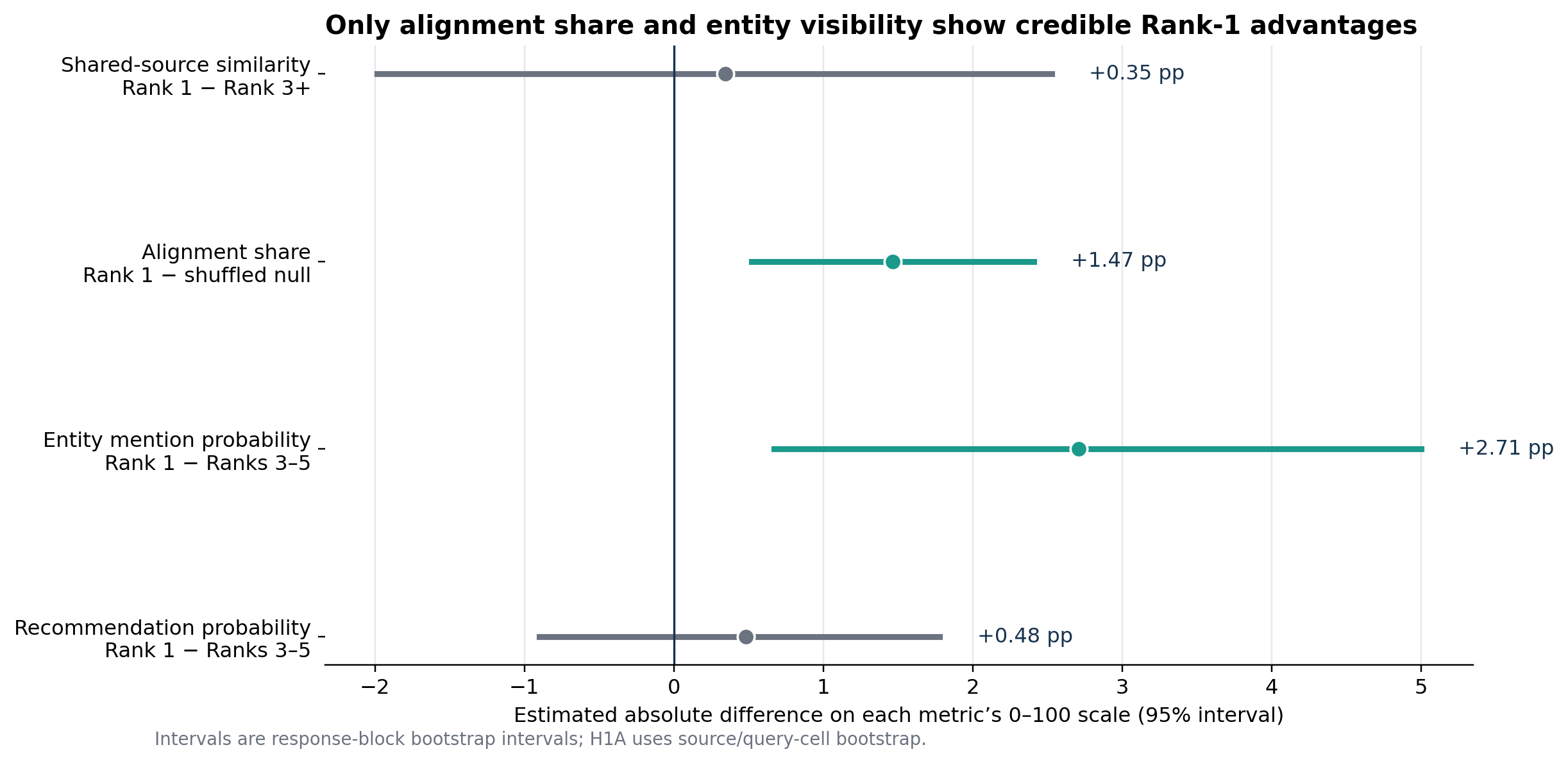
Study overview
Executive summary
The order of citations in an AI-generated answer feels consequential. A source listed first appears to have won the retrieval contest, making it tempting to assume that its ideas, entity names and recommendations will dominate the response.
The evidence is more restrained. Across 1,500 generated finance responses, Rank-1 evidence had a small but statistically discernible advantage in within-response semantic alignment. Entities associated with Rank-1 sources were also more likely to appear and tended to be introduced earlier.
Two stronger interpretations were not supported. Responses sharing a Rank-1 source were not meaningfully more similar to one another, and higher citation rank did not show a credible increase in explicit recommendation.
Rank 1 carries a modest narrative and visibility advantage, but it is neither narrative control nor endorsement.
Answer first
Do top-ranked citations shape AI-generated finance answers?
-
Modestly in alignment and visibility; not as control or endorsement
Rank 1 was associated with a 1.47-percentage-point alignment advantage over shuffled ranks and greater entity visibility. The study did not detect meaningful shared-source answer similarity or a reliable recommendation advantage, and its observational design cannot isolate citation position as the cause.
The four outcomes answer different questions. In this study, similarity ≠ alignment ≠ visibility ≠ recommendation.
Study design
What we studied
The dataset contains 1,500 generated responses split evenly across cash flow, payment processing and fraud detection. Prompts covered informational, educational, commercial and transactional intent.
- Response sample
- 500 cash-flow, 500 payment-processing and 500 fraud-detection responses.
- Citation coverage
- 1,171 responses contained at least one cited source; 329 did not.
- Citation records
- 3,797 citation rows across 3,039 distinct canonical sources.
- Four outcomes
- Shared-source response similarity, opportunity-aware semantic alignment, entity visibility and explicit recommendation.
Separating the outcomes prevents a citation from being treated as a generic unit of “influence.” Each measure represents a different stage between source inclusion and the final wording of an answer.
Finding 2 · Supported, but modest
Rank 1 had a modest within-response alignment advantage
A different question produced a different result. Rather than comparing separate answers, this analysis measured which available citation-rank bins aligned most closely with sections of each response. It then shuffled exact source ranks within each response to create the expected alignment share under the null.
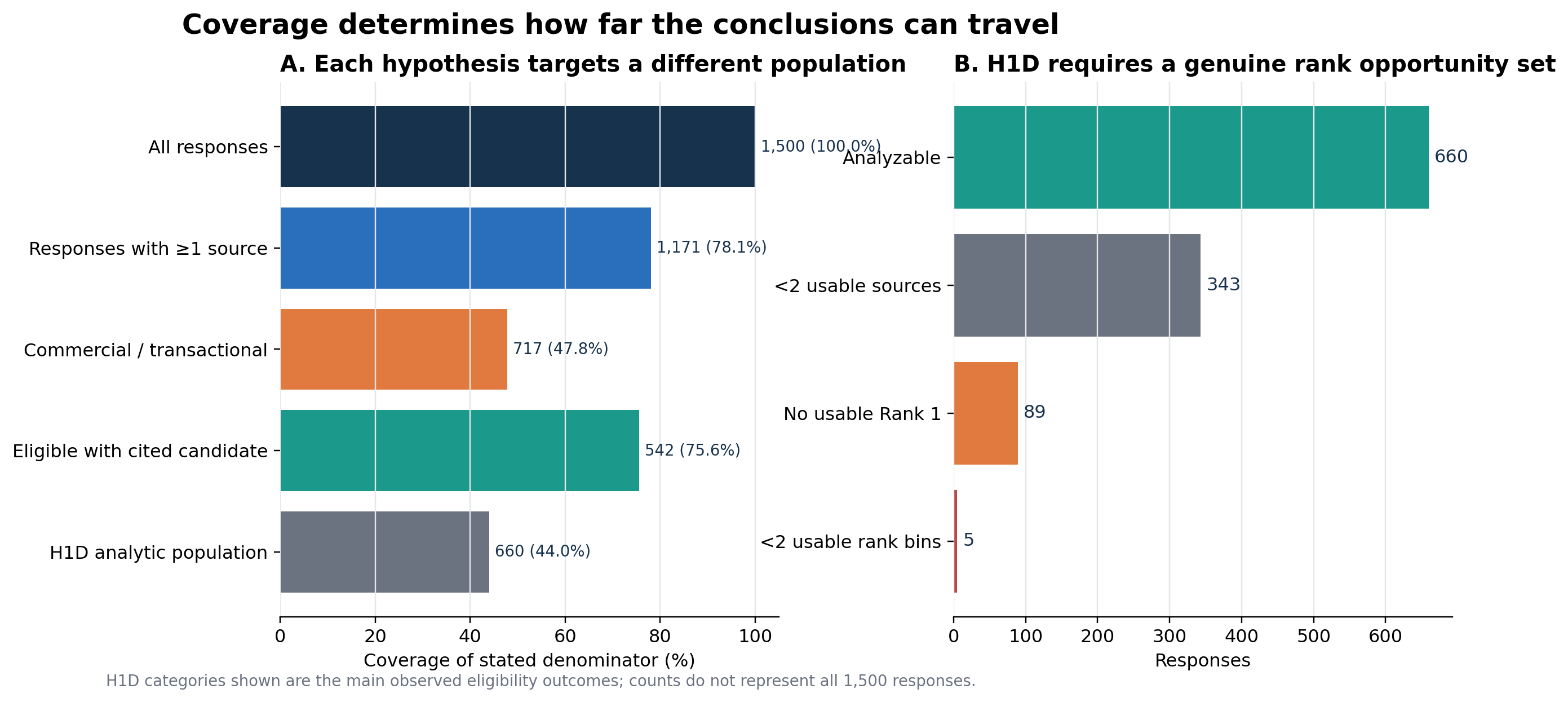
Among 660 responses with usable Rank-1 evidence and at least one lower-rank opportunity, the observed Rank-1 alignment share was 0.404. The shuffled expectation was approximately 0.390. The difference was 0.0147, or 1.47 percentage points, with a 95% response-level interval from 0.0052 to 0.0241. The directional permutation p-value was 0.001; the two-sided value was 0.004.
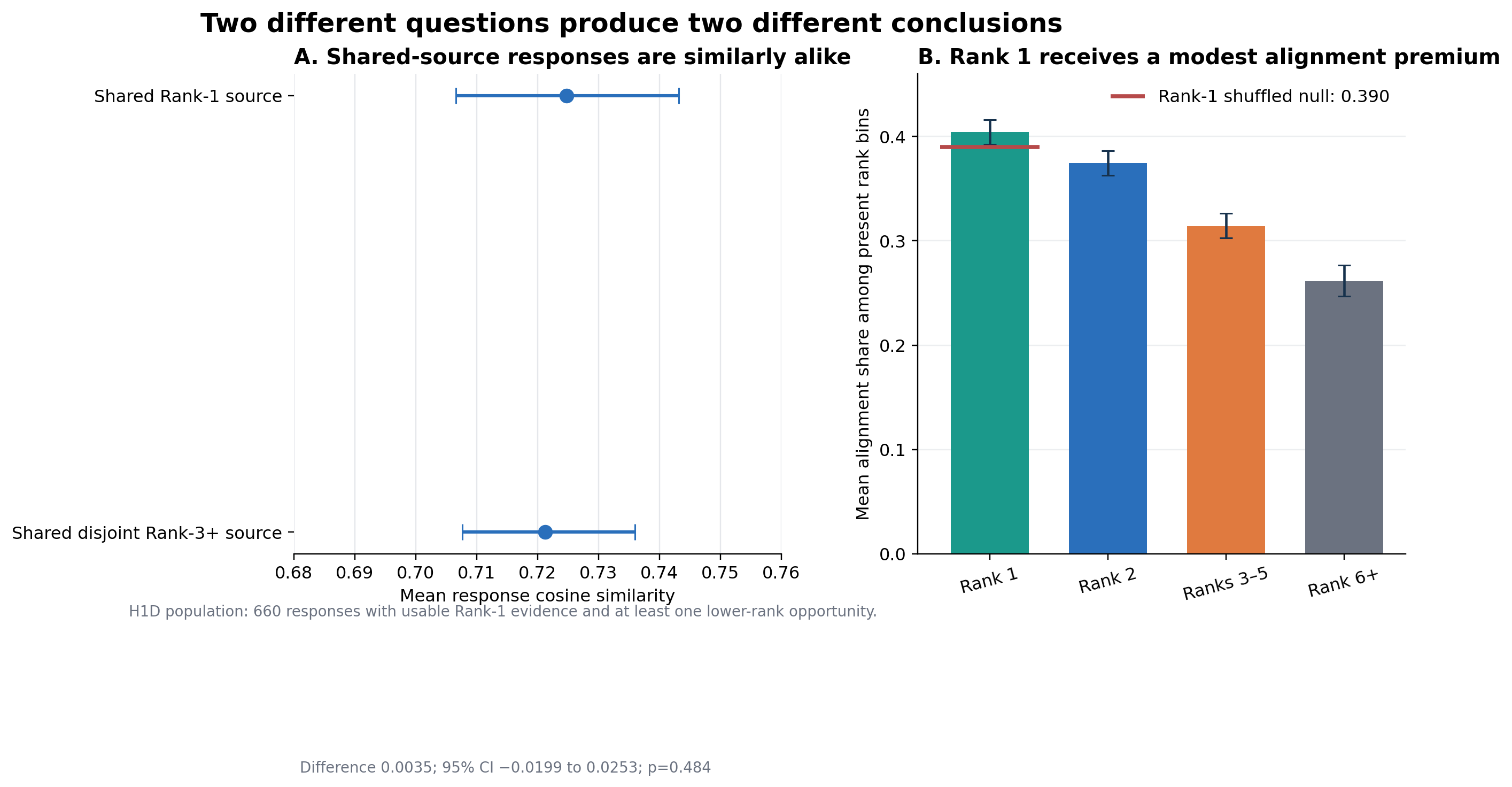
The size matters. A 1.47-percentage-point advantage is statistically discernible, but it is not dominance. The observational design also does not establish that experimentally moving a source into Rank 1 would make the answer align more closely with it.
Finding 3 · Observational association
Higher-ranked source entities were more visible
Raw entity mention rates declined with citation rank: 12.0% at Rank 1, 10.0% at Rank 2, 8.9% at Ranks 3–5 and 5.9% at Rank 6 or below.
After standardising for evidence brand density, finance topic, query intent and base query, the probabilities remained ordered: 11.7%, 10.2%, 9.0% and 6.5%, respectively. The adjusted Rank-1 minus Ranks-3–5 difference was +2.7 percentage points, with a 95% interval from 0.7 to 5.0. Rank 1 versus Rank 6+ was +5.2 points, with a 95% interval from 2.7 to 8.1. The Rank-1-versus-Rank-2 difference was less certain and should not be treated as established.
Mentioned Rank-1 entities first appeared about 33% of the way through a response, compared with 41% for Rank 2, 44% for Ranks 3–5 and 51% for Rank 6+.
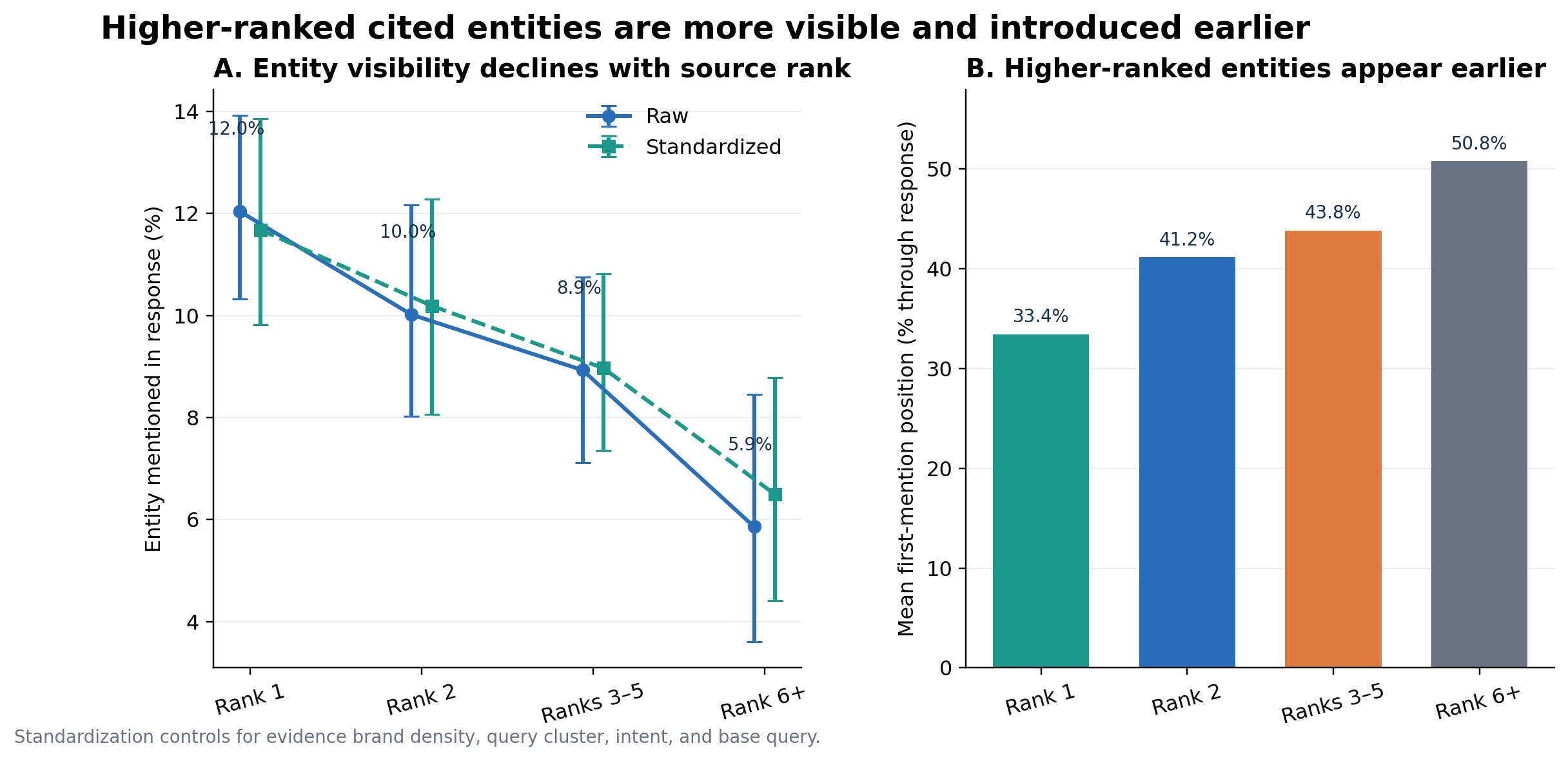
Higher rank may reflect better query fit, more salient entity cues, retrieval quality or other characteristics not fully observed here. Adjustment reduces several obvious alternatives but cannot isolate citation position as the mechanism.
Finding 4 · Unsupported effect
Citation rank did not translate into a credible recommendation advantage
Visibility is not endorsement.
The recommendation analysis covered 1,576 cited entity candidates in commercial and transactional responses, but only 25 positive recommendation events occurred. Raw recommendation rates were 2.03% at Rank 1, 1.63% at Rank 2, 1.62% at Ranks 3–5 and 0% at Rank 6+.
Standardised probabilities were 2.13%, 1.80%, 1.64% and 0.69%, respectively. The adjusted Rank-1 minus Ranks-3–5 difference was +0.48 percentage points, with a 95% interval from −0.90 to 1.78. Fisher’s exact p-value was 0.651.
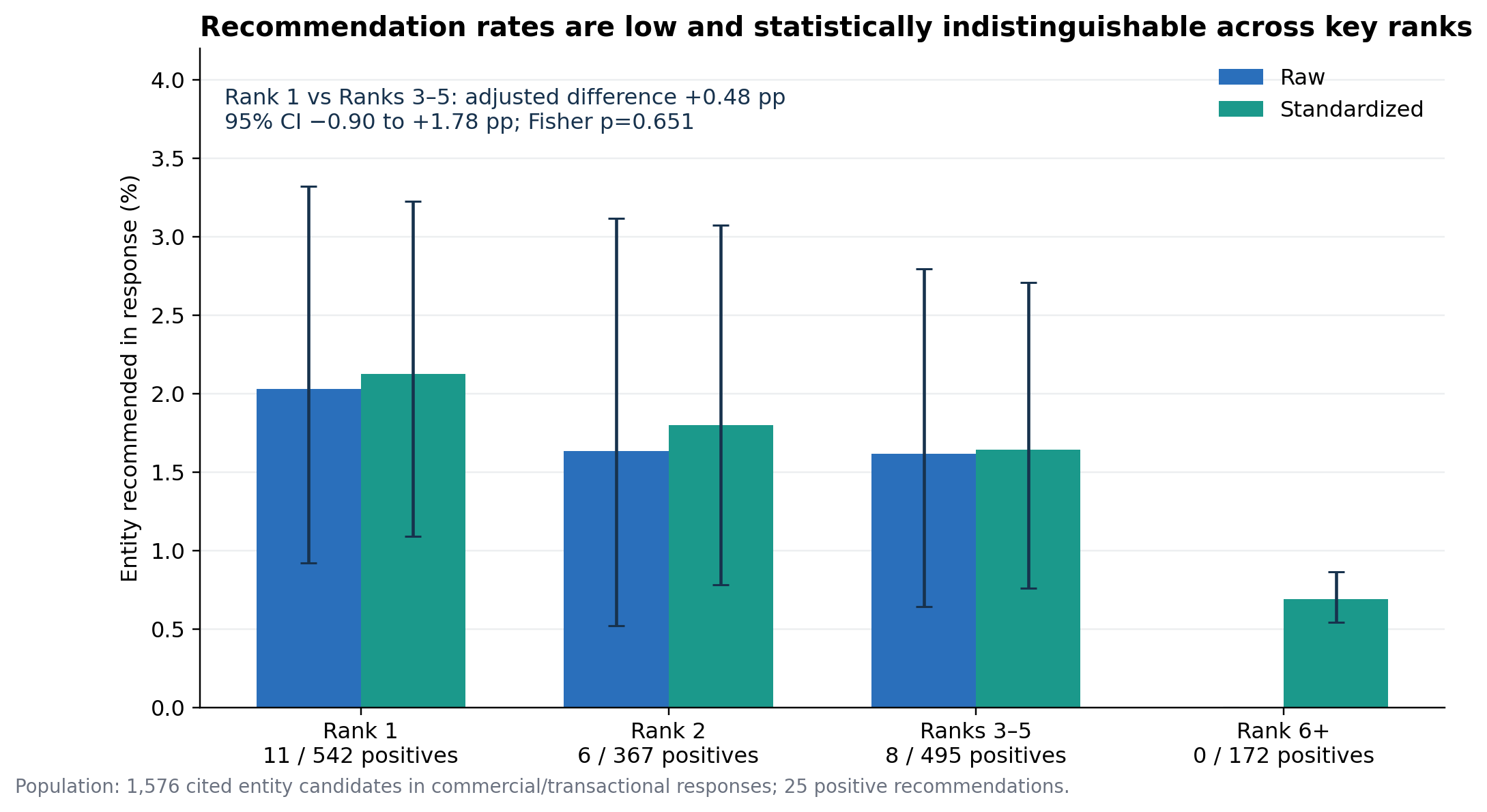
Interpretation: The available evidence is unsupported and imprecise, not proof that every small recommendation effect is impossible. It does rule out confidence in citation rank alone as a strong or reliable recommendation mechanism.
Coverage and opportunity
Each outcome has a different eligible denominator
Of 1,500 responses, 1,171 contained at least one cited source and 329 did not. Later analyses required additional opportunities: the alignment analysis needed usable Rank-1 evidence and at least one lower-rank opportunity, while recommendation was limited to cited entity candidates in commercial and transactional answers.
How far these findings travel
Rank is observed alongside relevance, retrieval quality and source characteristics
Citation position may be associated with source relevance, retrieval quality, evidence salience or other unobserved factors. The design therefore describes associations within this finance response dataset; it cannot isolate citation position as the causal mechanism.
The entity analysis uses domain-derived entity names rather than a fully human-curated brand taxonomy. This provides a consistent, conservative rule, but it can miss ambiguous or non-domain brand forms. Recommendation findings apply only to commercial and transactional responses with cited entity candidates.
Measurement system
Measure the path from inclusion to recommendation in stages
-
1. Source inclusion
Was the source present in the answer’s citation set?
-
2. Citation position
Where did the source appear among the citations?
-
3. Semantic and entity reflection
Did the answer reflect the evidence or mention its associated entity, and how early?
-
4. Explicit recommendation
Did the answer endorse the entity as suitable for the user’s goal?
The study finds evidence of movement across some of the first three stages. It does not establish a credible effect at the fourth.
Bounded interpretation
What the evidence supports
-
A small semantic-alignment advantage
Top citation position is associated with a modest increase in evidence-to-answer alignment among eligible responses.
-
A clearer entity-visibility association
Higher-ranked source entities appear more often and earlier, particularly when Rank 1 is compared with sources below Rank 2.
-
Recommendation remains a separate outcome
Citation rank alone is not reliable evidence that an entity will be recommended.
Claim boundary
What the evidence does not support
-
No narrative control
Rank 1 did not make answers sharing a source meaningfully more alike and did not absorb most semantic alignment.
-
No endorsement inference
A first-position citation is not evidence that the AI system endorses or will recommend its associated entity.
-
No position causality
The study does not show that moving a citation to Rank 1 would cause greater alignment, visibility or recommendation.
Next causal research step
Randomise source order while holding the prompt and evidence fixed
A stronger future experiment should distinguish citation order from source relevance and retrieval quality. It should:
-
Hold the prompt and source set fixed
Randomly vary only source ordering across otherwise comparable conditions.
-
Use repeated generations
Separate order effects from ordinary model variability.
-
Add blinded human review where appropriate
Keep reviewers unaware of source-order assignment when evaluating qualitative outcomes.
-
Measure the complete outcome sequence
Record semantic alignment, entity mentions, first-mention position, recommendation and factual accuracy.
This is the proposed causal follow-up, not the design used for the observational study reported on this page.
Study summary
Four outcomes, four separate conclusions
| Outcome | Effect | Conclusion | Reason |
|---|---|---|---|
| Shared-source response similarity | +0.0035 versus Rank 3+ | Not supported | 95% interval crosses zero. |
| Opportunity-aware alignment share | +0.0147 versus shuffled ranks | Supported, but modest | Positive response-level interval; small magnitude. |
| Adjusted entity mention probability | +0.0271 versus Ranks 3–5 | Supported | Adjusted interval remains above zero. |
| Adjusted recommendation probability | +0.0048 versus Ranks 3–5 | Not supported | Interval crosses zero; only 25 positive events. |
Methodology and research details
Opportunity-aware tests preserve the question each outcome asks
Shared-source similarity compared response pairs that shared a Rank-1 source with pairs sharing a disjoint Rank-3-or-lower source. Cosine similarity summarised answer-to-answer semantic proximity, with permutation inference and a standardised effect used to assess the observed difference.
Within-response alignment summarised usable evidence at the source level, compared only rank bins present in each eligible answer and shuffled exact source ranks within the response. This preserves the answer’s available citation opportunities while estimating the expected Rank-1 share under exchangeable ranks.
Entity visibility recorded domain-derived entity mentions and first-mention position. Adjusted probabilities standardised over evidence brand density, finance topic, query intent and base query. Recommendation analysis then narrowed the population to cited entity candidates in commercial and transactional responses.
Figures were generated from the study’s retained figure-source data and reproducible build script. The production page serves copied PNG assets so editorial source materials remain separate from public web paths.
Limitations
Interpret position as an association, not an intervention
-
Observational design
Citation position may travel with relevance, retrieval quality or other unobserved factors. Position was not randomised.
-
Outcome-specific coverage
329 responses had no cited source, alignment required usable Rank-1 and lower-rank opportunities, and recommendation covered only eligible commercial and transactional responses.
-
Entity taxonomy
Domain-derived entity names are not equivalent to a fully human-curated brand taxonomy.
-
Rare recommendation events
Only 25 positive events materially limit precision and the ability to distinguish small differences between rank groups.
-
Finance scope
Results come from three finance topics and four prompt-intent classes; other domains, models or collection conditions may differ.
Narrative Fidelity series
This flagship synthesis begins the completed five-part sequence
This page establishes the full study and its overall result. All five Narrative Fidelity articles are now published:
-
Citation Rank and Semantic Alignment
Article 2 explains shared-source similarity versus within-answer alignment.
-
Citation Rank and Brand Visibility
Entity mentions, first-mention position and discoverability.
-
A Citation Is Not an Endorsement
Citation position versus explicit recommendation.
-
What This Study Can—and Cannot—Prove
Research governance, inference boundaries and the next causal experiment.
Continue through the Kojable Research library or read the related study of query-to-passage semantic relevance. The five-part Narrative Fidelity series is complete.
FAQ
Frequently asked questions
Do top-ranked citations control AI-generated finance answers?
No. Rank 1 had a modest within-response alignment advantage and a clearer entity-visibility association, but shared Rank-1 evidence did not make separate answers meaningfully more alike.
How large was the Rank-1 semantic-alignment advantage?
Among 660 eligible responses, Rank 1 received an alignment share of 0.404 versus an approximately 0.390 shuffled expectation: a 0.0147 difference, or 1.47 percentage points.
Were Rank-1 source entities more visible?
Yes, observationally. Adjusted entity mention probability was 11.7% at Rank 1, compared with 9.0% at Ranks 3–5 and 6.5% at Rank 6+. Mentioned Rank-1 entities also appeared earlier on average.
Did Rank 1 make an entity more likely to be recommended?
The study did not establish a credible recommendation advantage. Only 25 positive events occurred, and the adjusted Rank-1 versus Ranks-3–5 interval crossed zero.
Would moving a source to Rank 1 cause these outcomes?
This observational study cannot answer that causal question. A stronger experiment would hold prompts and source sets fixed, randomise source order and use repeated generations with blinded review where appropriate.