Kojable research · Narrative fidelity · Article 3
Citation Rank and Brand Visibility: Why Higher-Ranked Source Entities Appear More Often and Earlier
Article 1 established the broader pattern, while Article 2 separated evidence reflection from narrative control. Article 3 isolates the next downstream question: when a source is cited, does its associated entity appear in the answer, and how early?
Key finding
Higher citation rank was associated with greater source-entity visibility and earlier first-mention position, particularly when Rank 1 was compared with ranks below two.
Qualification: This observational study does not establish that moving a source to a higher cited position would cause its associated entity to appear or appear earlier.
- Narrative fidelity
- Brand visibility
- Entity visibility
- Citation rank
- Article 3 of 5
- 14 min read
Technical continuation
Article 3 follows evidence from citation to visible entity
Article 1 established the broad result across four outcomes. It found modest Rank-1 alignment and a clearer entity-visibility relationship, but no credible whole-answer similarity or recommendation effect.
Article 2 then separated whole-answer convergence from within-answer evidence reflection. Article 3 moves one step further through the pathway: from cited evidence to the source-associated entity that a reader can actually see.
The central distinction is simple: citation presence is not entity presence, and entity presence is not endorsement or recommendation.
Answer first
Does higher citation rank make a source entity more visible in an AI answer?
-
A graded association, not a visibility guarantee
Higher citation rank was associated with greater entity visibility and earlier first-mention position, particularly when Rank 1 was compared with ranks below two. But most Rank-1 source entities were still not named, Rank 1 was not clearly separated from Rank 2, and citation position was not randomized.
Measurement sequence
Citation presence is not entity presence
A citation list shows that a source survived into the final answer. It does not show whether the organization or product associated with that source entered the generated prose. A source can support a factual claim while its entity remains absent from the answer.
-
Source inclusion
Was the source cited at all?
-
Citation position
Where did it appear among citations?
-
Semantic reflection
Was its evidence reflected in the answer?
-
Entity visibility
Was the associated entity named?
-
First-mention position
How early did it enter the answer?
-
Framing
Was the treatment descriptive or evaluative?
-
Explicit recommendation
Was the entity actually recommended?
Article 2 focused on semantic reflection. Article 3 focuses on entity visibility and first-mention position. Article 4 tests whether that visibility gradient extends to explicit recommendation.
Unit of analysis
3,668 unique response–entity observations
One observation represented a unique response × source entity. When the same entity appeared through multiple cited URLs or ranks in a response, its best—or minimum—cited-source rank defined exposure.
- Rank 1
- 1,171 response–entity observations
- Rank 2
- 838 response–entity observations
- Ranks 3–5
- 1,198 response–entity observations
- Rank 6+
- 461 response–entity observations
Entity identities were derived conservatively from source domains and matched with token-bounded aliases designed to reduce substring collisions. This is not a fully human-curated brand taxonomy. Throughout this article, “brand visibility” therefore means the narrower outcome of measured source-entity visibility.
Raw results
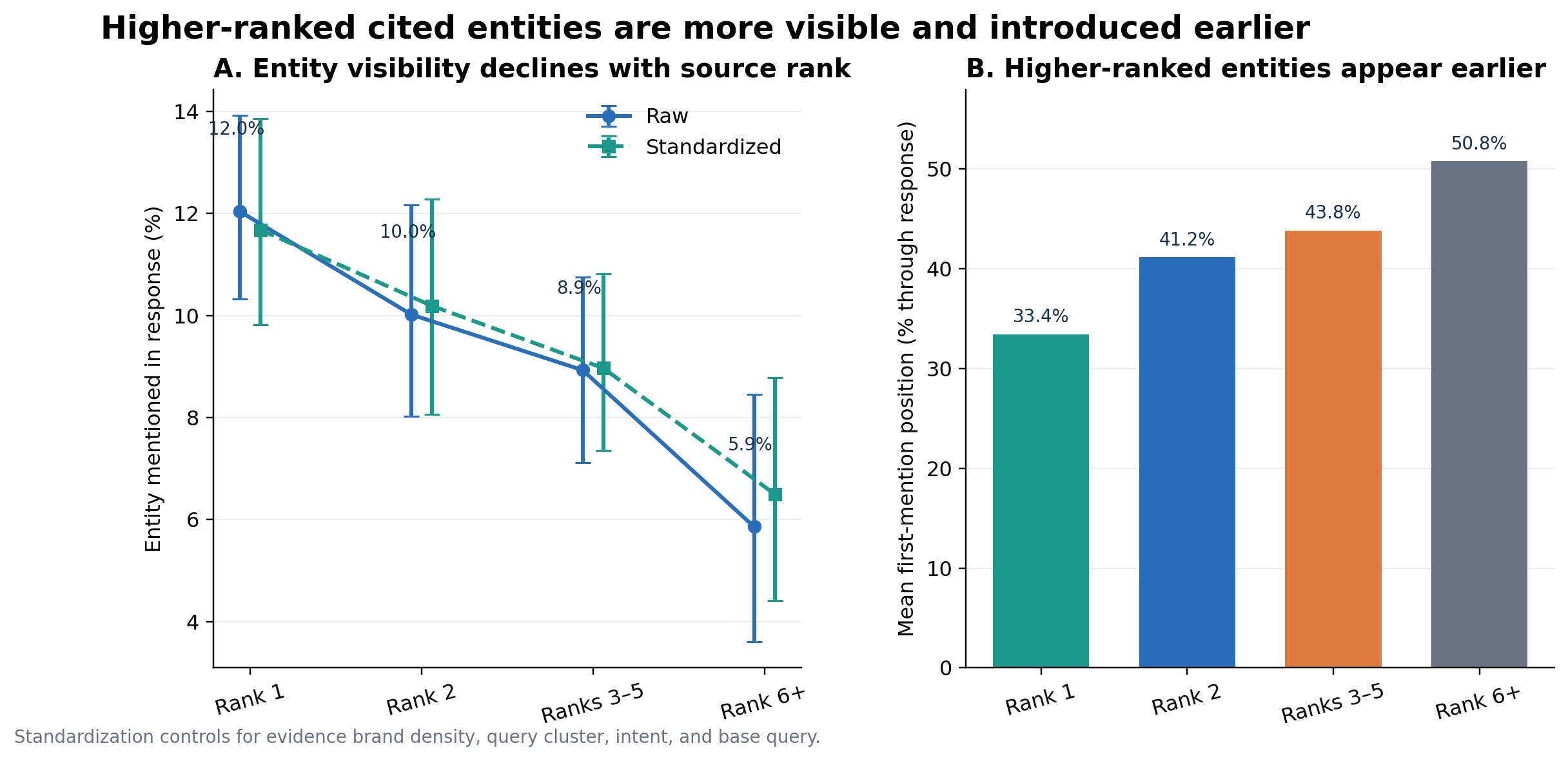
Entity visibility declined monotonically with citation rank
| Best cited-source rank | Mentioned | Candidate rows | Mention rate |
|---|---|---|---|
| Rank 1 | 141 | 1,171 | 12.0% |
| Rank 2 | 84 | 838 | 10.0% |
| Ranks 3–5 | 107 | 1,198 | 8.9% |
| Rank 6+ | 27 | 461 | 5.9% |
Adjustment
Why raw comparisons are insufficient
Citation rank was not assigned randomly. Source material can differ in how strongly it names its own entity, and finance questions differ in how naturally they invite company or product names. Base queries also create different opportunities for entity inclusion.
The analysis standardized for entity or brand-mention density in the evidence text, finance cluster, query intent and base query. Standardization reduces several obvious alternative explanations; it does not eliminate unmeasured confounding or make the result causal.
Standardized results
The visibility gradient remained after standardization
- Rank 1
- 11.7%; 95% interval 9.8% to 13.9%
- Rank 2
- 10.2%; 95% interval 8.1% to 12.3%
- Ranks 3–5
- 9.0%; 95% interval 7.4% to 10.8%
- Rank 6+
- 6.5%; 95% interval 4.4% to 8.8%
The adjusted Rank-1-minus-Ranks-3–5 contrast was +2.7 percentage points, with a 95% response-block interval from 0.7 to 5.0 points. Rank 1 minus Rank 6+ was +5.2 percentage points, with an interval from 2.7 to 8.1 points.
Those contrasts support a visibility association between Rank 1 and materially lower cited-source positions. They do not show that citation position caused the difference.
Important qualification
Rank 1 was not clearly separated from Rank 2
The adjusted Rank-1-minus-Rank-2 difference was +1.5 percentage points, with a 95% interval from −0.7 to 3.6 points. Because the interval crosses zero, the data do not support a clean or reliable distinction between first and second cited positions.
The strongest supported Rank-1 visibility differences are against materially lower positions, particularly Ranks 3–5 and Rank 6+.
Narrative position
Higher-ranked entities also tended to appear earlier
For source entities that were actually mentioned, the first occurrence was measured as a proportion of total response length. Average first-mention positions were:
- Rank 1 · 33.4%
- About the first third of the response.
- Rank 2 · 41.2%
- Later than the Rank-1 group on average.
- Ranks 3–5 · 43.8%
- Approaching the middle of the response.
- Rank 6+ · 50.8%
- About halfway through the response.
This analysis is conditional on the entity being mentioned. Among mentioned source entities, higher citation rank was associated with earlier first appearance in the response. Earlier placement does not establish influence, favorability, endorsement or recommendation.
Hypotheses
Several mechanisms could produce the visibility gradient
-
Underlying relevance
Sources may occupy higher positions because their content and associated entities fit the query more naturally.
-
Entity salience in the evidence
Some sources connect an entity more clearly to a concrete claim than a simple mention-density count can capture.
-
Citation or context ordering
Ordering might matter during synthesis, but the observational design cannot isolate such an effect.
-
Source-set composition
Surrounding evidence may reinforce the same entity or claim, and that source set was not experimentally controlled.
These mechanisms are hypotheses, not findings. The current study cannot determine how much of the gradient belongs to cited-source position itself versus the characteristics that placed a source there.
Interpretation boundary
Earlier visibility is not endorsement
-
Cited
The source appears in the citation list.
-
Named
The source-associated entity appears in the answer.
-
Named early
Its first mention occupies an earlier narrative position.
-
Recommended
The answer makes the stronger endorsement outcome explicit.
Article 3 provides evidence about the middle of that sequence: entity inclusion and first-mention position. It does not establish favorable description, comparative success or recommendation.
Measurement stack
Citation rank is an upstream signal, not the final visibility metric
Even the highest adjusted mention probability—11.7% at Rank 1—means that most source entities were not named. Measuring only “cited at Rank 1” would miss the distinction between evidence supporting an answer in the background and an entity being surfaced to the reader.
- Citation presence
Track whether a source was included.
- Citation position
Record where the cited source appeared.
- Semantic reflection
Measure whether the answer used the evidence.
- Entity presence
Measure whether the associated entity was named.
- First-mention position
Locate where the visible entity entered the response.
- Framing and recommendation
Evaluate downstream treatment separately.
Information quality
Practical content implications should remain defensible
The study does not establish that raw brand repetition causes AI visibility. A more defensible objective is to make the relationship between entity, claim and evidence easy to interpret.
- Clear entity identification
Name the organization, product or service without ambiguity.
- Concrete factual evidence
Connect specific claims to support a reader can verify.
- Direct relevance
Address the likely user question rather than relying on repetition.
- Explicit entity-to-claim relationships
Provide enough context to reduce unnecessary inference.
These are information-quality practices, not experimentally validated levers for moving a source to Rank 1 or causing an entity mention.
Causal boundary
What this analysis does not prove
“Rank 1” means the first cited-source position in the observed answer. It is not a search-engine ranking and not a directly observed internal retrieval order.
- No position causality
The analysis cannot show that citation position increased entity visibility.
- No Rank-1 guarantee
Most Rank-1 source entities were not named.
- No clear first-versus-second result
The adjusted Rank-1-minus-Rank-2 interval crossed zero.
- No endorsement inference
Earlier first mention does not establish sentiment, influence or recommendation.
Causal test
What would establish a citation-order effect on visibility?
- Hold prompt, source set and content fixed
Keep the substantive information identical across conditions.
- Randomize source order
Move the same source between positions rather than comparing different sources.
- Repeat generations
Separate an ordering effect from ordinary generative variation.
- Measure downstream outcomes independently
Track entity mention, first-mention position, alignment, framing and recommendation.
That design would test whether the same source entity becomes more visible when its source is moved to the first cited position. Until position is randomized, the current result should remain an association.
Conclusion
The narrower conclusion is the useful one
Entities associated with higher-ranked cited sources were more likely to appear in generated finance answers. When they appeared, higher-ranked entities also tended to enter the response earlier. The clearest adjusted visibility differences were between Rank 1 and ranks below two.
But most Rank-1 source entities still were not named, Rank 1 was not cleanly separated from Rank 2, and the study cannot establish that citation position caused the gradient. Citation rank is a useful diagnostic signal—not a causal lever, endorsement signal or substitute for measuring the answer.
Research details
How entity visibility was measured
For the broader 1,500-response study design, see Article 1’s research details. Article 3 focuses on the entity-level design needed to interpret visibility and first-mention position.
- Observation
- One unique response × source entity.
- Rank assignment
- The entity’s best/minimum cited-source rank within the response.
- Entity identity
- Conservatively derived from source domains.
- Text matching
- Token-bounded aliases reduced short-name substring collisions.
- Raw outcome
- Whether the source-associated entity appeared in the answer text.
- Standardization
- Evidence mention density, finance cluster, query intent and base query.
- Narrative position
- First entity occurrence as a proportion of response length, conditional on mention.
- Design
- Observational; cited-source position was not randomized.
Boundaries
Limitations
- Observational design
Citation position was observed rather than randomized.
- Domain-derived identity
Entity matching is not a fully human-curated brand taxonomy.
- Conditional first-mention analysis
Narrative position was measured only when an entity was mentioned.
- Residual confounding
Standardization cannot eliminate unmeasured differences in relevance or salience.
- Uncontrolled source sets
Surrounding evidence may influence both rank and entity visibility.
- Finance-domain scope
Results may not generalize to other domains, platforms or collection conditions.
Narrative Fidelity series
Article 3 measures the transition from citation to visible entity
-
Article 1 — Flagship synthesis
Do Top-Ranked Citations Shape AI-Generated Finance Answers?
-
Article 2 — Semantic alignment
Citation Rank and Semantic Alignment: Why Shared Sources Don’t Make AI Answers Converge
-
Article 3 — Brand visibility
Citation Rank and Brand Visibility: Why Higher-Ranked Source Entities Appear More Often and Earlier
-
Article 4 — Recommendation
A Citation Is Not an Endorsement
-
Article 5 — Research governance
What This Study Can—and Cannot—Prove About Citation Rank in AI Answers
Continue through the Kojable Research library. Articles 4 and 5 complete the recommendation and research-governance stages.
FAQ
Frequently asked questions
Does a Rank-1 citation guarantee that a company will be mentioned?
No. The raw Rank-1 source-entity mention rate was 12.0%, and the adjusted probability was 11.7%. Most Rank-1 entities were not named.
Was Rank 1 clearly more visible than Rank 2?
No. The adjusted Rank-1-minus-Rank-2 difference was 1.5 percentage points, with a 95% interval from −0.7 to 3.6 points.
Where were Rank-1 entities first mentioned?
Among entities that were mentioned, Rank-1 entities first appeared on average about 33.4% through the response.
Does appearing earlier mean an entity was endorsed?
No. Earlier first-mention position measures narrative placement, not sentiment, comparison outcome, endorsement or recommendation.
Does the study prove that moving a source to Rank 1 increases brand visibility?
No. Citation position was observed rather than randomized, so the study does not establish a causal citation-position effect.