An anonymised B2B case study · Company A · September–November 2026
From 2.42% to 12.12%: A B2B AI Search Visibility Case Study
- Average unprompted AI visibility
September 2.42% · November 12.12% - +9.70 percentage points
- Distinct prioritised third-party target URLs observed in AI citations
- 1 → 6
- Third-party source opportunities Kojable researched and prioritised
- 129
Company A rarely appeared in AI answers to questions its prospective buyers ask. Kojable measured that starting point, investigated the sources behind the answers and identified third-party pages that could provide better information. External creators worked on content separately. In the matched November recheck, Company A appeared more often and more of the selected pages appeared in citations.
What the evidence showed
Company A appeared more often in answers to buyer questions that did not name it. The retained answers also cited more distinct pages from the prioritised list.
| Measured outcome | September | November | Observed difference |
|---|---|---|---|
| Average unprompted company visibility | 2.42% | 12.12% | +9.70 percentage points |
| Distinct URLs cited from the 129-target list | 1 | 6 | Five additional URLs |
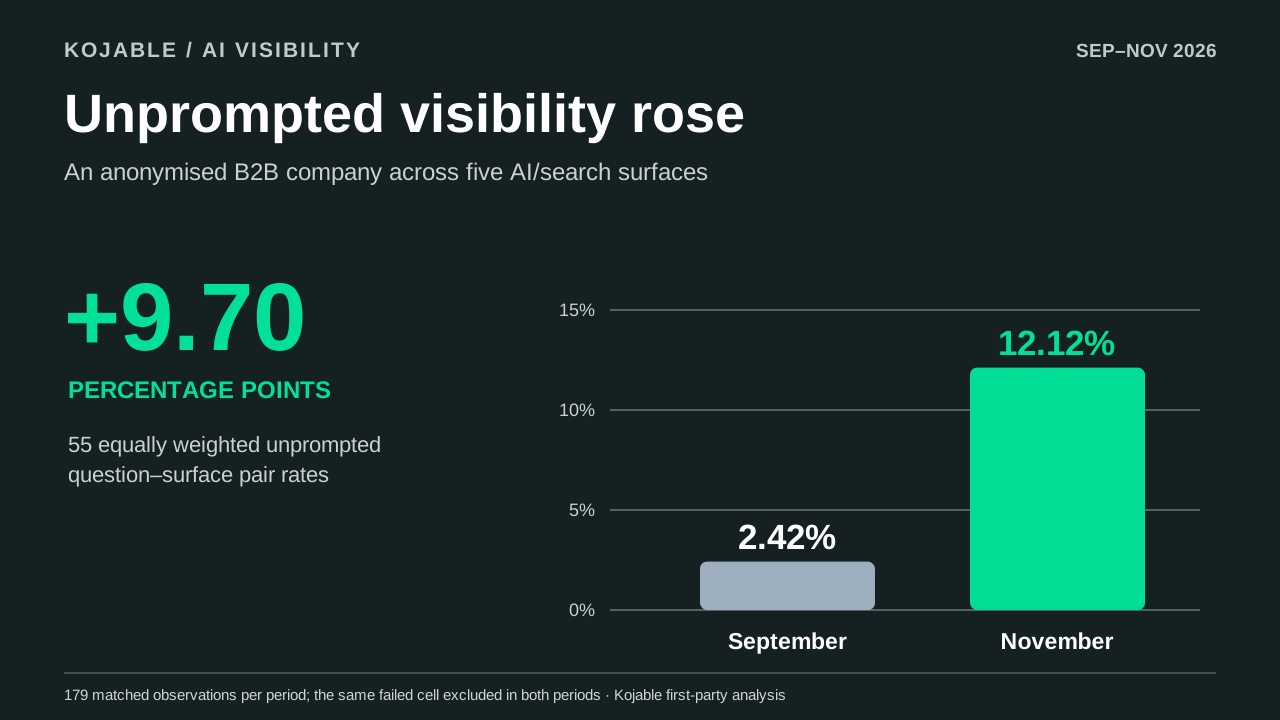
The chart shows the average mention rate for the same unprompted buyer questions and AI surfaces in each period.
These results come from a matched September–November observational comparison. The study does not establish causation or commercial impact.
What Kojable investigated
-
Measure
Establish how often Company A appeared in AI answers across the selected buyer-question panel.
-
Investigate
Examine cited sources and assess relevant third-party pages for information gaps.
-
Prioritise
Produce a ranked workbook of 129 third-party source opportunities.
-
Recheck
Repeat the matched panel and analyse company mentions and citations.
During this one-time engagement, Kojable organised source URLs by buyer question and AI surface. The team checked which pages were accessible, what they covered, who published them where that could be established, and where useful context was missing. The workbook ranked pages for consideration as part of Kojable's Creator & Publisher Intelligence work.
Kojable supplied the research and measurement. External creators handled content production separately. The workbook records source opportunities, and the follow-up records observed citations. The case records do not link specific creator work to the five URLs newly observed in November.
Where Company A started in September
Our first measurement showed a substantial gap between the buyer questions Company A cared about and the AI answers that named it.
The September benchmark used 12 selected buyer questions across five AI and search surfaces: ChatGPT, Claude, Gemini, Google AI Mode and Google AI Overview. Each question–surface combination was planned for three repetitions. Eleven questions did not name the company and were eligible for unprompted visibility measurement; one explicitly named it and was analysed separately.
Of the 165 planned unprompted observations, one Google AI Overview response failed technically. After that failure was excluded, the company appeared in four of 164 usable answers, or approximately 2.4%.
That was a clear starting point: within this selected panel, the company seldom appeared when a buyer had not already named it. It was not a diagnosis of the hidden cause. The company could have been absent for several reasons, including the available source environment, retrieval, selection or how the final answer was composed. The recorded answers alone could not distinguish those possibilities.
The September baseline case study explains the original measurement design. This follow-up tracks Company A.
How did the five AI surfaces differ?
Google AI Overview and Claude recorded the largest gains in this panel, at 21.21 percentage points each. Google’s measured surfaces improved overall as AI Overview and Gemini rose. Google AI Mode and ChatGPT held steady.
| AI/search surface | September | November | Change (percentage points) |
|---|---|---|---|
| Claude | 6.06% | 27.27% | +21.21 |
| Google AI Overview | 3.03% | 24.24% | +21.21 |
| Gemini | 0.00% | 6.06% | +6.06 |
| Google AI Mode | 3.03% | 3.03% | 0.00 |
| ChatGPT | 0.00% | 0.00% | 0.00 |
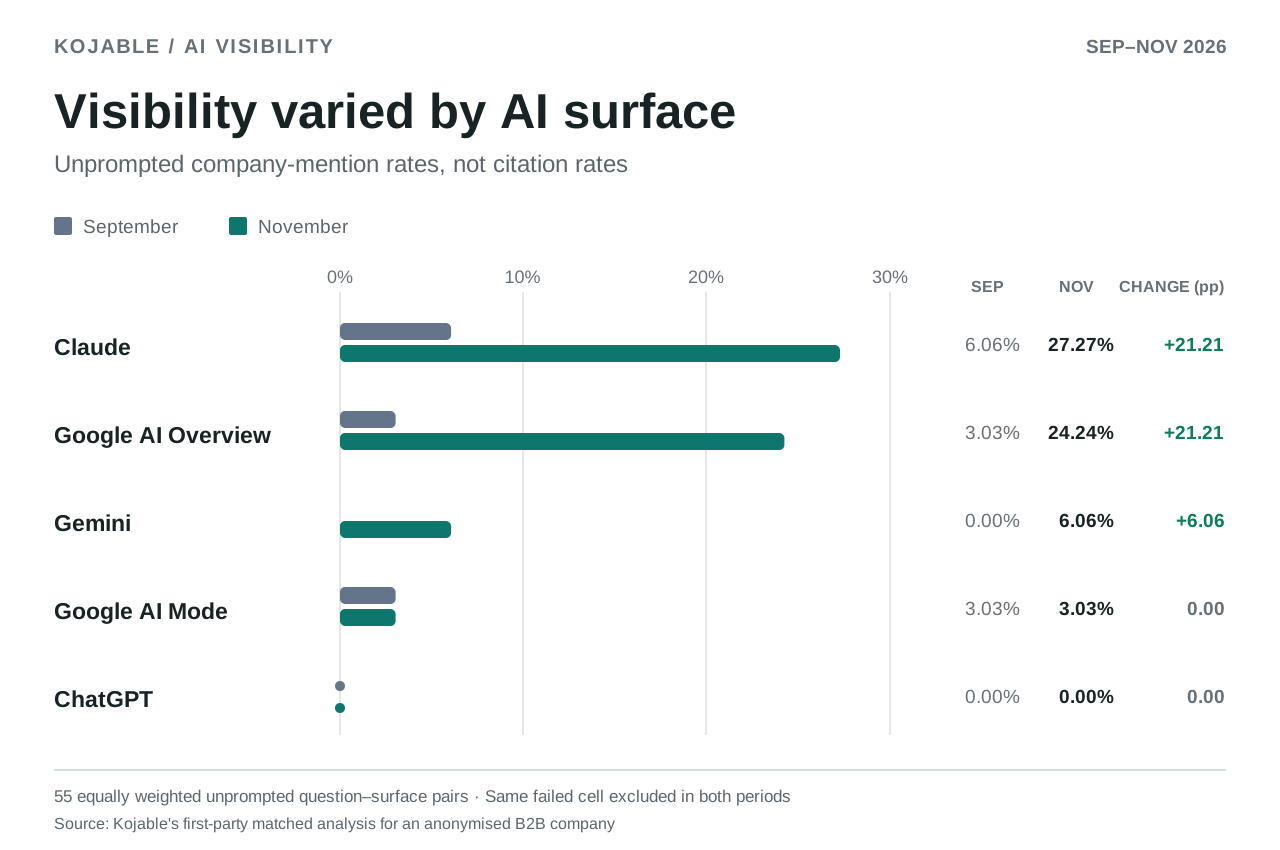
Unprompted company-mention rates by measured AI/search surface. These are not citation rates or general platform rankings.
These are company-mention rates for the eleven unprompted questions, not citation rates and not general scores for the five platforms. They describe the observed surfaces under this benchmark's conditions; they are not evidence that any platform now generally prefers Company A.
The movement also differed by buyer question. Of the eleven unprompted question areas, five increased, four were unchanged and two declined when their visibility was averaged across the five surfaces. Each declining question area fell by 6.67 percentage points. We have withheld the detailed question wording and categories to protect the company's identity.
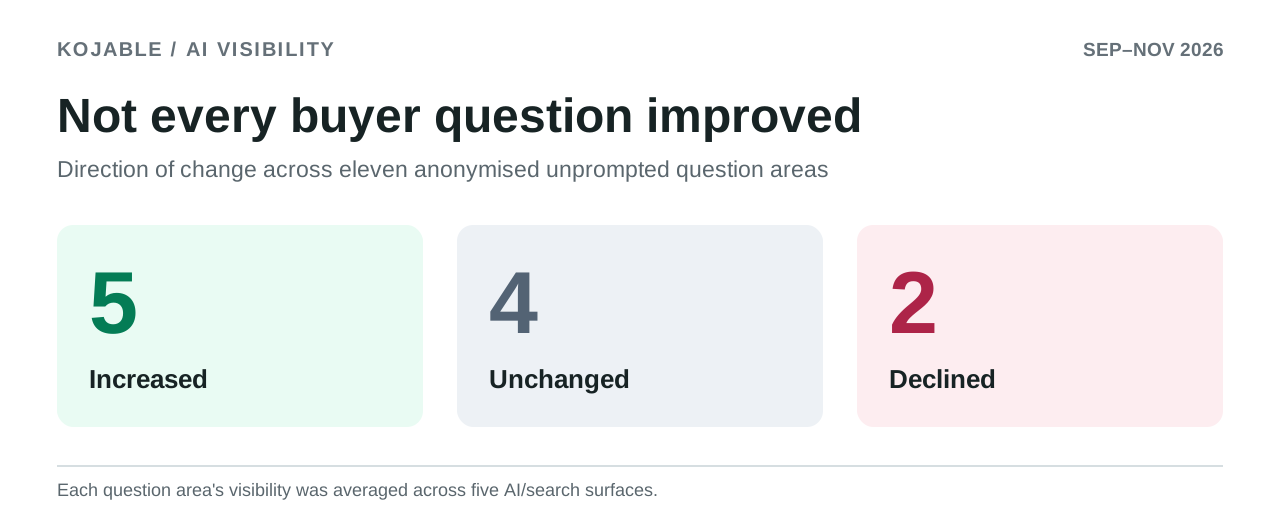
Question-level variation across the eleven unprompted areas, averaged over the five measured surfaces. Exact buyer questions are withheld.
This matters operationally. If a team reports only the overall increase, it can miss questions where the company still does not appear and questions where its measured presence became weaker. Those may be the more useful places to investigate next.
How did citations of prioritised URLs change?
The citation result tells a narrower, but useful, story about visible sources.
From Kojable's 129 prioritised target URLs:
One appeared at least once in September's recorded citations.
Six appeared at least once in November's recorded citations.
Five of the November URLs were newly observed in that citation set: four in Claude and one in ChatGPT.
The one target cited in September appeared again in November.
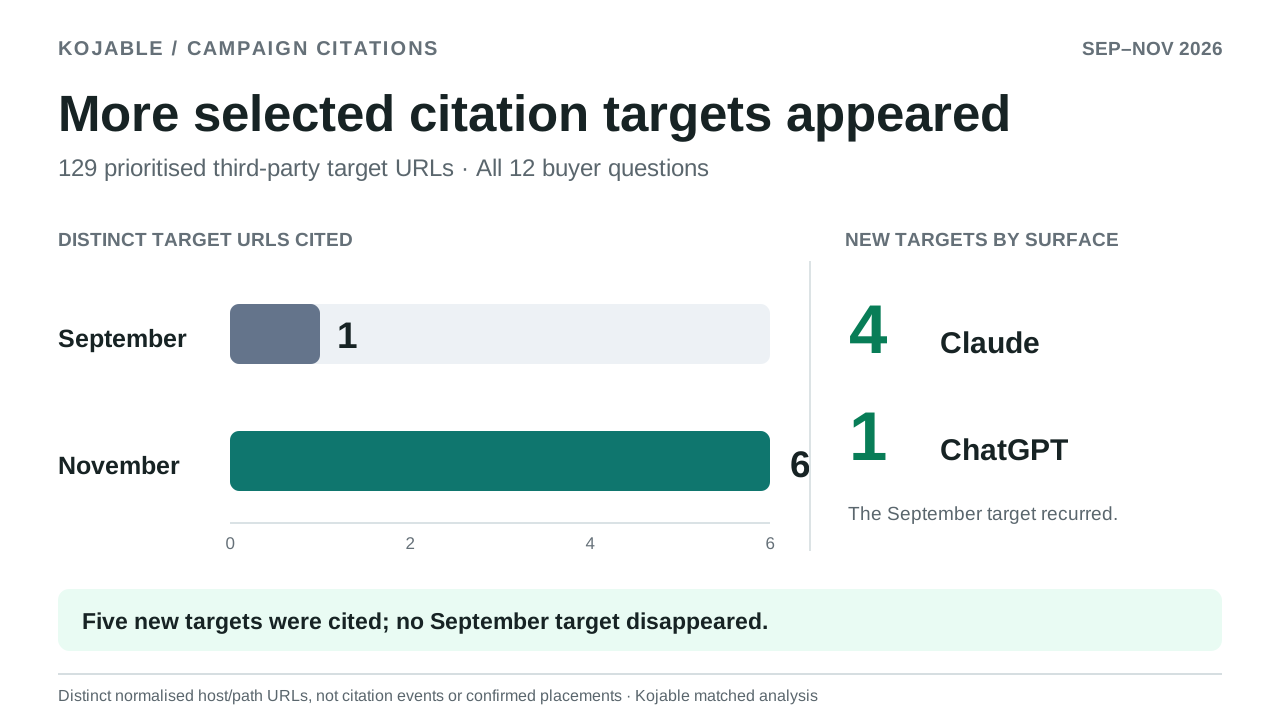
Distinct prioritised third-party URL targets seen at least once among citations across all twelve measured questions; five targets were new in November and one recurred.
The five newly observed URLs are distinct pages, not five total citation events. A page could have appeared more than once in the underlying answers and would still count as one unique URL in this measure.
One detail is particularly instructive. ChatGPT cited one newly observed target URL in November even though it still did not name Company A in any unprompted answer in this panel. A relevant third-party source can enter an answer's citation list without the company itself entering the visible response.
That is why citation tracking alone cannot tell a B2B team whether buyers are learning the right thing about the company. A source being linked is observable; what the answer said about the company is another observation. Whether the cited source genuinely supported a particular statement requires a further evidence check.
Kojable's AI Citation Monitoring is designed around that distinction between visible source attribution and the wider answer. Neither a newly cited URL nor its recurrence proves that the page caused the answer, secured a lasting place in retrieval, or received a buyer visit.
What the short follow-up cannot prove
The September and November measurements show a change in recorded answers. They do not isolate what produced it.
There was no controlled comparison that separated the creators' content activity from other changes in the information environment or the AI services themselves. Nor did the evidence supplied for this case include a dated, verified mapping from individual creator assets to the newly cited campaign target URLs.
Several important outcomes were outside the measurement:
-
Causal impact: We cannot say Kojable's research or the creators' content caused the 9.70-point visibility difference or the five additional cited URLs.
-
Commercial impact: We did not measure qualified visits, leads, pipeline, sales or revenue. “Not measured” does not mean there was no effect; it means this case cannot make that claim.
-
Durability and model behaviour: One November follow-up does not establish long-term persistence, robustness to different prompts, a permanent model change, training use or a change in hidden retrieval or ranking preferences.
-
Recommendation quality: We counted unprompted mentions and visible cited target pages. We did not separately score whether each mention was an accurate, complete or appropriate recommendation.
The fact that the September-cited URL appeared again in November is encouraging as an observation, but two measurement windows are not enough to call it durable. Further repeated checks would be needed to know whether the pattern holds.
What B2B teams can take from this example
The practical value of the case is the discipline of following a specific buyer-answer gap through research and a comparable recheck.
-
Monitor what buyers actually ask. Establish a defined panel of unprompted questions, AI surfaces, repetitions and collection rules. Keep branded questions separate so they do not inflate discovery visibility.
-
Diagnose the evidence environment. Inspect the sources visible alongside relevant answers and research where useful, verifiable information is missing or hard to find. A cited source is a research lead, not a complete explanation of an AI system's reasoning.
-
Improve through accountable content work. Give creators and other content owners clear evidence needs and realistic opportunities. Preserve what was actually produced, changed or published so later measurement can be interpreted more strongly.
-
Verify with comparable answers. Repeat the panel, track brand inclusion and exact source URLs separately, and record unchanged or declining results alongside increases. If the aim is to establish causation or revenue impact, design those tests explicitly.
This case illustrates Kojable’s See → Align → Prove → Compound approach. Kojable is an AI answer alignment platform for B2B companies. Answer Intelligence helps teams assess how accurately AI answers describe their business and identify where better information could help.
Frequently asked questions
Is this the same company as the September AI visibility baseline case study?
Yes. This follow-up covers Company A, the anonymised company with low unprompted visibility in Kojable's September two-company baseline. The November results are not from a newly introduced customer or a combination of the two baseline companies.
How was the increase from 2.42% to 12.12% calculated?
Kojable reran the original unprompted buyer-question panel across five AI/search surfaces. For each of the 55 question–surface pairs, it measured the share of usable repetitions in which Company A was named, then averaged those pair rates equally. The comparison used 179 matched observations per period across all questions, with one corresponding technical failure cell excluded from both periods; 164 observations per period were eligible for unprompted visibility. The difference between the two pair-weighted averages was 9.70 percentage points.
Did Kojable create the content or publish 129 pages?
No. Kojable supplied source intelligence and prioritised 129 citation opportunities. External creators worked on creating content. The number 129 describes the target list, not pages written, placements accepted, publications secured or URLs confirmed as edited.
Does an AI citation mean the company was mentioned or recommended?
No. A citation means a source page appeared as a visible reference in a recorded AI answer. A brand mention means the company was named in the answer, and a recommendation requires a further assessment of how it was presented. In this follow-up, ChatGPT cited a newly observed target URL while its unprompted Company A mention rate remained 0%.
What does the increase from one to six cited URLs actually measure?
It counts how many distinct URLs from the same 129-target list appeared at least once in the citations across the full 12-question matched panel. Five URLs were newly observed in November, and the one September target appeared again. It is not a percentage of answers citing the brand, a count of creator placements or evidence that the citations drove buyer traffic.
Did the programme cause the visibility gain, increase sales or permanently change AI models?
Those conclusions are not supported by this short follow-up. The before-and-after comparison was observational; commercial outcomes were not measured; and one November recheck cannot establish long-term model behaviour. The results give a concrete basis for further diagnosis and testing, not a guarantee of what another company will experience.
Sources and measurement note
- Buyer questions
- 12
- AI/search surfaces
- 5
- Matched observations
- 179 per period
- Eligible unprompted observations
- 164 per period
How the comparison was calculated
Kojable compared 179 matched observations in each period across the full 12-question panel. One September Google AI Overview response failed technically. Kojable excluded that observation and its November match, leaving 164 eligible unprompted observations per period.
Unprompted visibility measures how often the company was named in answers to questions that did not supply its name. Kojable calculated the mention rate for each of the 55 unprompted question–surface pairs (11 questions × five surfaces) and averaged those rates equally. The resulting scores were 2.42% in September and 12.12% in November. The September baseline's 4/164, approximately 2.4%, uses the raw share of usable answers that named the company.
The cited target URL count covers distinct pages from the 129 URLs prioritised in October that appeared in the retained citations from all 12 questions, including the one that named the company. Kojable matched targets by normalised host and page path, ignoring tracking parameters and fragments. Each matching page counted once per period. The September count was reconstructed after the October target list was selected.
This panel measures visible mentions and references on the tested surfaces. A citation can support a topic without the answer mentioning or recommending Company A. The study tracked neither clicks on cited links nor underlying retrieval or ranking decisions.
The original starting point and measurement design are documented in Kojable's publicly available AI search visibility baseline case study. The September–November figures and target-URL citation comparison come from Kojable's retained first-party matched analysis dated 13 November 2026. The October opportunity-workbook process and the division between Kojable's intelligence work and creators' content work are described from the programme's first-party account.
The precise buyer questions, client identity, individual target URLs and unredacted measurement files are withheld to preserve confidentiality. The reported percentages and citations belong to the specified question panel, surfaces and measurement windows. They should not be read as a market-wide estimate, a controlled intervention effect or a forecast of future AI answers.
Find out where your company is missing from AI answers
Kojable helps you measure how AI answers represent your business, investigate the sources behind those answers and prioritise the information gaps worth addressing.
