Kojable research · Finance AI sources · 496 target-oriented responses
The External Publisher Ecosystem Behind Finance AI Answers: Why No Single Source Dominates
A companion analysis of 496 finance AI responses found 3,028 external named-source objects associated with 1,197 inferred external publisher identities, with recurring evidence spanning press distribution, video, communities, reviews, specialist media and analyst-style sources.
Key finding
The 496 finance prompt runs contained 3,028 external named-source objects associated with 1,197 inferred external publisher identities. Even the most recurrent external identity, PR Newswire, appeared in only 67 responses—13.5%—indicating a long-tailed external evidence environment rather than one dominant source.
Qualification: Response incidence measures how often an inferred source identity appeared in this bounded target-oriented dataset. It does not measure publisher authority, source quality, causal influence, endorsement, channel ROI or general finance-market share.
- External source ecosystem
- Publisher incidence
- Finance GEO
- 17 min read
Study overview
Executive summary
When an AI system answers a question about a finance company, the outside evidence does not come from one dominant publisher, one “authority” domain or one universal channel. Across 496 target-oriented finance prompt runs, the study recorded 3,028 external named-source objects associated with 1,197 inferred external publisher identities.
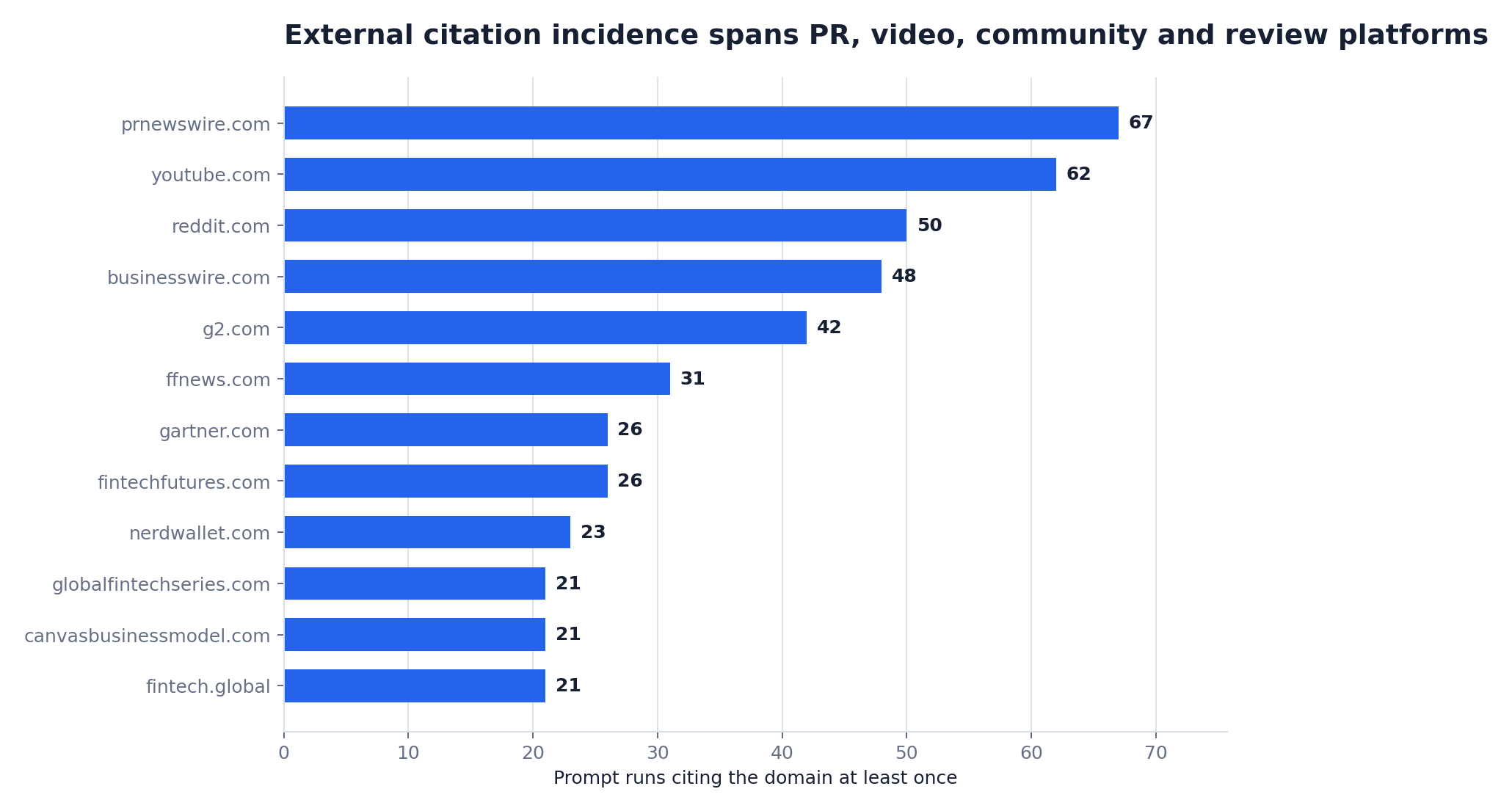
The recurrent sources were heterogeneous. They included press-release distribution services, video and community platforms, product-review sites, specialist finance publications, analyst-style sources and consumer-finance editorial sites. PR Newswire had the highest response incidence, but appeared in only 67 responses—13.5% of the prompt set. YouTube appeared in 62, Reddit in 50, Business Wire in 48 and G2 in 42.
The result is fragmentation, not a publisher leaderboard. The data show where external source identities recurred in a bounded target-oriented experiment. They do not establish which sources are most authoritative, which content caused an answer, or which publishing channel will produce an improvement in GEO performance.
Answer first
Direct answer
The external source environment was highly fragmented. Multiple source environments recurred, but no external identity appeared in even one out of every seven prompt runs. The incidence ranking identifies recurring presence, not publisher authority or causation.
Companion analysis
Research lineage
This companion analysis uses the same 496-response finance dataset as the two earlier Finance GEO publications. These are three views of one experiment, not three independent 496-response studies.
- Research 01 · Full empirical source study
What 496 Grounded AI Responses Reveal About Finance GEO Visibility covers target-owned source presence, external publisher incidence, source identity, co-citation and the broader methodological boundaries.
- Research 02 · Measurement interpretation
Branded AI Visibility Is Not Market Visibility explains branded discoverability versus general market and consideration-set visibility.
- Research 03 · External evidence ecosystem
This paper isolates which external source environments recur and what response incidence can—and cannot—support.
Study boundary
Scope of the external-source analysis
The underlying study covered 496 target-oriented prompt runs across 49 finance-related target domains. Responses were generated in US English using gemini-2.5-flash-lite during 14–15 January 2026. The prompts were branded, comparative or otherwise target-oriented; they were not a representative sample of unbranded finance-market demand.
Of the 496 requested runs, 495 completed successfully, 494 contained at least one raw source object, 492 contained at least one identifiable named source and 450 contained at least one target-owned source.
- Raw source layer
6,884 grounding source objects before removal of retrieval artifacts.
- Analytical source layer
4,660 identifiable named-source objects after 2,224 artifacts were removed.
- External source layer
3,028 named-source objects classified as external rather than target-owned.
Operational definition
What “external publisher” means here
External publisher is an operational dataset label: an inferred named-source identity not classified as belonging to the target company’s own domain. It is not a claim that every source is an equivalent editorial institution.
- Distribution and platform environments
Press-release distribution services, video platforms and community platforms can all be present in the external source layer.
- Evaluation and specialist environments
Review and comparison sites, specialist publications, analyst-style sources and consumer-finance editorial sites also appear.
- Non-equivalent institutions
YouTube, Reddit, PR Newswire, G2 and Gartner are not equivalent kinds of publishers simply because they occur in the same incidence analysis.
This paper therefore prefers external source identity or external source environment where that wording is more precise. Because canonical page URLs were almost entirely unavailable, the results are strongest at response and inferred identity level—not as a verified inventory of unique articles, videos, reviews or posts.
Finding 1
The external source ecosystem has a long tail
The 3,028 external named-source objects were associated with 1,197 inferred external publisher identities. A small group recurred across dozens of responses, while a much larger long tail appeared less frequently. No leading external identity appeared in even one out of every seven prompt responses.
| External source identity | Responses | Share of 496 runs | Broad source environment |
|---|---|---|---|
| PR Newswire | 67 | 13.5% | Press-release distribution |
| YouTube | 62 | 12.5% | Video / creator platform |
| 50 | 10.1% | Community platform | |
| Business Wire | 48 | 9.7% | Press-release distribution |
| G2 | 42 | 8.5% | Product review / comparison |
| FF News | 31 | 6.3% | Specialist finance media |
| FinTech Futures | 26 | 5.2% | Specialist fintech media |
| Gartner | 26 | 5.2% | Analyst / research material |
| NerdWallet | 23 | 4.6% | Consumer-finance editorial |
| Global FinTech Series | 21 | 4.2% | Specialist fintech media |
| fintech.global | 21 | 4.2% | Specialist fintech information |
| CanvasBusinessModel.com | 21 | 4.2% | Business / educational explanation |
PR Newswire’s 13.5% is the highest observed incidence, but it is not evidence of a universal gatekeeper. The finding is bounded to this prompt set, model, locale, collection period and set of target-oriented finance questions; it does not prove that every finance AI source distribution is always long-tailed.
Finding 2
Recurring sources span different evidence environments
The leading identities represent different ways information enters a public evidence environment. Distribution services carry company-originated announcements; video and community platforms carry demonstrations and discussion; review sites frame comparisons; specialist and analyst sources add category context; consumer editorial sources support practical decisions.
A practical evidence-role framework
| Evidence role | Possible contribution | Observed source environments | Boundary |
|---|---|---|---|
| Event evidence | Launches, funding, partnerships, expansion and corporate announcements. | PR Newswire, Business Wire, specialist news. | Presence does not prove announcements caused visibility. |
| Comparative context | Alternatives, category framing and product evaluation. | G2, analyst-style sources, specialist media. | Comparison presence is not endorsement. |
| Sector context | Industry developments, regulation and category meaning. | Specialist finance / fintech media and analyst sources. | Overall incidence may hide topic concentration. |
| Public explanation and discussion | Experience, demonstrations, commentary and reactions. | YouTube and Reddit. | Platform-level presence does not imply source quality. |
| Consumer or decision support | Product explanation, comparison and practical guidance. | NerdWallet and similar editorial sources. | Relevance depends on the prompt and target market. |
Finding 3
Press distribution is prominent, but prominence is not causation
PR Newswire appeared in 67 responses and Business Wire in 48. The supported conclusion is narrow: press-distribution sources were recurrent in this external source ecosystem.
The study does not show that buying or increasing press-release distribution causes higher AI visibility. Alternative explanations include company news volume, prompt relevance, source-label identifiability, syndication, company size or activity and recent events. The dataset has no matched panel of eligible but uncited releases, controlled exposure timing or normalized company news volume.
- Observed
Company-distributed news was recurrent around the tested target-oriented finance questions.
- Not established
Issuing more releases will produce a known improvement in GEO performance or commercial outcomes.
Finding 4
Video and community platforms are part of the evidence surface
YouTube appeared in 62 responses and Reddit in 50. Their recurrence shows that the observed external environment extended beyond company sites, major editorial publications and analyst sources to include video and community platforms.
Those environments can contain product demonstrations, interviews, walkthroughs, implementation discussion, informal comparisons, user experience, criticism and debate. But recurrence does not establish trust, endorsement or quality. A source can be relevant, explanatory, critical, current, popular or simply accessible to the retrieval system.
The unit of analysis matters. “YouTube” and “Reddit” were largely platform-level identities. The source records do not reliably resolve individual channels, creators, videos, subreddits, threads or posts. Platform presence therefore cannot be converted into a statement that all content on either platform is equally valuable.
Finding 5
Specialist finance sources remain visible inside the fragmented ecosystem
FF News appeared in 31 responses, FinTech Futures in 26, Global FinTech Series in 21 and fintech.global in 21. Their recurrence suggests that sector-specific context remains part of the evidence environment even when broad platforms and press distribution are also present.
A lower aggregate incidence can still matter if a source is concentrated around an important product category, regulatory topic or buyer question. A publication focused on payments, banking infrastructure, lending or financial crime may be highly relevant to one prompt family and irrelevant to another.
Publisher relevance should be assessed against the topic and question family, not only aggregate incidence. This dataset does not support a universal specialist-publisher ranking.
Finding 6
Publisher incidence is not publisher authority
Response incidence asks one precise question: for each inferred external identity, in how many of the 496 prompt responses did that identity appear at least once?
Response incidence is an observed outcome. It is not a causal authority score. A source may recur because of topical breadth, publication frequency, company coverage, prompt relevance, accessibility, syndication, repeated labeling, recency, company news volume or genuine usefulness. The current dataset cannot isolate those mechanisms.
Estimating why one source appears while another does not would require an eligible-but-uncited comparison panel. Cited pages could then be compared with relevant uncited pages on topical fit, recency, page type, authorship, content structure, company and topic exposure and other characteristics. Without that negative panel, an incidence ranking cannot defensibly become an authority ranking.
Resolution boundary
Source identity limits document-level conclusions
Among 4,660 named-source objects, only 2 had canonical page identities. The other 4,658 relied on title-fallback identity, while 3,912 objects—83.9%—had unknown source type.
- Inferred identities
1,197 is not a verified count of unique documents or independently confirmed publisher websites.
- External objects
3,028 source objects are not necessarily 3,028 unique articles.
- Channel mix
Weak source-type coverage prevents precise external channel-share estimates.
- Page performance
Exact article, video, thread or page performance cannot be evaluated reliably.
See the full Finance GEO source study for the detailed source-readiness analysis. This companion paper keeps the implication at the level its data support: recurring inferred source identities, not exact-document attribution.
Supported conclusions
What this analysis supports
- A fragmented external evidence environment
The 3,028 external named-source objects were associated with 1,197 inferred identities, and no single identity dominated the prompt set.
- Different source environments recur
Press distribution, video, communities, reviews, specialist finance media, analyst-style material and consumer editorial sources all appeared among leading identities.
- First-party and external evidence can coexist
The wider study found target-owned sources in 90.7% of target-oriented runs while the same response environment contained thousands of external source objects.
- Relevance appears context-dependent
The long tail is consistent with different question families and topics activating different sources, although the study did not isolate topic as a causal mechanism.
- Incidence can prioritise investigation
Recurring identities identify source environments worth examining more closely by topic, target and prompt family.
Claim boundary
What this analysis does not support
- A universal winner
The ranking is not a universal best-publisher list, an authority ranking or a publishing strategy for every finance company.
- Authority, quality or endorsement
Incidence alone does not establish source quality, trust or approval of the cited company.
- Causal influence or ROI
The study cannot attribute answer outcomes or commercial returns to a publisher, press distribution or any other source environment.
- Precise channel or document attribution
The weak page and source-type identity layer prevents exact external channel shares and reliable article, video or thread attribution.
- Stable generality
The results do not establish stable rankings across models, time, markets or countries, and they do not represent all finance demand.
Next study design
What a stronger external-source study should measure next
The next research stage should improve the source layer, not simply collect more unresolved labels. This is a research agenda—not functionality already completed.
- Resolve exact documents
Capture landing and canonical URLs, redirect chain, status, title, publisher identity and retrieval timestamp.
- Deduplicate syndication and copies
Separate originals, syndicated copies, rewritten coverage, aggregators and duplicate identities.
- Classify source type at page level
Use a governed taxonomy with confidence, provenance and manual review for high-incidence sources.
- Map citations to claims
Record which sentence or assertion each source supports to test evidence roles directly.
- Separate presence from recommendation outcomes
Analyse company mention, sentiment, comparison outcome, shortlist status and recommendation direction independently.
- Build an eligible-but-uncited comparison panel
Compare relevant cited pages with relevant uncited pages to investigate selection mechanisms.
- Repeat across models, markets and time
Keep AI system, retrieval mode, geography, language, model version and collection wave visible.
- Separate branded and unbranded questions
Test whether the source ecosystem changes when the model must first select companies from a neutral market question.
Practical implications
Use contextual evidence mapping—not generic diversification
The table does not justify publishing on PR Newswire, YouTube, Reddit and G2 merely because they rank highest. A stronger operating approach begins with the questions that matter and diagnoses the information environment around them.
- Start from the buyer question
Separate questions about what a company does, safety and compliance, comparison, alternatives, recent changes, use-case fit, user views and category membership.
- Inspect the recurring external environment
For each relevant question family, examine domains, information role, recency, accuracy, alignment with first-party claims and missing evidence environments.
- Diagnose before choosing a channel
Distinguish missing first-party explanation, absent validation, weak specialist coverage, stale comparisons, insufficient review evidence, missing demonstrations, inaccurate community narratives and candidate-selection problems.
- Retest comparable questions
Measure company presence, representation, source participation, source quality and recommendation outcome without treating any one source as a guaranteed lever.
The goal is to build an accurate and credible information environment around high-value questions—not to manufacture citations from a particular publisher.
Conclusion
Finance AI visibility emerges from an ecosystem
The external source environment behind the tested finance AI answers was broad, heterogeneous and highly fragmented. Across 496 target-oriented runs, 3,028 external named-source objects were associated with 1,197 inferred external publisher identities. PR Newswire was the most recurrent, yet appeared in only 13.5% of responses.
Press distribution can expose company events. Reviews and analyst material can frame comparisons. Specialist media can add sector context. Video and community platforms can supply demonstrations, discussion and experience. Consumer editorial sources can support practical decision-making. These are plausible evidence roles, not proven causal mechanisms.
The current dataset measures recurrence, not authority. Publisher incidence does not explain why a source appeared, whether it changed the answer, whether it was trusted or whether investment in that channel would improve visibility.
The practical lesson is contextual evidence mapping: understand which external environments surround important buyer questions, identify where the landscape is inaccurate or incomplete, and measure change at the level the evidence can support. Finance AI visibility is not controlled by one publisher. It emerges from an ecosystem.
Frequently asked questions
Frequently asked questions
Which external publisher appeared most often in the finance AI responses?
PR Newswire had the highest observed response incidence, appearing in 67 of 496 prompt runs, or 13.5%.
Does that mean PR Newswire is the most authoritative source for finance GEO?
No. Response incidence measures recurrence in this dataset. It does not isolate authority, source quality or causal influence.
Were YouTube and Reddit important sources?
They were recurrent external source identities: YouTube appeared in 62 responses and Reddit in 50. This shows that video and community platforms formed part of the observed evidence environment, not that every item on either platform was trusted, endorsed or equally valuable.
Do press releases improve AI visibility?
The study does not prove that they do. PR Newswire and Business Wire recurred, but the design did not compare cited and comparable uncited releases or control for company news volume, relevance, size or timing. The result is recurrence, not causal lift.
Why are the percentages not market share?
Several external sources can appear in one response. A response containing PR Newswire, YouTube and G2 adds one incidence to each, so the percentages are non-mutually-exclusive rates rather than shares of a single total.
Are the 1,197 publishers verified unique websites?
Not fully. They are inferred external identities based on available source metadata. Canonical page identity was almost entirely unavailable, so the number is not a verified count of unique documents or independently confirmed publisher sites.
Can the study identify the exact article or video?
Usually not. Only 2 of 4,660 named-source objects had canonical page identities. The analysis is much stronger at response and inferred publisher level than at exact-document level.
Should finance teams publish across every source type?
No. The observed ecosystem is fragmented and topic-dependent. Teams should identify the buyer questions that matter, the source environments recurring around those questions and the actual information gaps before choosing a publishing or outreach strategy.