Kojable research · Finance AI co-citation · 496 responses
Co-Citation Maps Co-Presence, Not Influence: What Finance AI Answer Ecosystems Reveal
A companion analysis of 496 target-oriented finance AI responses found 923 recurring source-identity pairs. Support, Jaccard similarity and lift reveal repeated answer contexts—but not backlinks, partnerships, authority or causal influence.
Key finding
Across 496 target-oriented finance AI responses, 923 source-identity pairs appeared together in at least two responses. These repeated pairings reveal candidate answer ecosystems, but an edge records co-presence only—not influence or a verified relationship between sources.
Qualification: The network is descriptive and exploratory. Nodes are inferred source identities, mostly at publisher/domain level rather than verified pages. Edges are undirected response-level co-occurrences—not hyperlinks, syndication, partnerships, endorsement, ownership, authority or causality.
- Source co-occurrence
- Support, Jaccard and lift
- Finance GEO
- 15 min read
Study overview
Executive summary
Individual source incidence tells us which inferred source identities appear. Co-citation adds a second question: which identities appear together in the same AI response?
Across 496 target-oriented finance prompt runs, 923 source-identity pairs appeared jointly in at least two responses. Higher-support pairs connected distribution services with company and specialist-finance domains; others connected community and video platforms, review and analyst environments, or narrowly concentrated target/topic identities.
These patterns reveal candidate answer ecosystems: recurring combinations occupying the same response contexts. They do not explain why the combinations occurred. An edge is response-level co-presence—not a backlink, referral, partnership, syndication path, endorsement, authority signal or causal effect.
Co-citation is therefore a hypothesis-generation and prioritisation layer. It maps repeated co-presence in AI answers, not influence between sources.
Answer first
Direct answer
Co-citation measures which inferred source identities appear together in the same AI response. Support measures recurrence, Jaccard measures response-footprint overlap and lift measures concentration relative to individual prevalence.
These metrics identify recurring answer contexts and research hypotheses. They do not establish relationships or influence between the underlying sources.
Fifth companion analysis
Research lineage
This page uses the same underlying 496-response Finance GEO dataset as Research 01–04. It is not an independent experiment.
- Research 01 · Full landscape
What 496 Grounded AI Responses Reveal About Finance GEO Visibility reports the complete source study.
- Research 02 · Visibility measurement
Branded AI Visibility Is Not Market Visibility separates branded discoverability from general market visibility.
- Research 03 · Individual incidence
The External Publisher Ecosystem Behind Finance AI Answers asks who appears and why incidence is not authority.
- Research 04 · Source identity
A Named Source Is Not a Verified Citation establishes that identity resolution sets the maximum resolution of a claim.
- Research 05 · Joint appearance
This paper asks which inferred source identities appear together and what the pair metrics can responsibly support.
Operational definition
What response-level co-citation means
For each response, the analysis identified the available inferred source identities. If identities A and B both appeared, their pair received one unit of support. Repeated appearances of one identity within the same response did not create additional pair observations.
Response-level source co-occurrence is the most precise description. Co-citation is used as shorthand for joint source-identity appearance.
“Source-identity pair” is more accurate than “publisher pair” because the nodes are heterogeneous: editorial publishers, press-distribution services, platforms, review environments, analyst sources, company domains and other inferred domains. Business Wire, YouTube, Unit21, G2 and Gartner are not equivalent publishers.
Research snapshot
Scope and analytical boundaries
| Measurement | Observed value | Interpretation |
|---|---|---|
| Prompt runs / target domains | 496 / 49 | Target-oriented response universe |
| Named / external source objects | 4,660 / 3,028 | Named and external analytical layers |
| Inferred external identities | 1,197 | Broad external ecosystem |
| Eligible co-citation pairs | 923 | Support ≥ 2 responses |
| Highest selected support / lift | 13 / 43.73 | Different pair properties; neither is influence |
| Canonical page identities | 2 | Severe document-level identity limit |
| Model / language | gemini-2.5-flash-lite / US English | One recorded model snapshot |
| Collection window | 14–15 January 2026 | One bounded wave |
| Prompt / analysis mode | Target-oriented / descriptive | Exploratory and hypothesis-generating |
Three distinct measures
Support, Jaccard similarity and lift
No composite “relationship strength” score is used. Each metric answers a different question.
- Support · How often?
Number of prompt responses containing both identities. High support means repeated observed co-presence, but common identities have more opportunities to overlap.
- Jaccard · How much overlap?
Responses containing both A and B divided by responses containing A or B. High Jaccard means strong overlap in observed response footprints—not causation.
- Lift · How concentrated?
Observed joint probability divided by the probability expected under independence. Lift above 1 indicates more overlap than marginal prevalence predicts.
Lift must always be interpreted with support. Rare identities can produce extreme lift from modest joint counts.
Teaching comparison
High support and high lift measure different things
| Pair | Support | Jaccard | Lift | Interpretation |
|---|---|---|---|---|
| Reddit × YouTube | 10 | 0.098 | 1.59 | Recurring co-presence, but both identities are individually common. |
| New Frontier Funding × Pipe | 8 | 0.727 | 43.73 | Fewer shared observations, but highly concentrated response overlap. |
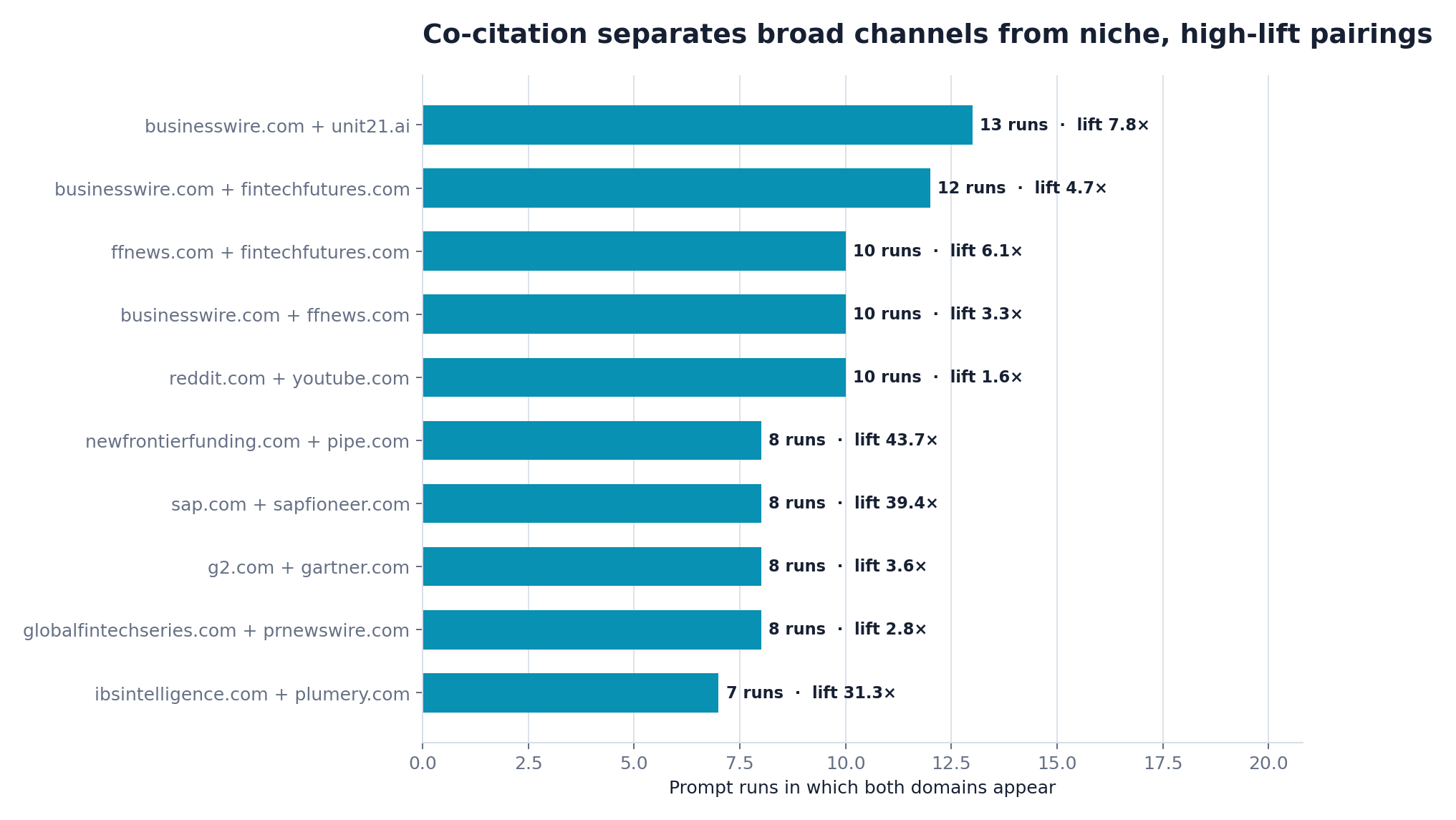
Figure 1
Selected source-identity co-citation edges
Observed pairs
Leading source-identity pair metrics
| Source-identity pair | Support | Jaccard | Lift |
|---|---|---|---|
| Business Wire × Unit21 | 13 | 0.250 | 7.84 |
| Business Wire × FinTech Futures | 12 | 0.194 | 4.73 |
| FF News × FinTech Futures | 10 | 0.213 | 6.10 |
| Business Wire × FF News | 10 | 0.145 | 3.31 |
| Reddit × YouTube | 10 | 0.098 | 1.59 |
| New Frontier Funding × Pipe | 8 | 0.727 | 43.73 |
| SAP × SAP Fioneer | 8 | 0.667 | 39.36 |
| G2 × Gartner | 8 | 0.133 | 3.60 |
| Global FinTech Series × PR Newswire | 8 | 0.100 | 2.80 |
| IBS Intelligence × Plumery | 7 | 0.500 | 31.31 |
This is not a single leaderboard. Support identifies recurrence; Jaccard identifies footprint overlap; lift identifies concentration relative to prevalence.
Research 03 connection
Why individual source incidence is not enough
Research 03 reports individual external response incidence: PR Newswire 67, YouTube 62, Reddit 50, Business Wire 48 and G2 42. Those counts tell us who appears. Co-citation asks who appears together.
Common identities have more opportunities to overlap, which is why support needs prevalence-adjusted context. Research 05 does not repeat the individual-incidence ranking or its figure.
Pattern 1
Distribution and specialist identities share answer contexts
Business Wire × Unit21 recorded support 13 and lift 7.84; Business Wire × FinTech Futures 12 and 4.73; Business Wire × FF News 10 and 3.31. FF News × FinTech Futures recorded support 10 and lift 6.10, while Global FinTech Series × PR Newswire recorded 8 and 2.80.
These are candidate source bundles in shared answer contexts where company-distributed announcements, company information and specialist-finance material may all be relevant. The data do not establish that one source caused, reused or syndicated another, or that the sources supported the same claim.
Pattern 2
Community and video show recurring cross-format co-presence
Reddit × YouTube appeared together in 10 responses, with Jaccard 0.098 and lift 1.59. This relatively high support coexists with modest lift because both platform identities were individually common.
The pair may identify contexts containing community discussion and video material, but that is an interpretive possibility rather than a measured claim-level role. The records also do not reliably resolve the underlying threads, subreddits, channels or videos.
Pattern 3
Review and analyst identities share some comparison contexts
G2 × Gartner appeared in 8 responses, with Jaccard 0.133 and lift 3.60. This is a candidate shared comparison or evaluation context.
It does not establish that either source validated or influenced the other, that the AI system weighted them equally, or that both supported the same claim. The evidence is joint response presence only.
Pattern 4
High-lift pairs can reveal concentrated response contexts
New Frontier Funding × Pipe recorded support 8, Jaccard 0.727 and lift 43.73. SAP × SAP Fioneer recorded 8, 0.667 and 39.36. IBS Intelligence × Plumery recorded 7, 0.500 and 31.31.
These overlaps are highly concentrated relative to individual prevalence, making them strong qualitative follow-up candidates. With modest support and clustered target-oriented prompts, they can reflect narrow question families, repeated comparisons, topic clusters, company/product ecosystems, recurring coverage or source reuse.
Network boundary
Co-citation maps co-presence, not relationships
An edge means only: two inferred source identities appeared in the same AI response. It is undirected, response-based, prompt-dependent, model-dependent, collection-window-dependent and limited by source resolution.
It is agnostic about whether sources know about, link to, agree with, compete with, syndicate or have a commercial relationship with each other. “AI answer co-citation network” and “response-level source co-occurrence network” are therefore more accurate than “publisher relationship network”.
Design boundary
Prompt clustering limits market-wide interpretation
The 496 observations are not unrelated draws from the entire finance market. Prompts cluster around target companies, question families, comparison contexts and related topics. Repeated related prompts can recreate the same source pair.
An edge can be genuinely recurrent and highly concentrated within this dataset while still being driven by one target or prompt family. Future inference should model target, prompt family, topic, collection wave, model and market.
Research 04 connection
The co-citation network is only as resolved as its nodes
The underlying records contain 4,660 named-source objects but only 2 canonical page identities. Nodes should therefore be treated as inferred source identities, mostly at publisher/domain level—not verified individual documents.
The network cannot generally distinguish independent coverage, syndication, a shared announcement, different claim support, duplicate content or repeated prompt activation. Research 04 explains the full identity-resolution boundary. Publisher/domain nodes cannot produce verified page-to-page network claims.
Statistical framing
An exploratory network, not confirmatory edge testing
The audit retained 923 pairs with support of at least two responses. No confirmatory hypothesis was specified for every edge. Support ≥ 2 does not make an edge statistically confirmed; high lift does not imply significance; rare marginals can create large lift; prompts are clustered; and the result comes from one model snapshot.
The correct framing is descriptive, exploratory and hypothesis-generating.
Supported conclusions
What this evidence supports
- 923 recurring source-identity pairs
Each appeared jointly in at least two observed responses.
- Different pair properties
Support, Jaccard and lift separately describe recurrence, footprint overlap and prevalence-adjusted concentration.
- Concentrated response overlap
Some identities have disproportionately overlapping observed response footprints.
- Source assembly beyond individual incidence
Repeated source bundles show that individual counts alone do not describe the observed answer context fully.
- Prioritised research hypotheses
Pairs can identify targets, prompts, topics and source combinations for deeper inspection.
Claim boundary
What this evidence does not support
- Real-world source relationships
No hyperlinks, referrals, content lineage, syndication, partnerships, ownership, endorsement or agreement are established.
- Influence or authority
Edges do not show direction, causal publisher effects, source authority, quality or acquisition pathways.
- Confirmed network structure
The analysis does not establish stable communities or statistically independent significance for every edge.
- Broad generality
The network is not proven market-wide, cross-model, international or longitudinally stable.
- Verified page-to-page co-citation
Publisher/domain-level identity cannot support exact document-pair claims.
Operating sequence
How to use co-citation responsibly
- Start with support
Identify recurring pairs, then inspect the target, prompt family and topic producing them.
- Use lift for concentration
Require a meaningful support floor and treat extreme lift from rare identities cautiously.
- Use Jaccard for footprint overlap
Measure shared response footprint without converting overlap into a relationship claim.
- Inspect underlying responses
Determine whether a pair comes from one target or many, one prompt family or several topics.
- Resolve documents
Capture final URLs, canonical signals, fingerprints, duplicates and syndication relationships where possible.
- Map sources to claims
Test whether sources support the same or different claims, contradict one another or play primary versus evaluative roles.
- Test persistence
Repeat across dates, models, locales and retrieval modes.
- Separate branded and unbranded networks
Test unbranded demand separately because target-oriented prompts can create target-specific bundles.
Future research
A stronger next-stage co-citation study
Future work should resolve exact documents, deduplicate document families, retain target/prompt/topic context for every edge, model clustering, compare branded and unbranded networks, repeat across models, measure edge persistence and eventually build claim-level source graphs.
These are future analytical layers—not results completed in the current study.
Conclusion
Use co-citation to find candidate answer ecosystems
Across 496 target-oriented finance responses, 923 source-identity pairs recurred in at least two answers. High-support pairs highlighted repeated contexts; Jaccard described footprint overlap; lift identified concentration relative to marginal prevalence.
The pair patterns reveal structure that individual source counts cannot. They show recurring response bundles—but not a map of influence. An edge means two inferred source identities appeared in the same response.
The responsible use of co-citation is to identify candidate answer ecosystems for deeper document-, prompt- and claim-level inspection. Co-citation reveals repeated co-presence in AI answers—not influence between sources.
Frequently asked questions
Frequently asked questions
What does co-citation mean in this research?
It means two inferred source identities appeared in the same AI response. Each pair receives at most one unit of support from a given response.
How many recurring source pairs were observed?
The analysis retained 923 source-identity pairs that appeared together in at least two of the 496 prompt responses.
Does a co-citation edge mean one source links to another?
No. The network is built from joint appearance in AI responses. It does not measure backlinks, referrals or hyperlinks between the underlying sources.
Does co-citation prove that two publishers or companies have a relationship?
No. Joint appearance does not establish partnership, ownership, endorsement, syndication or any other organizational relationship.
What is support?
Support is the number of prompt responses containing both source identities.
What is Jaccard similarity?
Jaccard measures how much the two identities' observed response footprints overlap relative to the set of responses containing either identity.
What is lift?
Lift compares the observed joint response rate with the rate expected if the identities appeared independently. High lift indicates concentrated overlap, but it must always be interpreted alongside support.
Why can lift be very high with only a few joint responses?
Rare identities have low expected overlap under independence. A modest joint count can therefore produce very high lift. High lift with low support is a hypothesis signal, not strong standalone evidence.
Why is Reddit × YouTube a useful example?
The pair appeared together in 10 responses, but lift was only 1.59 because both platforms were individually common. It shows that high support and distinctive concentration are different concepts.
Can the network identify information pathways?
Not reliably. It cannot determine whether one source led to another, one republished the other or both appeared because they were relevant to the same prompt.
Are the nodes verified individual pages?
Generally not. The underlying dataset is mostly resolved at inferred source-domain or publisher level rather than exact page level.
Is this a statistically confirmed network?
No. It is descriptive and exploratory. The 923 retained pairs were scanned after a support threshold, prompt observations are clustered and the analysis comes from one model snapshot.
How should teams use co-citation?
Use it to prioritize source combinations, prompt families and target contexts for deeper inspection. Then resolve documents, inspect answer context, map sources to claims and test persistence across collections.