Kojable research · 750 matched AI responses
How Persona Conditioning Changes AEO Answers
Across 150 neutral scenarios and five persona conditions, the study found systematic shifts in search, pipeline, AEO and SEO language. The fixed-order, single-model design describes model-output steering and does not establish independent persona causation.
By Piush Vaish, founder and CEO of Kojable.
Key finding
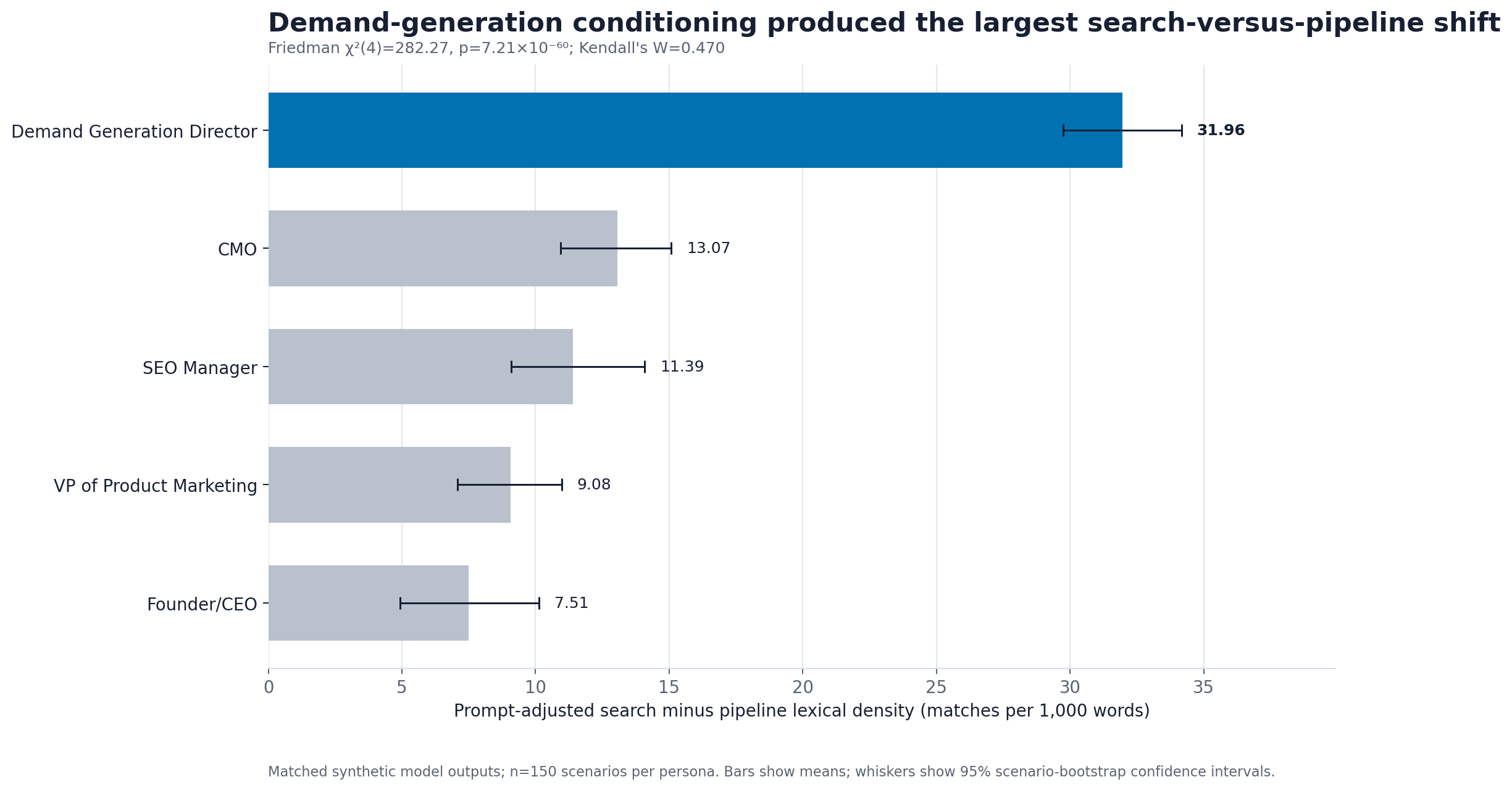
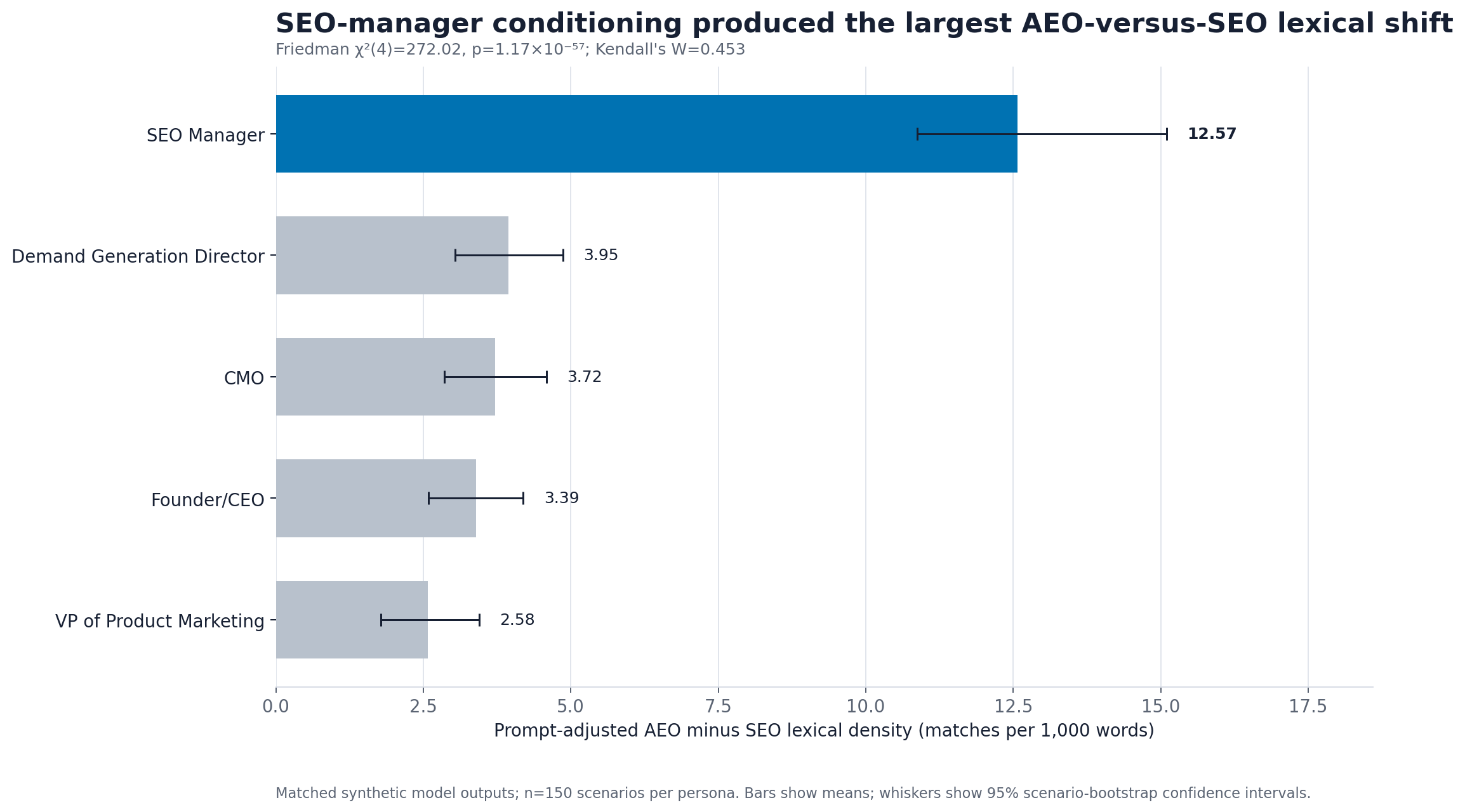
Demand Generation Director produced the largest search-versus-pipeline shift, while SEO Manager produced the largest AEO-versus-SEO shift.
Qualification: Persona order and contiguous topic clusters were confounded with collection position and time. The results describe one model run and do not show how real people in those roles think or behave.
- Persona conditioning
- AEO and SEO language
- 150 matched scenarios
- 750 model responses
- 10 min read
Study overview
Executive summary
Persona conditioning systematically changed how the recorded model framed the same business problems. Across 150 neutral scenarios and five persona conditions, two separations were especially strong: Demand Generation Director produced the largest search-versus-pipeline lexical shift, and SEO Manager produced the largest AEO-versus-SEO lexical shift.
The RQ1 Friedman test was χ²(4) = 282.27, p = 7.21 × 10−60, with Kendall’s W = 0.470. The RQ4 result was χ²(4) = 272.02, p = 1.17 × 10−57, with Kendall’s W = 0.453. Within this run, the five complete prompt bundles did not produce interchangeable language.
The response-similarity and vendor results are descriptive. Similarity was lowest whenever SEO Manager was one of the paired conditions, but the run has no same-persona replicates needed for an equivalence conclusion. Vendor incidence was concentrated in Perplexity, OpenAI/ChatGPT, Gemini and Anthropic/Claude, but a mention is not necessarily a recommendation or evidence of bias.
Answer first
Direct answer
In this 750-response, five-persona model run, persona instructions systematically changed generated language. Demand Generation conditioning produced the largest search-versus-pipeline shift, while SEO Manager conditioning produced the largest AEO-versus-SEO shift. The fixed-order study describes one model run and does not show that people in those roles think or behave differently.
Study design
Five persona conditions within 150 matched scenarios
- Reference run
-
The supplied article reports 150 neutral business scenarios and one response for each of five persona conditions: CMO, Demand Generation Director, Founder/CEO, SEO Manager and VP of Product Marketing. All 750 expected responses were observed and response-valid.
- Recorded model
-
The model name is reported exactly as recorded in the supplied article:
gemini-3.6-flash. Provider-side version details, release date, decoding configuration, hidden system instructions and retrieval settings were not supplied. - Matched block
-
The neutral scenario is the statistical block. Matching controls scenario topic and difficulty more directly than treating all 750 outputs as unrelated observations. One record,
N093::SEO Manager, lacks usable query and grounding metadata but retains valid response text for the textual analysis. - Lexical orientation
-
The prompt-adjusted orientation score subtracts the assigned prompt’s left-minus-right term density from the response’s left-minus-right term density. Density is measured as matches per 1,000 words. A positive score indicates a response shift toward the left-hand vocabulary relative to its prompt; it is not a measure of business preference or answer quality.
Finding 1
Demand Generation produced the largest search-versus-pipeline shift
All five persona conditions had positive average prompt-adjusted search-minus-pipeline scores. Demand Generation Director was far above the other four conditions.
| Persona condition | Mean | 95% confidence interval |
|---|---|---|
| Demand Generation Director | 31.96 | 29.73 to 34.17 |
| CMO | 13.07 | 10.95 to 15.07 |
| SEO Manager | 11.39 | 9.08 to 14.08 |
| VP of Product Marketing | 9.08 | 7.08 to 10.98 |
| Founder/CEO | 7.51 | 4.92 to 10.12 |
The matched omnibus result was χ²(4) = 282.272, p = 7.21 × 10−60, with Kendall’s W = 0.470. Demand Generation exceeded each other condition: the mean differences ranged from 18.89 against CMO to 24.46 against Founder/CEO, and all four Holm-adjusted paired Wilcoxon p-values were below 1.2 × 10⁻²⁰.
Seven of the ten possible persona pairs were significant after Holm correction. Six also had mean-difference bootstrap intervals excluding zero. CMO versus SEO Manager was the exception: its paired rank result survived correction while the mean-difference interval crossed zero, so it should not be presented as a stable average separation.
Finding 2
SEO Manager produced the largest AEO-versus-SEO shift
SEO Manager conditioning produced an AEO-minus-SEO adjusted score roughly three to five times larger than the other persona conditions.
| Persona condition | Mean | 95% confidence interval |
|---|---|---|
| SEO Manager | 12.57 | 10.87 to 15.10 |
| Demand Generation Director | 3.95 | 3.04 to 4.87 |
| CMO | 3.72 | 2.86 to 4.59 |
| Founder/CEO | 3.39 | 2.59 to 4.19 |
| VP of Product Marketing | 2.58 | 1.79 to 3.44 |
The matched omnibus result was χ²(4) = 272.023, p = 1.17 × 10−57, with Kendall’s W = 0.453. SEO Manager exceeded all four other conditions. Its mean contrasts ranged from 8.62 against Demand Generation to 9.99 against VP of Product Marketing; every Holm-adjusted paired Wilcoxon result was below 1.9 × 10⁻²², and every bootstrap interval excluded zero.
The supported interpretation is that SEO Manager conditioning shifted the recorded model more strongly toward AEO vocabulary relative to traditional SEO vocabulary than the other four prompt bundles. It is not evidence that real SEO managers prioritise AEO more than other executives.
Finding 3
SEO-involving persona pairs had the lowest response similarity
Cross-persona response similarity ranged from 0.183 to 0.254 on the within-scenario TF–IDF cosine measure. TF–IDF cosine similarity is an analytical proxy for lexical overlap, not a direct measure of role equivalence, usefulness or business quality.
| Persona pair | Mean similarity | 95% confidence interval |
|---|---|---|
| CMO × Founder/CEO | 0.254 | 0.247 to 0.261 |
| CMO × VP Product Marketing | 0.226 | 0.221 to 0.232 |
| Demand Gen × VP Product Marketing | 0.221 | 0.215 to 0.226 |
| CMO × SEO Manager | 0.192 | 0.186 to 0.198 |
| SEO Manager × VP Product Marketing | 0.190 | 0.184 to 0.196 |
| Founder/CEO × SEO Manager | 0.184 | 0.179 to 0.189 |
| Demand Gen × SEO Manager | 0.183 | 0.177 to 0.188 |
The four lowest-similarity relationships all included SEO Manager. CMO and Founder/CEO were the most similar observed pair. The run contains only one response for each persona and scenario, so there is no same-persona diagonal, no same-persona replicate baseline and no registered equivalence margin.
Finding 4
Vendor incidence was concentrated in a small set of entities
At least one canonical vendor entity appeared in 580 of 750 responses, or 77.3%. The article reports 16 detected canonical vendor entities, 2,198 response-vendor incidences and a descriptive Herfindahl–Hirschman Index of 0.169. One response can contribute to several vendor counts.
| Canonical vendor entity | Responses | Share of 750 responses |
|---|---|---|
| Perplexity | 541 | 72.1% |
| OpenAI / ChatGPT | 532 | 70.9% |
| Google Gemini | 354 | 47.2% |
| Anthropic / Claude | 262 | 34.9% |
| Google Analytics 4 | 147 | 19.6% |
| Google Search Console | 121 | 16.1% |
| Salesforce | 65 | 8.7% |
| HubSpot | 51 | 6.8% |
| Semrush | 43 | 5.7% |
| 6sense | 39 | 5.2% |
Perplexity and OpenAI/ChatGPT represented 48.8% of all response-vendor incidences, while the top four AI assistants or providers represented 76.8%. No vendor name was reported as directly present in the prompts.
Management interpretation
What the findings mean for AEO teams
Within this run, the persona system functioned as a model-steering mechanism. Teams testing persona-conditioned answers should therefore measure whether an instruction produces the intended strategic frame while preserving factuality, safety and relevance.
-
Review SEO Manager outputs for AEO-specific framing
This condition produced the largest AEO-minus-SEO shift and was also present in the four lowest-similarity role pairs.
-
Investigate the Demand Generation direction qualitatively
Its search-minus-pipeline orientation was the largest observed RQ1 result, but the counterintuitive direction should be examined in the generated text rather than projected onto demand-generation leaders.
-
Do not collapse roles from cross-persona similarity
CMO and Founder/CEO had the highest observed cross-persona similarity, but no same-persona baseline or equivalence threshold was supplied.
-
Audit vendor mentions with labels
A follow-up analysis should distinguish endorsement, comparison, warning and incidental reference before evaluating mentions against a scenario-specific eligible-vendor baseline.
Claim boundary
What the study does not establish
-
Real-role behaviour
Preferences, priorities or behaviour of real people in the named roles.
-
Independent causation
Independent persona causation free from collection-order and time effects.
-
Role interchangeability
Business interchangeability of CMO and Founder/CEO.
-
Registered differentiation
Meaningful role differentiation under a registered threshold.
-
Vendor quality or bias
Vendor recommendation quality, preference, fairness or bias.
-
Business outcomes
Improved factuality, usefulness, rankings, revenue or conversions.
-
Generalisability
Generalisation to other models, model configurations or collection periods.
Method and governance
Methodology and reproducibility details
- Statistical comparisons
-
RQ1 and RQ4 use Friedman omnibus tests across the five matched persona outputs, Kendall’s W as the matched omnibus effect size, paired Wilcoxon comparisons and Holm family-wise correction. The reported 95% confidence intervals were bootstrapped by neutral scenario.
- Response similarity
-
Cross-persona textual overlap uses within-scenario TF–IDF cosine similarity. The measure is an analytical proxy and has no same-persona replicate diagonal or registered equivalence margin.
- Vendor incidence
-
Vendor results use response-level entity incidence and a descriptive HHI. One response can contain several vendors. Incidence does not classify whether a reference is an endorsement, comparison, warning or incidental example.
- Reproducibility disclosure
-
No public analysis script, notebook, dataset or reproducibility package accompanies this publication. The published article, tables and figures document the reported design, findings, interpretation and limitations.
- Missing study context
-
Collection dates, study language, geography or market, model configuration and decoding parameters, bootstrap iteration count and random seed were not supplied.
en-GBis the website publication language, not a documented study condition. No independent review or replication was supplied. - Author review and sign-off
-
The final article, figures, interpretation and methodological limitations were reviewed and approved for publication by Piush Vaish, founder and CEO of Kojable, on 5 August 2026. This was an author review and publication sign-off rather than an independent external review or replication.
Study boundaries
Limitations
-
Single-run scope
The evidence comes from one stated model and one collection run.
-
Fixed-order design
Persona order was fixed within every scenario, and topic clusters were collected in contiguous blocks.
-
Time confounding
Persona and cluster were therefore confounded with collection position and time.
-
Causal limitation
The matched scenarios make the associations precise within this run but do not make the persona treatment causal.
-
Missing replication
The run has no same-persona replicates and no registered equivalence margin.
-
Measurement boundary
TF–IDF cosine similarity and lexical-density scores are analytical proxies rather than measures of answer quality or business value.
-
Vendor interpretation
Vendor incidence does not measure recommendation quality, preference, fairness or bias.
-
Role inference
The results do not support inference about real people in the named roles.
-
Generalisability
The findings do not establish cross-model or cross-period generalisation.
Future confirmatory runs should randomise execution globally, repeat outputs within persona and scenario, register an equivalence margin, and label vendor references by their function in the answer.