Kojable Blog reference entry
Why AI Platforms Describe Your Company Differently: What to Investigate First
Cross-platform AI representation divergence is a difference in how AI systems describe, categorise, compare, cite or recommend the same company under comparable buyer questions. It becomes operationally material when the difference could change buyer understanding or conflicts with verified company reality.
Category AI Search Guides
Also known as cross-platform AI representation divergence, AI representation differences across platforms, different AI answers about a company, cross-model company representation differences, AI brand representation differences
Different AI answers about your company are a diagnostic signal, not automatically a problem. Compare the specific claim or framing that differs, establish whether it recurs, check it against verified company reality, inspect the observable evidence associated with it, and decide whether the difference could change a meaningful buyer decision. Then choose the smallest justified response: Accept, Monitor or Diagnose. If diagnosis establishes a sufficiently supported and actionable gap, move into Improve, then retest comparable questions to Verify what changed.
Visible citations can help with that diagnosis. They do not normally prove why an AI system produced the answer.
You might ask ChatGPT about your company and see the right category but an outdated audience. Claude might describe the audience correctly but omit an important capability. Gemini might frame the company against a different competitor set. Perplexity might attach a different group of sources to a broadly similar answer.
Those differences matter only if they change what a buyer is likely to understand.
TL;DR
- Different AI systems can produce different representations and visible evidence environments for the same buyer question.
- A difference is not automatically an error. First identify whether it changes accuracy, category, audience, capability, competitive framing, recommendation, recency or supporting evidence.
- Treat one answer as one observation. Establish recurrence before deciding that a provider or the wider information environment has a meaningful pattern.
- Check verified company reality before diagnosing an AI answer as wrong or incomplete.
- Citations and source recurrence are evidence for investigation, not proof of hidden weighting, training use or causal influence.
- Prioritise using materiality, recurrence, evidence clarity and actionability.
- The justified assessment may be Accept, Monitor or Diagnose. Improve only after diagnosis establishes a sufficiently supported, actionable gap.
- Retest comparable questions after an intervention to verify what changed without assuming one action caused or permanently fixed the result.
Why can AI systems describe the same company differently?
ChatGPT, Claude, Gemini and Perplexity are different AI products and provider stacks. Comparable buyer questions can therefore produce different answers and different observable evidence environments. Those differences can be measured, but the outputs do not expose one exact hidden reason for why they occurred.
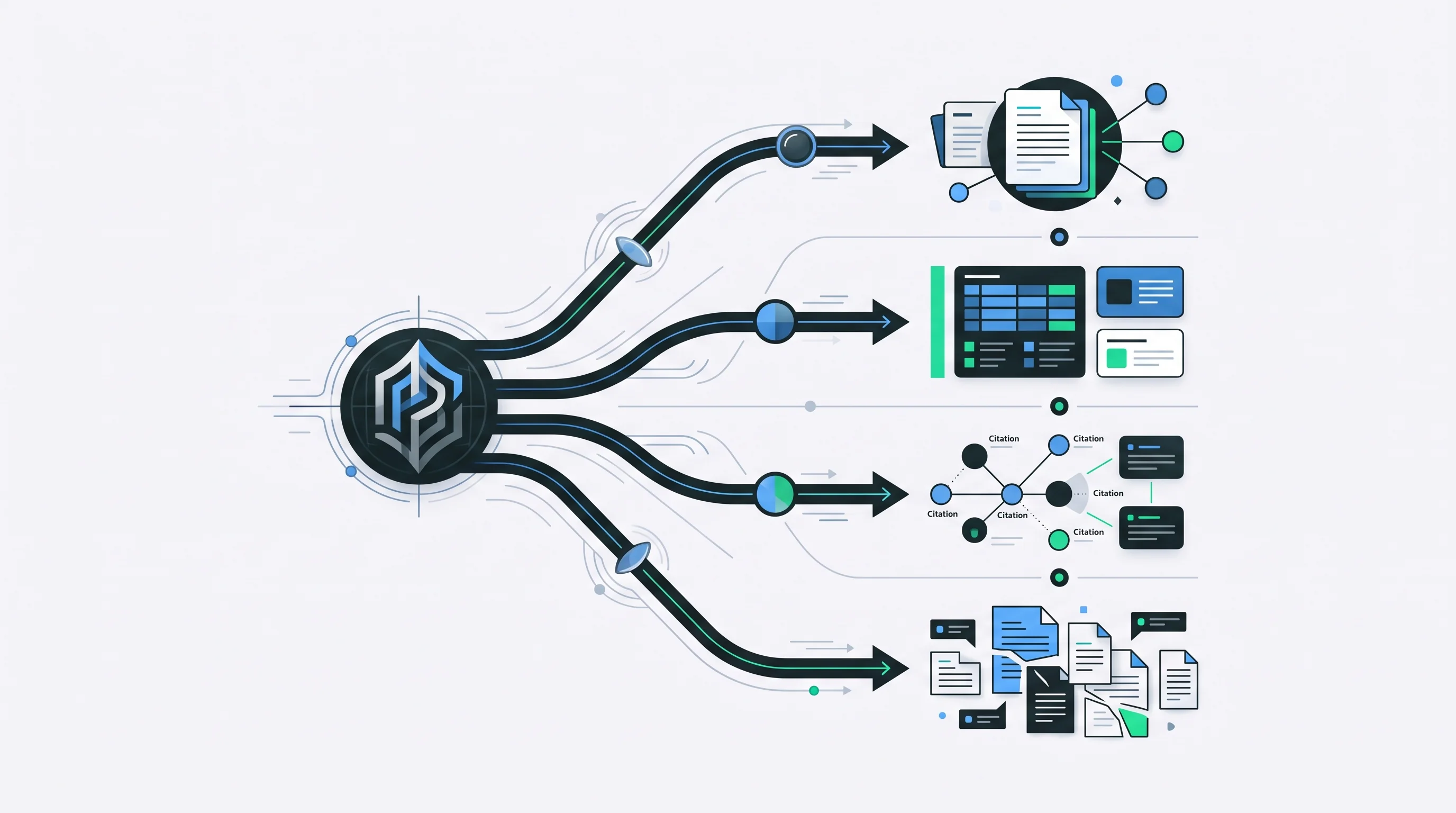
Kojable's Different Answers, Different Evidence research presented the same designed B2B buyer questions to Claude, Gemini, OpenAI and Perplexity. The provider stacks frequently assembled largely different cited-source sets for the same questions, while also differing in visible citation activity, source mix and other evidence characteristics.
That finding has an important limitation. Each provider-question cell contained one observed run. The study therefore does not establish permanent provider preferences, run-to-run stability or a causal mechanism explaining why the systems differed. The provider-stack results can combine model behaviour, search infrastructure, retrieval orchestration, citation implementation, answer construction and other system-level differences.
That distinction matters because explanations such as “Claude trusts this source”, “Gemini weights third-party pages more heavily” or “ChatGPT learned the old positioning during training” may sound plausible without being demonstrated.
The observable fact is simpler: the answers or evidence environments differed under the tested conditions.
The practical question is what that difference means for your company.
When does cross-platform disagreement actually matter?
A difference deserves attention when it materially changes buyer understanding, conflicts with verified company reality or alters how the company is evaluated. Different wording alone is not a representation problem.
AI Representation includes more than whether your company appears. It includes how the company is categorised, who it is said to serve, which capabilities are included, how competitors are framed, whether current information is reflected and whether the company is recommended for the buyer's use case.
Consider a fictional company, Acme.
One answer says:
“Acme provides workflow software for enterprise finance teams.”
Another says:
“Acme is a business process software company used by larger organisations.”
The language differs, but the buyer meaning may be effectively equivalent.
Now compare:
“Acme provides workflow software for enterprise finance teams.”
with:
“Acme is primarily a small-business productivity tool.”
That difference can change the category, audience, perceived capability and shortlist decision. It deserves investigation.
The test is not:
Are the answers identical?
It is:
Does the difference change something that matters to the buyer?
A useful diagnosis therefore separates harmless variation from material divergence before anyone starts changing pages, commissioning content or trying to influence third-party sources.
What exactly should you compare across the answers?
Compare defined representation dimensions rather than asking whether two complete answers simply “look different”.
| Divergence type | Diagnostic question | Evidence required | Likely next decision |
|---|---|---|---|
| Factual accuracy | Which version agrees with verified current company truth? | Current authoritative facts | Diagnose; Improve if supported |
| Category | Does the category change how a buyer understands what the company is? | Current positioning plus recurring observations | Monitor or Diagnose |
| Audience | Is an important buyer segment omitted or incorrectly assigned? | Current audience definition and supporting evidence | Diagnose |
| Capability | Is a capability relevant to the buyer question missing? | Current product or service evidence | Monitor or Diagnose |
| Competitive framing | Do the systems use different competitors or comparison criteria? | Comparable answers and current differentiation | Diagnose |
| Recommendation | Is the company recommended in one system and excluded in another for the same intent? | Repeated recommendation-intent observations | Monitor or Diagnose |
| Recency | Is one answer repeating legacy information? | Current record compared with older public information | Diagnose; Improve if supported |
| Evidence environment | Are materially different visible sources associated with the answers? | Observable citations and relevant source content | Diagnose |
| Benign wording | Has the phrasing changed without altering buyer meaning? | Meaning-level comparison | Accept |
The important point is that these dimensions can move independently.
A company might have excellent factual accuracy but poor competitive framing. It might appear consistently but be associated with an obsolete audience. It might be described accurately while a commercially important capability is repeatedly omitted.
This is why a single “AI consistency” score can hide the actual problem.
External research points in the same direction. Seer Interactive's 2026 brand study separated accurate answers, inaccurate answers and non-answers rather than treating every weak result as the same problem. Its study covered 1,562 branded prompts and 28,123 responses across six AI surfaces between May and June 2026.
For a deeper assessment of one captured answer against verified company truth, use the AI Answer Accuracy and Alignment Guide. This article applies that assessment logic specifically to disagreement across providers and product surfaces.
The action needed for an inaccurate fact is not necessarily the action needed for an omission, a weak comparison or a recommendation gap.
Is the gap provider-specific or a broader representation problem?
Establish recurrence before deciding how broadly to act. One unusual answer is an observation. Repeated comparable observations can establish a pattern, but still do not prove its exact cause.
Suppose Gemini gives one outdated description while ChatGPT, Claude and Perplexity all reflect the current positioning.
That may justify a Gemini-specific retest or evidence investigation. It does not yet justify rebuilding the company's public content.
Now suppose the same legacy positioning appears repeatedly across several systems and buyer questions.
That is a stronger signal that the broader public information environment deserves investigation.
Repeated-run research also shows why teams should be careful about treating one output as a stable provider characteristic. Organic Labs ran the same three commercial recommendation prompts 1,000 times per system across four systems and found materially different levels of run-to-run stability depending on both system and category.
Conductor reached a related conclusion from a different design. Across 14,000 API calls covering 10 industries, seven intent types and four engines, recommendation consistency varied meaningfully with the type of query being asked.
These studies should not be turned into a universal volatility rule. They show why prompt intent, product surface and repeated observations are part of the measurement conditions.
If you need the full methodology for establishing that baseline, AI Brand Monitoring covers the monitoring process in more depth.
For this diagnosis, the practical distinction is:
| Observed pattern | What it supports | Default response |
|---|---|---|
| One materially different answer | Direct observation | Monitor or retest |
| Same gap recurs on one defined surface | Provider/surface-specific pattern | Diagnose |
| Same material gap recurs across several systems | Broader recurring pattern | Diagnose the wider information environment |
| Systems use different wording but preserve the same buyer meaning | Benign variation candidate | Accept |
| Multiple systems repeat a verified outdated fact | Strong representation-gap signal | Diagnose, then Improve if the evidence path is clear |
A pattern tells you where to look next. It does not automatically tell you why it happened.
What evidence should you investigate before deciding why the gap happened?
Start with verified company reality, then work outward from the observed answer. Sources are useful when they help explain or test a diagnosis, not when they are treated as hidden telemetry from the model.
The first question is:
What is actually true now?
That may sound obvious, but it prevents a common mistake: treating the company's preferred marketing language as the reference point when the underlying fact has not been clearly defined.
For example, if an AI system says a company serves mid-market customers, determine whether current product, sales and public positioning evidence supports enterprise, mid-market or both.
Next, preserve the observation itself: exact buyer question, product or surface, date, answer, relevant claim, competitors and visible sources where available.
Then establish whether the pattern recurs.
Only after that should you inspect public evidence that may be relevant to the gap. That can include current owned pages, old owned pages, directories, reviews, partner profiles, media coverage, competitor comparisons and other public sources.
Kojable's cross-provider research illustrates why source analysis needs restraint. It distinguishes visible citations from exposed candidate/search pools and notes that equivalent retrieval information is not observable across every provider surface. A source absent from exposed metadata cannot automatically be described as “not retrieved”.
The useful rule is:
A citation is evidence for investigation, not proof of causal influence.
A recurring review page may be relevant. It may contain the exact legacy wording appearing in AI answers. That supports investigating the relationship.
It does not prove:
“This review caused the answer.”
Likewise, citation frequency does not prove that a provider “trusts” the publisher, that the page was used during model training or that reproducing the same source will reproduce the same answer.
Those are stronger claims than the visible evidence supports.
How do you decide whether to Accept, Monitor or Diagnose the divergence?
Prioritise the divergence using four questions: Does it matter? Does it recur? Is the evidence clear enough? Is deeper diagnosis justified?
Materiality
Would the divergence change a meaningful buyer decision?
An old founding year may be inaccurate but commercially minor. An incorrect statement that the company does not support enterprise deployment could materially affect consideration.
Recurrence
Is the gap one observation, recurring on one defined surface or recurring across several systems and questions?
Recurrence does not prove causality, but it helps distinguish an isolated observation from an operationally relevant pattern.
Evidence clarity
Do you have a verified contradiction or a clearly observable information gap?
Or do you only have a plausible theory?
Evidence clarity should control the strength of the recommendation.
Actionability
If diagnosis confirms a material gap, is there a realistic information or evidence change the team can make?
An outdated owned product page is directly actionable. A claimable directory profile may be influenceable. Independent journalism may be important but not directly editable. A competitor comparison page may be neither wrong nor realistically changeable.
Taken together, those four dimensions support three assessment decisions:
| Decision | Use it when |
|---|---|
| Accept | The difference is accurate, immaterial or only stylistic under the tested buyer question |
| Monitor | The difference is isolated, materiality is uncertain or the available evidence is not yet sufficient for diagnosis |
| Diagnose | A material representation gap merits deeper investigation of recurrence, evidence, source patterns and likely drivers |
If diagnosis then establishes a sufficiently supported and actionable gap, move into Improve.
This prevents a common overreaction to AI representation gaps:
“We need more content.”
Sometimes new content is appropriate. Sometimes the correct action is updating one factual page, correcting one profile, clarifying one claim or doing nothing yet.
Diagnosis should determine the intervention.
What should you change first when action is justified?
Make the smallest change that directly addresses the diagnosed information or evidence gap.
If the problem is an outdated fact on an owned page, correct the owned record.
If the company has changed category or audience but several public pages still use the old positioning, align the relevant current evidence.
If a commercially important capability is repeatedly absent and the public proof is weak, strengthen the proof where a buyer or AI system could reasonably verify it.
If an actionable third-party profile contains old information, correct that profile.
If the problem is competitor framing, first determine whether the company has a genuine evidence gap in the comparison rather than publishing a reactionary competitor page by default.
The deeper implementation process belongs in the AI Representation Remediation Guide, which starts after a material representation gap has been diagnosed.
The distinction is important:
Diagnosis asks whether an action is justified. Remediation determines how to carry it out.
A useful improvement should be traceable back to the diagnosed gap.
How do you verify whether anything improved?
Retest comparable buyer questions against the recorded baseline and measure the affected representation dimension again.
If the original problem was audience framing, retest audience framing.
If it was an outdated capability claim, retest that claim.
If it was recommendation inconsistency, repeat comparable recommendation-intent questions under the same defined conditions where possible.
Do not change the question, provider surface, metric and evaluation rule at the same time and then treat the result as a clean comparison.
Kojable's operating model closes the loop through Monitor → Diagnose → Improve → Verify. Verification means comparing later observations with the baseline to see what moved, what held and what still requires attention.
The correct interpretation of a changed answer is:
The observed representation changed after the intervention.
That can be useful.
It is not automatically:
The intervention caused the model to change permanently.
AI systems, retrieval environments and public evidence continue to change. Verification therefore belongs in a recurring operating process rather than at the end of a one-time content project.
Quick answers
Frequently asked questions
Does it mean one AI system is wrong if the answers differ?
No. Two systems can use different language while communicating effectively the same meaning. A meaningful accuracy problem exists when an answer conflicts with verified current company reality. Other disagreements may concern completeness, category, comparison criteria, recommendation or evidence rather than factual correctness.
Which AI description of my company should I trust?
Do not choose an answer simply because it comes from a preferred provider. Compare each material claim with verified company reality and the buyer question being asked. Then look for recurrence across comparable observations. The useful reference point is evidence, not provider preference.
Do citations tell me why an AI system produced an answer?
Not normally. A visible citation shows an observable relationship between the answer and a source reference. It can be useful diagnostic evidence, but it does not by itself reveal hidden source weighting, prove training use or establish that the source caused the answer. Kojable's Research also shows that source observability differs across provider stacks.
Should every difference across ChatGPT, Claude, Gemini and Perplexity be fixed?
No. Some differences are harmless wording variation. Others are isolated observations without enough evidence to justify diagnosis or action. Accept immaterial differences, Monitor uncertain ones, and Diagnose material recurring gaps before deciding whether Improve is justified.
How do I know whether a representation change worked?
Define the affected attribute before changing anything, preserve the baseline and retest comparable questions afterwards. Look for movement in the same attribute under comparable conditions. Treat the movement as an observation unless the study design supports a stronger causal conclusion.
From disagreement to a justified next action
Different answers across ChatGPT, Claude, Gemini and Perplexity are useful because they expose where a company's AI representation may be unstable, incomplete or misaligned.
But disagreement itself is not the diagnosis.
The useful process is:
Classify the difference → establish recurrence → check verified company truth → inspect observable evidence → assess materiality → Accept, Monitor or Diagnose → Improve when justified → Verify what changed.
That approach prevents teams from reacting to one screenshot, treating every citation as causal evidence or publishing content without knowing which problem it is meant to solve.
Kojable is an AI answer alignment platform for B2B companies. It monitors how major AI systems represent a company, diagnoses the gaps that matter, guides practical improvements and retests comparable buyer questions to verify what changed.
Run your free AI brand audit to establish your current representation baseline and identify which gaps deserve diagnosis first.