Kojable Blog reference entry
Ghost Citations: Why AI Can Cite Your Website Without Mentioning Your Company
A ghost citation, in AI-search usage, is a visible citation to a real source where the company or brand associated with that source is not named in the generated answer.
Category AI Search Guides
Also known as ghost citation, ghost citations, AI ghost citation, citation without brand mention, AI citation without company mention, cited but not mentioned
Quick answer: Yes. An AI answer can visibly cite your website without naming your company because citation presence and company or entity presence are separate observable outcomes. In AI-search marketing, this is sometimes called a ghost citation. The citation tells you that a source attribution appeared. It does not, by itself, explain why your company was absent or prove that the page caused, trained or controlled the answer. First decide whether the omission matters to the buyer question, then investigate the evidence before choosing a fix.
There is an important terminology caveat. Academic research also uses “ghost citation” for fabricated or invalid references generated by AI. This article uses the cited-but-not-named meaning. The GhostCite research project illustrates the competing academic usage. (arxiv.org)
01 · Definition
What is a ghost citation in AI search?
A ghost citation is a real visible source citation where the company or brand associated with that source is absent from the generated prose.
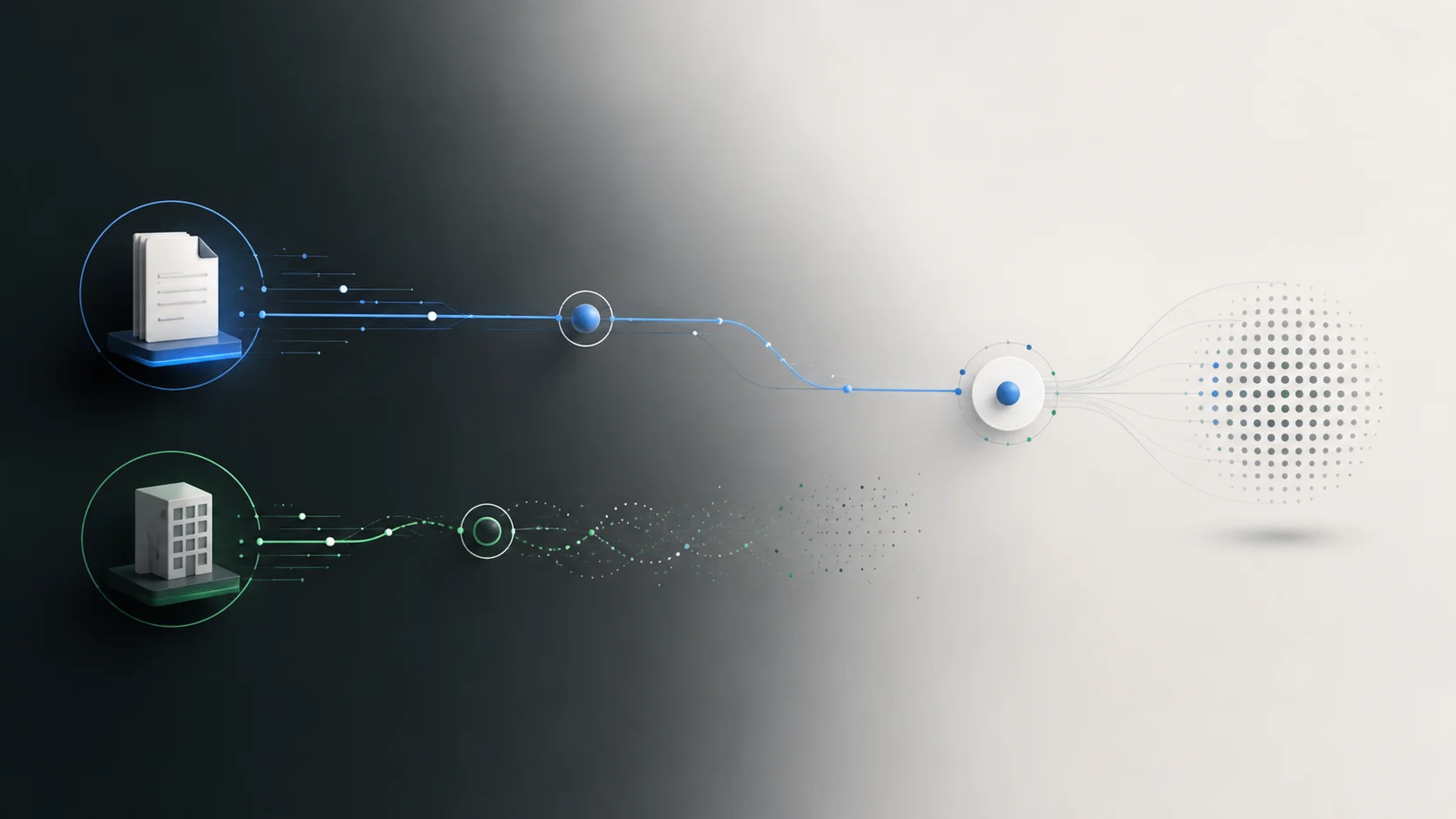
Imagine an AI answer explaining a market trend. Your research page appears in the citations, but the answer says only:
“Recent research suggests that buyers increasingly use AI systems during vendor evaluation.”
The source may point to your research. The reader, however, is never told that your company produced it.
That is different from a hallucinated citation. A hallucinated citation is fabricated, nonexistent or materially invalid. A ghost citation in the sense used here involves a real source attribution with an absent company or brand mention.
The term has gained traction in AI-search marketing during 2026. Semrush uses it for a citation where the source brand is absent, while Search Engine Land and Writesonic use the same definition in their recent analysis. (semrush.com)
The distinction matters because a source link and company visibility answer different questions.
02 · Separate outcomes
Why can AI cite your website without mentioning your company?
Because source citation and company/entity visibility are separate observable outcomes.
Kojable's Citation Rank and Brand Visibility research examines that distinction directly. The study tracks whether a cited source's associated entity actually appears in the generated prose. Even among entities associated with the first cited-source position, most remained unnamed. The research is observational and finance-specific, so it does not establish that citation position caused an entity to appear or disappear.
That leads to a more useful measurement sequence:
- Was the source visibly cited?
- Was the associated company or entity named?
- If named, how was it described or framed?
- Was it compared with competitors?
- Was it actually recommended?
Those outcomes should not be compressed into one “AI visibility” result.
A company can therefore be:
- cited and named;
- cited but unnamed;
- named without its website being cited;
- neither cited nor named.
Kojable's AI citations Reference Entry treats citation and company mention as separate evidence objects for exactly this reason. It also cautions against renaming a visible citation as hidden retrieval, grounding, influence or support.
03 · Evidence boundary
What does a ghost citation tell you, and what does it not prove?
It tells you that a source attribution appeared while the associated company was absent. It does not explain why the answer occurred.
That is evidence worth recording. It is not a complete explanation of why the answer occurred.
A visible citation does not automatically prove that the cited page:
- caused a claim to appear;
- was the most influential source;
- was first in an internal retrieval process;
- was trusted or endorsed by the AI system;
- was used in model training;
- was the reason a competitor was named;
- should be the first page you change.
Kojable's citation research makes the same distinction between source inclusion, entity presence and downstream recommendation. Its separate recommendation study found that citation position should not be interpreted as endorsement.
This is also why phrases such as “the AI used our content but hid our brand” should be treated cautiously. A citation may make the source relationship visible to the reader, but the citation itself is not internal model telemetry.
The practical rule is simpler:
Record what you observed first. Diagnose the explanation separately.
04 · Materiality
When does a ghost citation actually matter?
A ghost citation matters when the company's absence materially changes a buyer-relevant answer.
It may matter little in a neutral educational answer and substantially more in a vendor, comparison, evidence-ownership or recommendation question.
Consider the difference between these questions:
| Buyer question | Website cited, company absent | Likely importance |
|---|---|---|
| “What is zero-trust security?” | An educational page is cited but its publisher is not named | Often low |
| “What evidence supports this market trend?” | Proprietary company research is cited without identifying its owner | Potentially meaningful |
| “Which companies provide X?” | Company evidence is cited while competitors are named | High |
| “How does Company A compare with Company B?” | Company A is cited but poorly or incompletely represented | High |
| “Which provider should I choose?” | Company evidence is cited but competitors are recommended | Potentially high |
These are decision rules, not a validated numerical scoring system.
A company does not automatically deserve a mention because one of its pages was cited. In a purely educational answer, naming every source owner may add little value.
The gap becomes more important when the question itself requires company identification, comparison, differentiation, evidence ownership or recommendation.
That is the point where a ghost citation becomes part of a wider AI representation problem rather than simply a citation observation.
05 · Measurement
How should citation and company mention be measured separately?
Record source citation, company/entity presence, accuracy/framing and recommendation as separate outcomes.
Use separate fields for the separate outcomes.
| Source visibly cited? | Company or entity named? | State | What it tells you |
|---|---|---|---|
| Yes | Yes | Cited + named | Source attribution and entity visibility both occurred. Accuracy and recommendation still need separate assessment. |
| Yes | No | Ghost citation / citation without entity mention | The primary state covered here. Assess materiality before diagnosing why it happened. |
| No | Yes | Mention without company-source citation | Entity visibility occurred without visible attribution to the company's own source. |
| No | No | Neither observed | Investigate only when the company reasonably belonged in the answer. |
A fabricated or nonexistent reference belongs in a separate category. It is a citation-validity or hallucination problem, not simply a citation-without-company-mention state.
For each buyer-relevant observation, a useful record includes:
- exact question;
- AI platform and surface;
- date and run;
- whether the company was named;
- whether a company source was cited;
- exact cited URL;
- competitors named;
- whether the company description was accurate;
- whether the company was recommended where recommendation was relevant.
This keeps the measurement tied to the actual buyer question instead of reducing several outcomes to one score.
06 · Study comparison
How common are ghost citations?
There is no defensible universal rate because published studies use different samples, platforms, prompts and analytical units.
Recent studies all show that citations and brand mentions can diverge, but they report materially different rates because their samples, platforms, prompts and analytical units differ.
| Study | Study design | Reported result | Correct interpretation |
|---|---|---|---|
| Semrush × Kevin Indig | 3,981 domain appearances, 115 prompts, 14 countries and four AI systems | 61.7% of recorded appearances were citation-only | Study-specific result |
| Writesonic / Search Engine Land | Roughly 16 million brand appearances across seven AI engines in a recent 30-day window | Around 40% of citations did not name the source brand | Separate study-specific snapshot |
| BuzzStream | 12,000 AI responses across roughly 200 brands, 10 industries and four AI surfaces | 69.9% of cited brand domains were also named | Different denominator and design |
Semrush records whether each domain appearance was cited, mentioned or both. (semrush.com) Search Engine Land and Writesonic explicitly describe their result as a snapshot and state that the study does not establish the causes of ghost citations or their effects on clicks, recall, trust or conversions. (searchengineland.com) BuzzStream uses yet another design and counts the overlap between brand-domain citations and brand mentions. (buzzstream.com)
These studies should not be averaged together.
Their disagreement is useful because it demonstrates why a company's own measurement contract matters more than a generic market benchmark.
The better question is:
Across the buyer questions that matter to us, how often are we cited, named, represented accurately and recommended under clearly defined conditions?
07 · Diagnosis
What should you investigate before trying to fix a ghost citation?
Inspect query intent, recurrence, cited-page clarity, current evidence, external descriptions and competitor framing before selecting an intervention.
Start with the buyer-facing gap, not with a theory about hidden model behaviour.
A useful diagnosis asks six questions.
1. Did the question actually call for a company mention?
Review the exact prompt and answer first.
If the question asks for a neutral definition, an absent company may be expected. If it asks for vendors, alternatives, providers or evidence ownership, the same absence may be much more important.
2. Does the pattern recur?
One answer is an observation.
Repeated comparable answers across relevant prompts or surfaces can establish a recurring pattern, but recurrence still does not prove why the pattern exists.
Keep the prompt, surface and measurement conditions comparable before calling something recurring.
3. Is the company clearly connected to the evidence on the cited page?
Inspect the cited page itself.
Ask:
- Is the company clearly identified?
- Is the relevant claim connected to the company or research owner?
- Is the information current?
- Does the page contain specific, verifiable evidence?
- Does the relationship between entity, claim and evidence require unnecessary inference?
Kojable's citation-rank research identifies clear entity identification and explicit entity-to-claim relationships as defensible information-quality practices. It does not establish them as guaranteed levers for causing a future company mention.
4. Is the evidence the buyer would need actually available?
A company may have a technically clear page while still lacking the evidence required for the buyer question.
For example:
- the page explains the category but not the company's differentiated position;
- the company claims enterprise suitability but offers little current enterprise proof;
- the website reflects current positioning while external descriptions still reflect an older offer;
- competitors provide clearer evidence for the decision being asked about.
That is an evidence problem, not simply a naming problem.
5. What do the other cited sources say?
AI answers can contain several source families at the same time.
A company-owned page, publication, review, directory and competitor source may all appear in the observed citation environment. Their presence tells you what information is worth inspecting. It does not reveal which one had the greatest hidden influence.
Review whether those pages contain:
- current or outdated positioning;
- relevant independent evidence;
- different category language;
- competitor-led framing;
- conflicting descriptions.
Do not call a source authoritative merely because it recurs.
6. Are competitors being surfaced where your company is not?
This is often the commercially important part of the diagnosis.
If your page is cited in a category answer while several competitors are named and your company is absent, record the pattern.
Then ask what evidence those competitors are associated with and whether your own relevant positioning or proof is missing, unclear or inconsistent.
Do not jump from “competitor named” to “competitor source caused our omission”.
That distinction is central to Answer Intelligence: separate the observed answer pattern from the evidence and plausible conditions worth investigating.
08 · Remediation
Should you fix the cited page first?
No. Start with the material claim, omission or framing problem; the cited URL is evidence, not an automatic remediation target.
A cited URL is evidence. It is not an instruction telling you where the remediation must happen.
Start with the material problem:
- What should the buyer understand?
- What is missing, inaccurate or poorly evidenced?
- Which information surface actually owns that truth?
- What is the smallest justified intervention?
Sometimes the cited page will be the right place to act. For example, the company-to-claim relationship may genuinely be unclear or the page may contain outdated information.
In other cases, the justified action could involve:
- adding missing proof to another owned page;
- updating current company positioning;
- correcting an outdated third-party profile;
- creating evidence that does not yet exist;
- clarifying a comparison or use case;
- doing nothing because the company did not need to appear in that answer.
Kojable's AI Representation Remediation Guide owns the full intervention process. Its central principle is to remediate the diagnosed representation gap rather than treating citation presence itself as the problem.
09 · Verification
How should you verify whether the gap improved?
Define the target signal before changing anything, then retest the same frozen question under comparable conditions.
For a ghost-citation problem, the target might be:
“On this buyer question, does the company now appear accurately in the answer while its relevant evidence is still represented appropriately?”
Track citation presence and company/entity presence separately. Where relevant, also track:
- description accuracy;
- category or audience framing;
- competitor co-mentions;
- recommendation status;
- cited-source changes.
Do not turn a single changed answer into a causal claim.
A before-and-after difference shows that the recorded answer changed. Stronger statements require stronger evidence and repeated comparable observations.
Kojable's AEO Change Verification method recommends frozen longitudinal prompts, predefined outcome measures and observation checkpoints rather than fixed “propagation deadlines”. It explicitly separates observed movement from causal attribution.
Quick answers
Frequently asked questions
Is a ghost citation the same as a hallucinated citation?
No.
In this article, a ghost citation means a real source is cited but its associated company or brand is not named in the generated answer.
A hallucinated citation is fabricated, nonexistent or materially invalid. Academic literature sometimes uses “ghost citation” for that second problem, which is why the intended meaning should always be defined explicitly. (arxiv.org)
Can ChatGPT or another AI system cite my website without mentioning my company?
Yes.
A citation and a company mention are different observable outcomes. A company source can appear in a citation set while the company itself receives little or no narrative visibility. Kojable's citation research measures these states separately.
Does an AI citation mean the system trusts or endorses my company?
No.
A visible citation establishes that a source attribution appeared under the recorded conditions. It does not automatically establish trust, endorsement or recommendation. Recommendation should be measured directly when it matters to the buyer question.
Is a ghost citation always a problem?
No.
It matters when the company's absence materially changes a buyer-relevant answer. A company omitted from a neutral educational answer may not require action. A company omitted from a vendor shortlist while its research is cited deserves much closer diagnosis.
Should I add more brand references or structured data to fix ghost citations?
Only when the diagnosis justifies that change.
Clear company identification and consistent entity information are sensible information-quality practices, but neither should be treated as a guaranteed AI-attribution lever. The intervention should follow the diagnosed information gap rather than a generic “entity optimisation” checklist.
How long does it take for a change to affect AI answers?
There is no defensible universal timeline.
Different pages, external sources and AI products update under different conditions. Define observation checkpoints and retest comparable questions rather than promising that a change must appear after a fixed number of days.
Practical takeaway
From a ghost citation to a better answer-alignment decision
A ghost citation is useful because it exposes a gap that a citation count alone can hide.
The right response is not to assume the AI ignored your company, trusted somebody else more or needs more mentions of your brand.
Instead:
Monitor the exact citation and company-mention state.
Diagnose whether the absence is material and what evidence is missing, outdated, unclear or inconsistent.
Improve the relevant information environment only when the diagnosis justifies an intervention.
Verify the same target signal under comparable conditions.
Kojable is an AI answer alignment platform for B2B companies. It helps teams understand how AI systems describe, compare, cite and recommend their company, diagnose the representation gaps that matter, identify what should change and how, and retest comparable questions to verify what moved.
A citation is evidence.
A company mention is another outcome.
The useful work begins when you measure the difference between them and decide whether that difference actually matters.