Kojable research · Persona conditioning · Panel design
How Many AI Personas Do You Need? What a Five-Persona Panel Actually Preserves
A matched study of persona-panel coverage across 149 business scenarios
Key finding
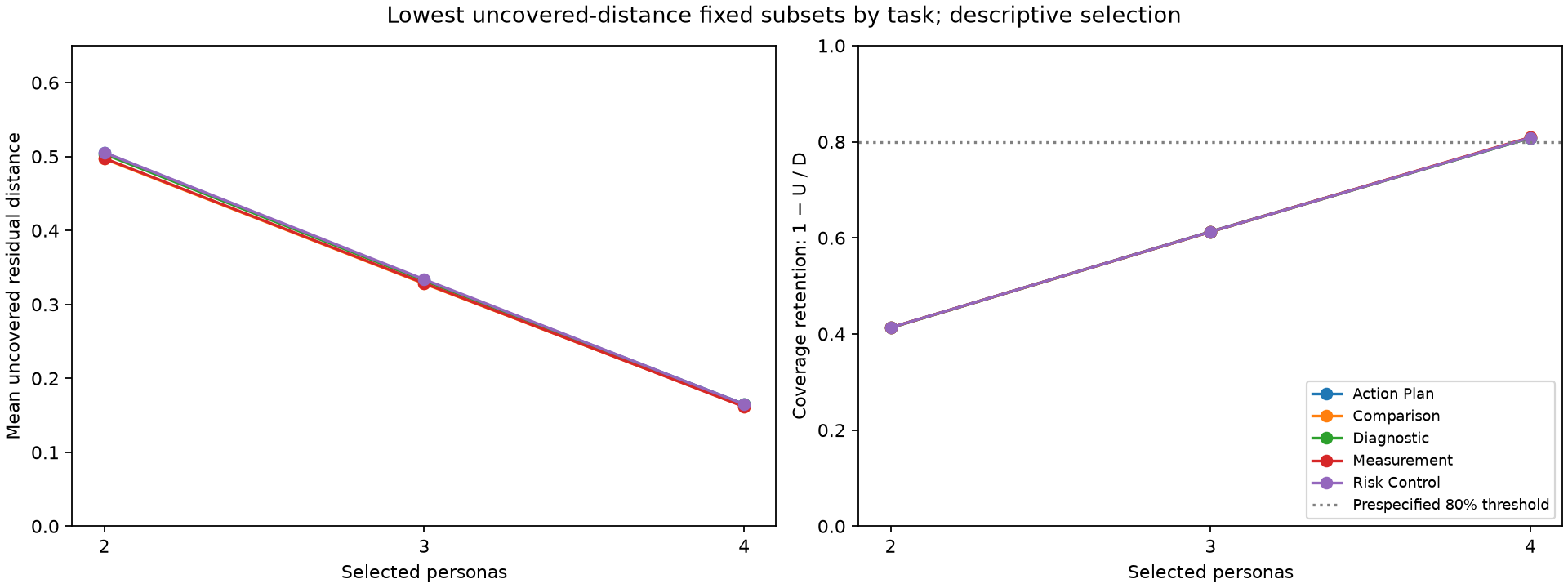
In a five-persona grounded-AI experiment, smaller fixed panels preserved progressively less of the answer-space diversity produced by the full panel. Across five task families, the best two-persona panels retained roughly 41% of the five-persona response-space coverage, three-persona panels about 61%, and four-persona panels about 81%.
Qualification: This measures lexical and structural coverage of the observed answer space. It does not show that five personas preserve more correct facts, better recommendations, stronger evidence or greater business value.
- Persona-panel coverage
- AI evaluation
- 149 complete scenarios
- 11 min read
At a glance
Research snapshot
| Study element | Detail |
|---|---|
| Research question | How much of a five-persona AI answer space is preserved by smaller fixed persona panels? |
| Parent study | 150 matched scenarios × 5 persona conditions |
| Primary complete scenarios | 149 |
| Persona conditions | CMO, VP Product Marketing, SEO Manager, Demand Generation Director, Founder/CEO |
| Task types | Action plan, comparison, diagnostic, measurement, risk control |
| Primary representation | Persona-residual answer distance |
| Two-persona retention | ~41% |
| Three-persona retention | ~61% |
| Four-persona retention | ~81% |
| Five-persona coverage | 100% reference panel by definition |
| Panel conclusion | Five-persona panel materially additive for observed response-space diversity |
| Major limitation | Coverage measures representation, not substantive usefulness |
Direct answer
How many AI personas should you test?
Answer
It depends on what you are trying to preserve.
If your goal is to preserve the observed range of answer representations produced by this five-persona panel, the study did not find a smaller fixed panel that retained near-full coverage.
Across the five task types, two-persona panels retained about 41%, three-persona panels retained about 61%, and four-persona panels retained about 81%.
Three-persona panels fell below the study's predefined 80% preservation threshold. Four-persona panels exceeded 80%, but remained below a separate 95% near-full-coverage criterion.
That does not mean every AI research project needs five personas.
It means that in this matched experiment, reducing the panel materially reduced the diversity of the answers represented.
Research question
Why this question matters
Persona panels are easy to expand.
A research team can ask the same question as a CMO, an SEO Manager, a Founder, a Product Marketing leader, a Demand Generation leader, and then keep adding roles.
At some point, though, more personas become expensive.
They increase model calls, review volume, annotation work, reporting complexity and repeated or redundant outputs.
That creates a practical design question:
How many personas are enough?
The obvious shortcut is to choose two or three roles that seem different and assume they capture most of the useful variation.
But that assumption needs testing.
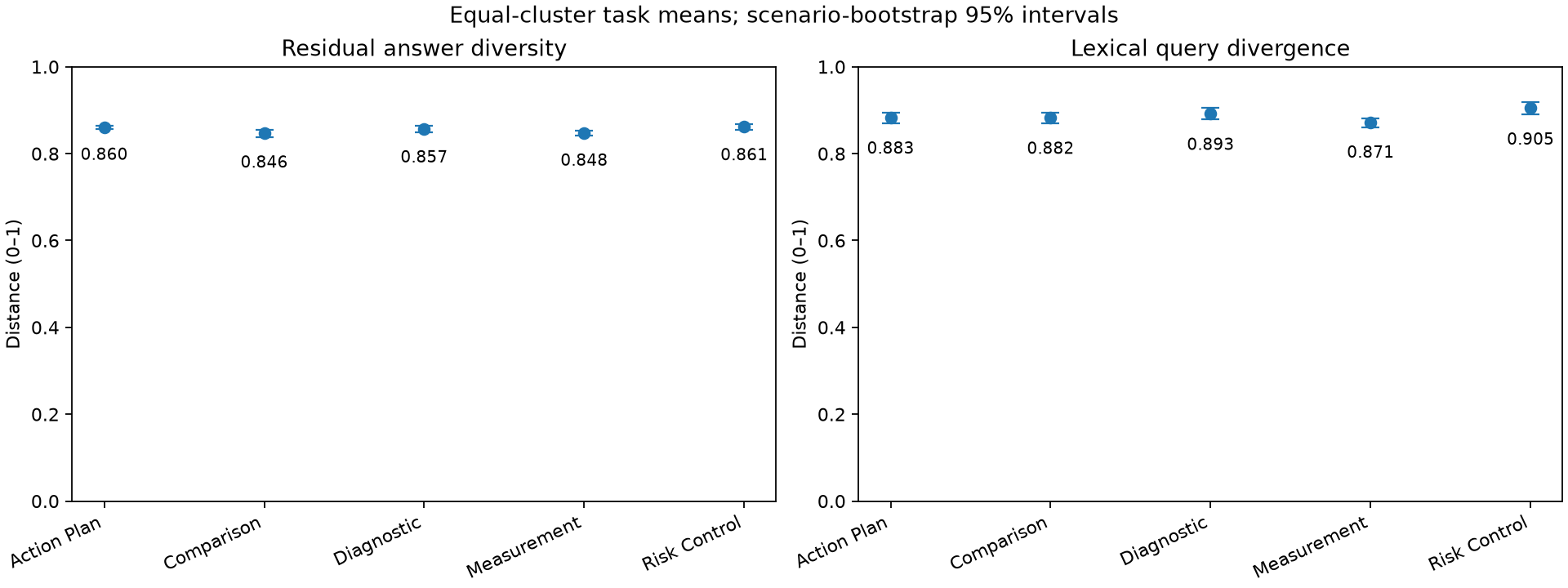
Our parent study found that five persona-conditioned responses remained strongly distinguishable after direct persona wording was removed. The same persona-associated differentiation also appeared in grounded search-query formulation and remained broadly high across five task families.
This analysis asks the next practical question:
If we reduce the five-persona panel, how much of the observed answer diversity disappears?
For the broader experiment and its causal limitations, see Persona Prompts Change More Than Tone: Evidence from 750 Grounded AI Responses.
Panel design
The five-persona panel
The panel contained:
- CMO
- VP of Product Marketing
- SEO Manager
- Demand Generation Director
- Founder/CEO
Each of 150 neutral scenarios was originally rendered under all five persona conditions.
After the historical quality screen removed one malformed SEO Manager response, the primary panel analysis used 149 complete scenarios.
The scenarios covered five task types:
- Action plan
- Comparison
- Diagnostic
- Measurement
- Risk control
The goal here was not to decide which persona gave the best answer.
Instead, we measured how much of the full five-persona response space remained when one or more persona conditions were removed.
Measurement
How panel coverage was measured
The analysis used the persona-residual answer representation from the parent study.
Direct persona labels and predefined persona-profile phrases had already been masked before the residual answer distances were calculated.
For each scenario, all ten unordered pairwise distances among the five persona answers were available.
The full panel therefore defined the reference geometry.
For every possible fixed subset of two, three and four personas, we asked:
How close is each of the five original persona answers to the nearest answer still represented by the smaller selected panel?
Selected personas have zero distance to themselves.
Unselected personas contribute the distance to their nearest selected persona.
The resulting uncovered distance was normalized against full-panel mean pairwise distance to produce a coverage-retention measure.
This is a geometric coverage convention.
It is not a percentage of facts, recommendations, evidence or business value retained.
Finding 1
Two personas preserved only about 41% of the five-persona answer space
The strongest two-persona subsets retained approximately 41% of the normalized five-persona representation.
That result was strikingly stable across task types.
| Task | Best fixed two-persona subset | Retention |
|---|---|---|
| Action plan | Founder/CEO + SEO Manager | ~41% |
| Comparison | Founder/CEO + SEO Manager | ~41% |
| Diagnostic | Founder/CEO + SEO Manager | ~41% |
| Measurement | CMO + SEO Manager | ~41% |
| Risk control | CMO + SEO Manager | ~41% |
SEO Manager appeared in every best-performing two-persona subset.
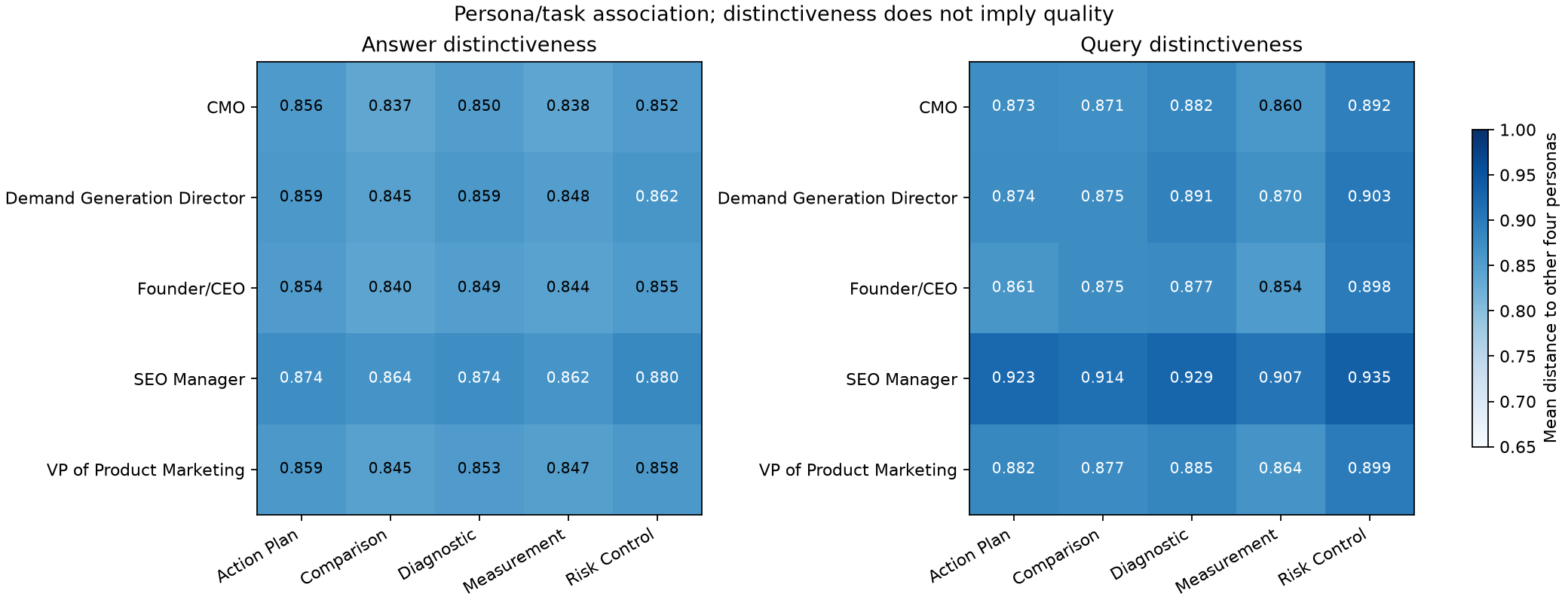
That aligns with the parent study, where SEO Manager was the most distinctive answer condition across all five task families.
But the result should not be interpreted as:
“Always include SEO.”
SEO Manager's inclusion here reflects representational distinctiveness under this experimental design.
It does not establish that SEO answers are more correct, more useful or more valuable.
Finding 2
Three personas preserved about 61%—well short of near-full coverage
Adding a third persona improved coverage substantially.
But the best three-persona panels still retained only about 61% of the full five-persona answer-space representation.
| Task | Best fixed three-persona subset | Retention |
|---|---|---|
| Action plan | Founder/CEO + SEO Manager + VP Product Marketing | ~61% |
| Comparison | CMO + SEO Manager + VP Product Marketing | ~61% |
| Diagnostic | CMO + Demand Generation + SEO Manager | ~61% |
| Measurement | CMO + Demand Generation + SEO Manager | ~61% |
| Risk control | Demand Generation + Founder/CEO + SEO Manager | ~61% |
No best three-persona task panel reached the predefined 80% preservation threshold.
That matters because three-persona research panels are intuitively appealing.
They feel broad enough to capture different viewpoints without becoming expensive.
In this experiment, however, three personas still left a large amount of the five-persona representational space uncovered.
Finding 3
Four personas reached about 81%, but still did not approximate the full panel
Removing only one persona produced a much smaller loss.
The best four-persona subsets preserved approximately 81% of the full-panel response-space geometry.
| Task | Best fixed four-persona subset | Retention |
|---|---|---|
| Action plan | CMO + Demand Generation + SEO Manager + VP Product Marketing | ~81% |
| Comparison | Demand Generation + Founder/CEO + SEO Manager + VP Product Marketing | ~81% |
| Diagnostic | Demand Generation + Founder/CEO + SEO Manager + VP Product Marketing | ~81% |
| Measurement | Demand Generation + Founder/CEO + SEO Manager + VP Product Marketing | ~81% |
| Risk control | Demand Generation + Founder/CEO + SEO Manager + VP Product Marketing | ~81% |
Four-persona panels passed the 80% preservation level.
But they remained below the separately predefined 95% near-full-coverage criterion.
That led to the study's panel conclusion:
The five-persona panel was materially additive for observed response-space diversity.
Again, “materially additive” refers to geometric coverage.
It does not establish incremental business utility.
Persona distinctiveness
Why does SEO Manager appear so often?
SEO Manager was the most distinctive answer condition for all five task families in the parent analysis.
Removing SEO reduced remaining-pair diversity more than removing any other persona:
| Task | Change in remaining-pair diversity after removing SEO Manager |
|---|---|
| Action plan | −0.0091 |
| Comparison | −0.0120 |
| Diagnostic | −0.0112 |
| Measurement | −0.0094 |
| Risk control | −0.0126 |
By contrast, removing CMO or Founder/CEO slightly increased the mean diversity among the remaining personas.
That does not mean removing CMO or Founder improves the panel.
The denominator changes when a persona is removed, so the remaining set can become more spread out even while losing coverage.
This is why the study measured both leave-one-out diversity and coverage of the original five-persona space.
The second metric is the more useful one for the panel-size question.
Persona proximity
The closest pair was CMO and Founder/CEO
Across every task family, the nearest persona pair was:
CMO / Founder/CEO
| Task | Nearest pair distance |
|---|---|
| Action plan | 0.828 |
| Comparison | 0.819 |
| Diagnostic | 0.828 |
| Measurement | 0.816 |
| Risk control | 0.829 |
They were consistently more similar to one another than other persona pairs.
But “closest” is relative.
A distance around 0.82 still reflects substantial separation in the residual answer representation.
And lexical proximity does not establish substantive redundancy.
CMO and Founder/CEO could still contribute different factual assertions, risks or recommendations.
That substantive question remains under human validation in the next stage of the research programme.
Finding 4
The panel-size result was broadly stable across task types
One possible explanation was that smaller panels might be sufficient for some tasks but not others.
The result was more stable than that.
The parent analysis found persona differentiation remained high across action plans, comparisons, diagnostics, measurement and risk control.
Panel retention showed a similarly consistent pattern.
Two-persona panels were around 41%.
Three-persona panels were around 61%.
Four-persona panels were around 81%.
That consistency is important.
It suggests the panel-size result was not simply the consequence of one unusually persona-sensitive task family.
Held-out-cluster checks produced similar results.
The study therefore did not identify a task where a small fixed panel suddenly became a near-complete substitute for the five-persona panel.
Research practice
What should AI research teams do with this?
The wrong conclusion is:
“Everyone should use five personas.”
The useful conclusion is:
Choose persona-panel size based on the coverage objective you are willing to sacrifice.
If the purpose is fast directional research, two or three personas may be enough.
If the purpose is to preserve most of the representational range observed in a broader persona panel, the trade-off becomes much sharper.
A practical workflow is:
- Define why each persona exists
Each persona should represent a distinct decision context—not a cosmetic job title.
- Test redundancy empirically
Do not assume two executive roles are interchangeable because their titles seem similar. Do not assume a specialist role is useful simply because its vocabulary is different.
- Separate diversity from quality
A more diverse panel may expose more answer formulations while still producing redundant substantive recommendations.
- Start broad, then prune
For exploratory studies, a broader pilot panel can reveal which conditions are genuinely distinctive. Later runs can reduce the panel if validated coverage remains acceptable.
- Use a holdout check
A panel selected on one topic may fail on another. The parent study therefore evaluated subset selection on four topic clusters and tested it on the held-out fifth.
Study boundaries
What this study does not tell us
- It does not show that five personas give better answers
The metric measures response-space coverage, not quality.
- It does not show that 61% means 61% of useful information
Three-persona retention is a geometric measure. It is not a factual-coverage or decision-value percentage.
- It does not establish that CMO and Founder/CEO are substantively redundant
They were the closest pair in the residual answer representation. Their factual claims or recommendations may still differ.
- It does not establish real-human role coverage
The study examines AI outputs under role-conditioned prompts. It does not measure actual professionals.
- It does not remove the historical collection-order limitation
Persona and within-scenario collection position remained perfectly confounded in the original run.
Open question
The unresolved question: representational coverage versus substantive coverage
This is now the most important open question.
Suppose a three-persona panel preserves only 61% of the observed lexical/structural response geometry.
That sounds like a large loss.
But what if the omitted 39% consists mostly of alternative phrasing, different formatting, role-specific terminology or redundant recommendations?
Then the smaller panel may still preserve most of the useful content.
The reverse is also possible.
A persona that looks lexically close to another may contribute a unique factual assertion, strategic recommendation, risk or decision priority.
Kojable's next validation layer is therefore measuring substantive divergence across factual claims, recommendations, risks and decisions.
That analysis is currently awaiting independent human calibration.
Until it is complete, the correct distinction is:
Five personas materially increased observed representational coverage. Whether they materially increase substantive decision coverage is not yet established.
Interpretation
Implications for AI visibility and Answer Alignment research
Persona panels are particularly relevant when testing how AI systems represent companies.
A buyer may approach the same company through different decision contexts:
- Strategic fit
- Technical implementation
- Revenue impact
- Positioning
- Risk
If an evaluation tracks only one generic version of the question, it may under-sample the range of representations the model can produce.
But blindly multiplying prompts is not an answer either.
A useful persona panel should balance coverage, cost, review burden, redundancy and substantive value.
The practical challenge is not to maximize persona count.
It is to identify the smallest panel that preserves the dimensions of AI representation that matter for the research objective.
This study measures one part of that problem: representational coverage.
Method and reproducibility
Methodology
The panel analysis uses 149 complete five-persona scenarios from the matched V2 persona experiment.
Each scenario contains responses from CMO, VP of Product Marketing, SEO Manager, Demand Generation Director and Founder/CEO.
The primary answer representation is the persona-residual TF-IDF space developed in the parent analysis after predefined persona labels and profile phrases were masked.
For each scenario, all ten persona-pair response distances were available.
The study enumerated all:
- 10 possible two-persona subsets
- 10 possible three-persona subsets
- 5 possible four-persona subsets
For each selected subset, every original persona response was mapped to its nearest selected response.
Selected persona responses receive zero uncovered distance.
The mean uncovered distance across all five original personas is the primary subset-loss measure.
Normalized retention is derived relative to the full-panel mean pairwise distance.
Subsets were evaluated as fixed panels rather than selected separately for each individual scenario.
A separate held-out-cluster test selected panels on four clusters and evaluated them on the fifth.
The analysis is offline and reuses frozen residual-response distances from the validated parent study.
FAQ
Frequently asked questions
Is three personas enough for AI research?
It may be enough for some practical objectives, but in this experiment the best three-persona panels preserved only about 61% of the five-persona response-space representation.
That is not the same as preserving 61% of useful information.
Which two personas gave the broadest coverage?
Founder/CEO + SEO Manager was the best fixed two-persona subset for action-plan, comparison and diagnostic tasks. CMO + SEO Manager was best for measurement and risk-control tasks.
These are descriptive results from this experiment, not universal persona recommendations.
Why was SEO Manager included in every best two-persona panel?
SEO Manager was the most distinctive answer condition across all five task types in the parent experiment.
Distinctiveness does not imply accuracy or usefulness.
Were CMO and Founder/CEO redundant?
They were consistently the closest persona pair in residual response space, but the study has not established substantive redundancy.
Why didn't four personas preserve nearly 100%?
Removing one persona removes the answer associated with that decision context. The remaining four can approximate it only to the extent that one of their responses occupies nearby response space.
The best four-persona panels retained about 81% under the study's normalized geometric measure.
Does this mean five personas are optimal?
No.
Five personas define the reference panel in this experiment. The study does not compare five against six, seven or more personas, and it does not measure business utility.
Should I start with five personas?
A reasonable research workflow is to begin with a deliberately diverse pilot panel, measure redundancy and substantive contribution, then prune only when coverage remains acceptable for the objective.
Conclusion
Conclusion
Persona-panel design is a coverage problem, not a counting exercise.
In this matched five-persona experiment, two personas captured roughly 41% of the observed response-space representation.
Three captured about 61%.
Four captured about 81%.
None of the smaller fixed panels approximated the full five-persona reference under the study's predefined near-full-coverage criterion.
That does not establish that five personas are universally necessary.
It does show that assuming a small persona panel captures “most perspectives” can be wrong even when the underlying business scenario is held constant.
The practical lesson is:
Do not choose persona count by intuition alone. Define the coverage you care about, measure redundancy, and reduce the panel only when the omitted conditions stop contributing dimensions that matter to the research objective.
For the full research programme—including prompt-echo testing, grounded-query differentiation and task robustness—see Persona Prompts Change More Than Tone: Evidence from 750 Grounded AI Responses.