Kojable Blog reference entry
AI Search Marketing: A B2B Framework for Demand, Attribution and Measurement
AI search marketing is the discipline of managing how a company is discovered and represented when AI systems participate in buyer research, alongside established search and marketing channels.
Category AI Search Guides
Also known as AI search marketing, AI search marketing strategy, marketing for AI search, B2B AI search marketing
AI search marketing is the discipline of managing how a company is discovered and represented when AI systems participate in buyer research. For B2B teams, the practical challenge is not only whether the company is mentioned or cited. Teams need to distinguish branded representation from unbranded consideration, identify which evidence appears, measure direct AI referrals where available, capture buyer-reported discovery where useful, and keep those observations separate from pipeline and revenue attribution.
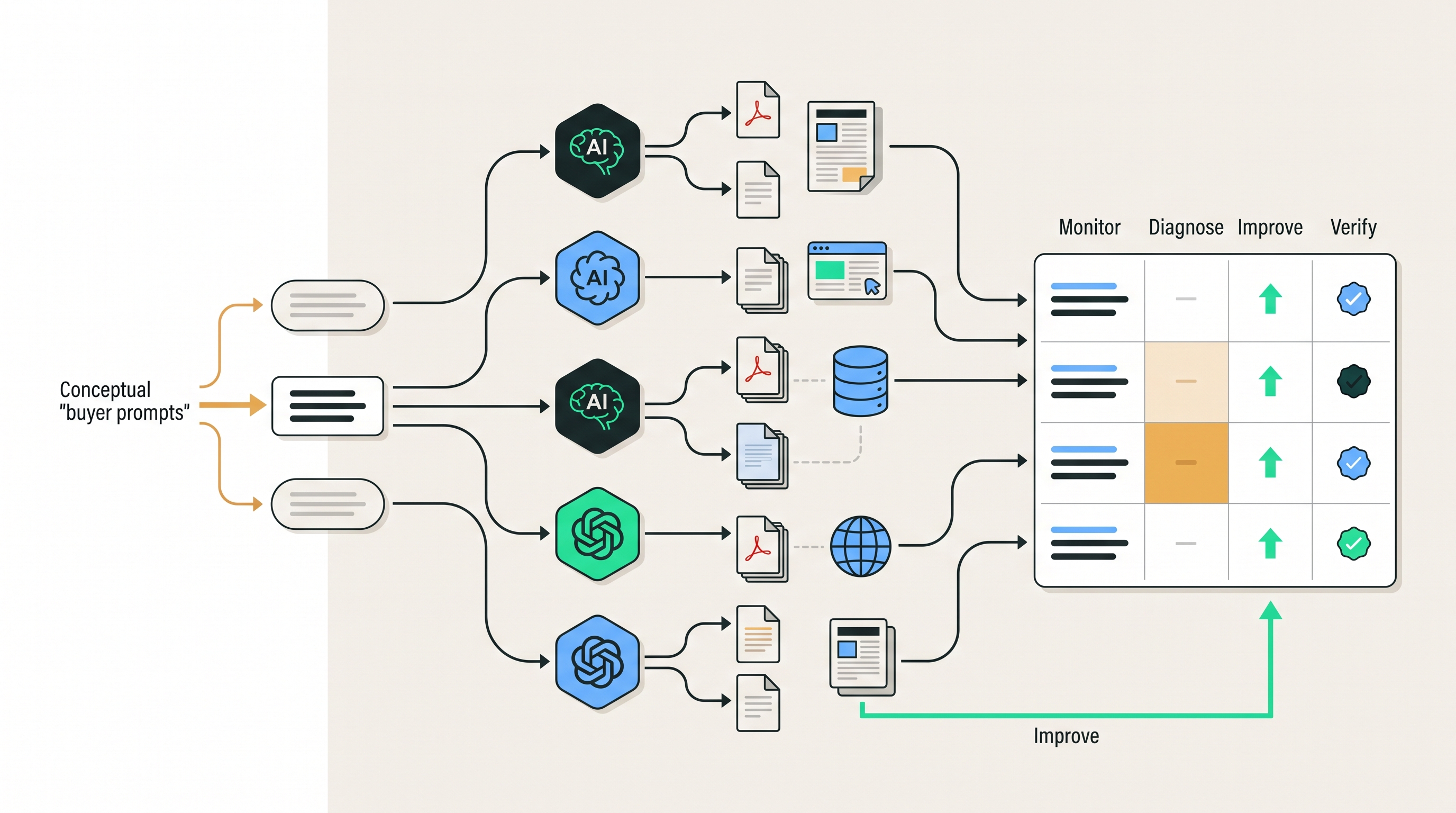
A strong programme follows a simple operating loop: Monitor → Diagnose → Improve → Verify.
TL;DR: AI search is becoming part of B2B research, but visibility is only one layer of the commercial problem. Branded visibility and unbranded market consideration answer different questions. Mentions, citations, referrals, buyer-reported discovery and revenue do not share one denominator. Measure each stage for what it can actually establish, improve the specific gap you diagnose, and retest comparable buyer questions.
01 · Question
What is AI search marketing?
AI search marketing manages how a company is discovered, described, compared, cited and recommended when AI systems participate in buyer research, alongside established search and marketing channels.
It is not simply SEO with a new label, and it is not the same as using AI to create campaigns or marketing content.
The distinction matters because an AI-mediated buyer journey creates questions that conventional rank and traffic reports do not fully answer. A marketing team may need to know whether the company appears in relevant answers, whether it is placed in the right category, whether its current capabilities are represented accurately, which competitors appear beside it, which evidence is cited, and whether those observations change across providers or buyer questions.
That does not make traditional search obsolete. Google's current guidance says established SEO best practices remain relevant to AI Overviews and AI Mode, with no special AI-only technical requirements needed for eligibility. (developers.google.com)
AI search marketing therefore adds a new operating layer rather than replacing crawlability, indexation, site architecture, search demand, internal linking or content quality.
The useful question is not:
How do we optimise everything for AI?
It is:
What part of our current representation or evidence environment is creating a meaningful buyer-facing gap, and what should we change?
02 · Question
Where does AI search fit in the B2B buyer journey?
AI systems can participate in discovery, research, comparison and validation, but observing a company in an AI answer does not establish that a particular buyer saw, considered or acted on that answer.
AI-mediated research is commercially relevant. Gartner's survey of 645 B2B buyers reported generative-AI use during recent purchases, primarily for vendor and product information, within a wider multi-source buying journey. (gartner.com)
For marketers, that means buyer context matters more than an isolated prompt win.
A question such as “What does Company A do?” tests something different from “Which providers should an enterprise consider for this problem?” A generic prompt may show that an AI system can recognise a company while saying little about whether that company enters the decision contexts that matter commercially.
Kojable's Stripe Target Visibility Rate case study makes the same practical distinction. Its 1,500-response analysis across 12 finance personas starts with the buyer context and a high-intent question, then measures representation within that defined context. The score is explicitly treated as an observation rather than a universal success measure.
The practical implication is straightforward: build monitoring around buyer decisions, not around a collection of convenient prompts.
03 · Question
What is the difference between branded visibility and market visibility?
Branded questions begin after a company is already in scope. Unbranded market questions test whether the company enters the candidate or consideration set before the buyer names it. Those are different measurement problems.
This distinction is easy to miss because both situations can produce a percentage labelled “AI visibility”.
Kojable's Branded AI Visibility Is Not Market Visibility research examined target-oriented finance questions where the company was already part of the research frame. The study's central methodological point is that strong first-party evidence participation in that setting cannot be relabelled as market visibility, share of voice, recommendation probability or unaided discovery.
Consider two questions.
“What are Company A's international payment capabilities?” starts with Company A already selected.
“What are the strongest options for international payments for a global SaaS company?” requires the answer environment to construct a candidate set before Company A can appear.
The first question can measure whether the company is understood and evidenced once it is already relevant. The second can help measure whether the company enters a defined unbranded consideration context.
Neither establishes that a real buyer created the same shortlist.
This is why a useful AI search marketing programme separates at least three decisions: Can the system represent us accurately when named? Do we enter relevant unbranded consideration contexts? If we appear, are we represented in a way that helps a buyer understand our fit and differentiation?
Do not collapse those questions into one visibility score.
04 · Question
Can AI search create demand?
AI-mediated answers can participate in discovery and consideration, which makes them relevant to demand generation. A mention, citation or recommendation alone does not demonstrate incremental demand, buyer intent or revenue.
This is the useful part of the “AI-driven demand generation” idea.
Marketing teams should care when relevant AI answers omit the company, place it in an outdated category, flatten its differentiation or repeatedly present competitors more clearly. Those are observable representation gaps occurring in an information environment that buyers may use.
But the commercial interpretation has to stop where the evidence stops.
A brand mention establishes that the company appeared in the tested answer.
An unbranded mention can establish that the company entered a defined AI-generated consideration context.
A recommendation establishes that the company was recommended in an eligible response.
None of those observations, by itself, establishes that a human buyer saw the answer, formed intent, entered a shortlist, visited the website or created pipeline.
The right response is not to ignore demand. It is to measure the journey in layers.
That means treating AI-mediated discovery as an upstream environment, then looking separately for direct response, buyer-reported discovery and downstream commercial outcomes.
This is a more useful model than assuming:
mention → demand → revenue
The stages may be related. The measurement design determines how strongly you can say they are related.
05 · Question
What do AI citations tell marketers?
An AI citation tells you that a source was visibly attributed in a particular answer. Citation patterns can help diagnose the evidence environment, but they do not prove hidden influence, authority, training use or causal source selection.
Kojable's cross-provider research illustrates why this distinction matters.
In Different Answers, Different Evidence, the same fixed set of B2B buyer questions was tested across Claude, Gemini, OpenAI and Perplexity provider stacks. The visible evidence sets differed materially across the tested environments. The benchmark had one observed run per provider-question cell, so the result does not establish permanent provider preferences or run-to-run stability.
The practical conclusion is narrower and more useful:
A single-provider observation should not be assumed to represent the complete AI answer environment.
Citation behaviour also changes with platform and question context. Kojable's larger Retrieval Need and AI Citation Exposure analysis found different observable citation patterns across ChatGPT, Gemini and Perplexity. The research explicitly treats citation exposure as an observable downstream signal, not telemetry of a platform's hidden retrieval process.
Source composition adds another layer. Which Sources Appear in Final AI Citations? found overlapping Brand-owned, Comparable-vendor, community, official and other third-party source families in final cited answers, with the balance changing by platform and buyer-question type. The research does not establish that one source family universally “wins” or that final citations reveal the full candidate sources a system discovered or rejected.
That rules out several common shortcuts.
A recurring citation is worth investigating. It is not proof of influence.
A third-party citation can be commercially useful. It does not establish that third-party evidence is universally weighted above first-party evidence.
A cited page tells you what appeared in the final answer. It does not tell you whether that page was used to train the underlying model.
For marketers, citations are diagnostic evidence, not hidden-model telemetry.
06 · Question
How should AI search attribution work?
AI search attribution is the attempt to connect AI-mediated discovery or research with later buyer and commercial outcomes. Answer-level mentions, citations and representation accuracy are upstream measurements, not revenue attribution by themselves.
The attribution problem becomes easier to reason about once the word attribution is reserved for an actual connection between stages.
If a company appears in ten AI answers, that is answer-level measurement.
If a buyer clicks from an identifiable AI search result to the company's site, that is a direct response signal.
If the buyer later tells sales that ChatGPT helped them discover the company, that is buyer-reported journey evidence.
If an opportunity closes, that is a commercial outcome.
These observations can coexist. They should not be presented as though they all measure the same event.
Which AI-search signals can marketers measure directly?
Some AI-mediated activity is directly observable.
OpenAI currently documents that publishers allowing OAI-SearchBot can track ChatGPT Search referral traffic because referral URLs include utm_source=chatgpt.com. (help.openai.com)
Google has also introduced dedicated Search Console generative-AI performance reporting. The reports show impressions for URLs appearing in generative features such as AI Overviews and AI Mode and include dimensions such as page, country, device and date. As of Google's June 2026 announcement, the dedicated reports were still rolling out to a subset of websites. (developers.google.com)
These signals are useful because their provenance is relatively clear.
They still answer different questions.
A ChatGPT referral records an identifiable visit.
A Google generative-AI impression records visibility within Google's own AI Search environment.
Neither is a universal measure of AI-assisted discovery across every platform.
How should teams measure AI-assisted discovery when there is no referral?
An AI interaction does not always end with an immediate click.
A buyer may research a category in an AI system, return later through branded search, type the company's URL directly, speak to a colleague, respond to an outbound campaign or arrive through another source.
When the upstream AI interaction is not directly observable, marketers can gather additional evidence through buyer-reported discovery, CRM notes and downstream behavioural patterns.
The language used in reporting should reflect the evidence.
If a buyer says ChatGPT helped them discover or evaluate the company, record that as buyer-reported AI discovery.
If branded search rises after a period of stronger AI representation, record the branded-search movement.
If direct traffic changes, record the direct-traffic movement.
Do not automatically relabel either as AI-attributed demand.
Google Analytics defines (direct) / (none) as traffic without a clear referral source and documents several possible causes, including direct URL entry, missing tracking information, redirects and ad blockers. Unattributed direct traffic is therefore not a valid proxy for “AI traffic”. (support.google.com)
The practical principle is triangulation without false precision.
Use direct evidence where it exists. Use buyer-reported and behavioural evidence where it adds useful context. Keep the distinction visible.
07 · Question
How should AI search marketing be measured?
Measure each stage according to what was actually observed. Do not collapse answer visibility, consideration, evidence, referrals, buyer-reported discovery and commercial outcomes into one AI-search score.
The central measurement mistake is denominator drift.
A brand-mention rate has an answer as its analytical unit.
A referral metric has a visit or session as its unit.
A self-reported discovery metric has a buyer or respondent as its unit.
A revenue metric has a commercial outcome as its unit.
Combining them without an explicit measurement model creates a number that is easy to present and difficult to interpret.
| Measurement layer | Observable evidence | What it can support | What it does not prove |
|---|---|---|---|
| AI answer | Mention, omission, category, recommendation | How the company was represented under defined test conditions | Human exposure or purchase intent |
| Consideration context | Company appears in an eligible unbranded answer | AI consideration-set visibility within the tested question set | Inclusion in an actual human shortlist |
| Evidence | Citation, source, page or domain | Which evidence was visibly associated with the answer | Hidden influence, authority, training use or causal source selection |
| Direct response | Identifiable AI referral or session | A recorded visit from the identified source | Every AI-assisted research journey |
| Buyer-reported discovery | Buyer reports using an AI system during discovery or research | Buyer-reported journey evidence | Perfect recall, exclusivity or sole-source causality |
| Assisted signal | Branded search, direct visit, CRM note or pipeline pattern | A directional association worth investigating | That AI caused the movement |
| Commercial outcome | Lead, qualified opportunity, conversion or revenue | A downstream business result | Attribution to a particular upstream AI answer without a suitable design |
For answer-level measurement, teams can define metrics such as:
Brand mention rate = eligible responses mentioning the company ÷ eligible responses
and
Direct citation rate = eligible responses containing a defined direct company citation ÷ eligible responses
Other useful dimensions include recommendation status, entity accuracy, competitor co-mentions, source overlap and answer or citation volatility.
The important word is defined.
Before treating any metric as a KPI, freeze the eligible population, numerator, denominator, analytical unit, exclusions, deduplication and aggregation rules.
This is also why one master “AI visibility score” can become misleading. A company can be highly visible in branded questions, absent from unbranded category questions, accurately described when mentioned and weakly recommended. Those are different states requiring different actions.
08 · Question
What should an AI search marketing strategy change first?
Start with the observed gap, not a predetermined tactic. Diagnose what is wrong before deciding whether the intervention is content, positioning, documentation, evidence, source correction or something else.
This is where AI search marketing moves from reporting into an operating process.
Monitor
Establish the current baseline around questions that correspond to real buyer decisions.
Record whether the company appears, how it is categorised, which capabilities or use cases are included, how competitors are framed, which claims appear, whether important information is missing, and which sources are cited where citations are available.
Do not treat one answer as the brand's permanent AI representation.
Diagnose
Identify the gap you can actually observe.
The company may be omitted from eligible unbranded questions. It may appear but be placed in the wrong category. It may be described accurately but weakly differentiated. A capability may be missing. An old price or product claim may still appear. A competitor may be framed against criteria the company does not address clearly.
Then investigate the relevant information environment.
A recurring source may be useful evidence. An outdated owned page may deserve attention. A missing proof point may be relevant. Conflicting public descriptions may be worth correcting.
Diagnosis identifies evidence, patterns and likely drivers. It does not expose the exact hidden reason a model generated one answer.
Improve
Choose the smallest justified intervention.
That might mean clarifying positioning on an existing page, updating product or pricing information, improving technical documentation, adding current proof, strengthening a comparison, correcting an owned source, pursuing a realistic third-party correction, improving internal linking or creating a new resource.
New content is only one option.
Kojable's AEO Buyer-Question Mapping Playbook starts with the decision a buyer is trying to make rather than with a predetermined page type. It also treats the evidence already available as an input to deciding where an answer should live.
Verify
Retest comparable buyer questions after the work has been carried out.
Compare the new observations with the baseline. Record what changed, what held and what remains unresolved.
A before-and-after difference is evidence that the observed answer changed. It is not automatically proof that one intervention caused the change.
Then return to monitoring.
Monitor → Diagnose → Improve → Verify
09 · Question
Is AI search marketing just SEO, AEO or GEO?
No. SEO, AEO and GEO can support parts of AI search marketing, but the wider marketing discipline also includes representation monitoring, buyer-context diagnosis, attribution boundaries, commercial measurement and verification.
SEO remains relevant to whether content can be discovered and understood through conventional Search infrastructure. Google explicitly says its standard SEO guidance remains applicable to AI Overviews and AI Mode. (developers.google.com)
AEO and GEO are useful terms for optimisation work aimed at answer engines or generative search environments. They can matter when diagnosis identifies a problem involving answer structure, retrievability, evidence coverage, comparison content or source quality.
They do not answer every commercial question in this article.
An optimisation method can help change the information environment.
AI search marketing still has to determine which buyer questions matter, what representation gap exists, which measurement layer is relevant, what action is justified, and what should be retested.
The same applies to “post-SEO marketing”. The phrase is useful if it means marketers should no longer treat rankings and organic clicks as the complete discovery picture. It becomes misleading if it implies that search fundamentals no longer matter.
10 · Question
What can AI search marketing measurement not prove?
AI-search measurement can document answer, citation, traffic, buyer-reported and commercial observations. It cannot automatically establish the causal path connecting them.
That means a citation does not prove a source caused an answer.
Repeated source occurrence does not prove hidden influence.
Retrieval or citation does not prove that a source was used in model training.
A brand mention does not prove that a human buyer saw the answer.
An unbranded recommendation does not prove the company entered a real buyer's shortlist.
A referral does not prove the AI answer was the only reason for the visit.
A branded-search increase does not prove AI caused the increase.
A closed opportunity does not prove one upstream AI interaction created the revenue.
And a before-and-after change does not prove that one intervention permanently changed a third-party model.
These are not reasons to avoid measurement. They are reasons to report the evidence at the level it can support.
Good AI search marketing should make the organisation more precise about what it knows, not simply produce a larger number.
11 · Question
What does Kojable's Research contribute to this framework?
Kojable's Research provides four evidence parents for the practical decisions in this article.
Different Answers, Different Evidence shows why teams should not assume one provider observation represents the entire AI-answer environment. Its fixed benchmark found materially different visible evidence sets for the same B2B question panel, while explicitly stopping short of stable provider or causal claims.
Branded AI Visibility Is Not Market Visibility establishes the denominator boundary between a company already being in scope and a company having to enter an unbranded consideration set.
Retrieval Need and AI Citation Exposure shows that visible citation behaviour needs platform and question context and cannot be treated as direct evidence of hidden retrieval.
Which Sources Appear in Final AI Citations? shows that final citation portfolios can contain overlapping owned, comparable-vendor, community, official and other third-party evidence, rather than supporting a universal source hierarchy.
The Research pages own the detailed methodologies, metrics and analytical findings. The practical implication here is simpler: measure the decision you are actually trying to make, and do not infer a hidden mechanism from an observable answer.
Frequently asked questions
Does AI search marketing replace SEO?
No. AI search marketing adds answer-level, buyer-context and cross-provider measurement problems that conventional SEO reporting does not fully describe. Google's current guidance explicitly says standard SEO best practices remain relevant to AI Overviews and AI Mode. (developers.google.com)
Is AI search marketing the same as AEO or GEO?
No. AEO and GEO are optimisation disciplines that can support parts of an AI search marketing strategy. AI search marketing, as used here, is broader: it includes buyer-question monitoring, AI representation, evidence diagnosis, appropriate improvement work, attribution boundaries and verification.
Can AI search be attributed to revenue?
Sometimes a measurable path can be established between identifiable AI-originating activity and a later commercial outcome, but an upstream mention, citation or recommendation is not sufficient by itself. Report direct referrals, buyer-reported discovery, assisted signals and commercial outcomes according to the evidence available rather than presenting them as one automatic causal chain.
Can ChatGPT referral traffic be tracked?
utm_source=chatgpt.com. That identifies measurable inbound traffic but does not capture every journey in which a buyer may have used ChatGPT during research. (help.openai.com)Should direct traffic be counted as AI traffic?
No. Google Analytics uses (direct) / (none) when there is no clear referral source, and several different conditions can produce that classification. Treat direct traffic as direct or unattributed traffic unless separate evidence establishes something more specific. (support.google.com)
Are AI citations enough to measure AI search marketing?
No. Citations tell you which sources were visibly attributed in an answer. They do not by themselves establish representation accuracy, market consideration, buyer trust, source influence, conversion or revenue. Kojable's research also shows that citation exposure and source composition vary by platform and question context. (kojable.com)
12 · Question
What is the practical takeaway?
AI search marketing should begin with the buyer question and the answer environment, not with an optimisation hack.
Measure whether the company appears and how it is represented. Separate branded representation from unbranded consideration. Inspect citations without turning them into hidden-model explanations. Track direct AI referrals where they are identifiable. Gather buyer-reported discovery where it improves understanding. Keep assisted signals and commercial outcomes visible without pretending they share one denominator.
Then act on the diagnosed gap.
Kojable is an AI answer alignment platform for B2B companies. Its operating model is designed around that process: Monitor the answer, Diagnose the material representation and evidence gaps, Improve the appropriate information environment, and Verify what changed through comparable retesting.
For teams that want to establish their current baseline, the current Kojable starting point is Run your free AI brand audit.